
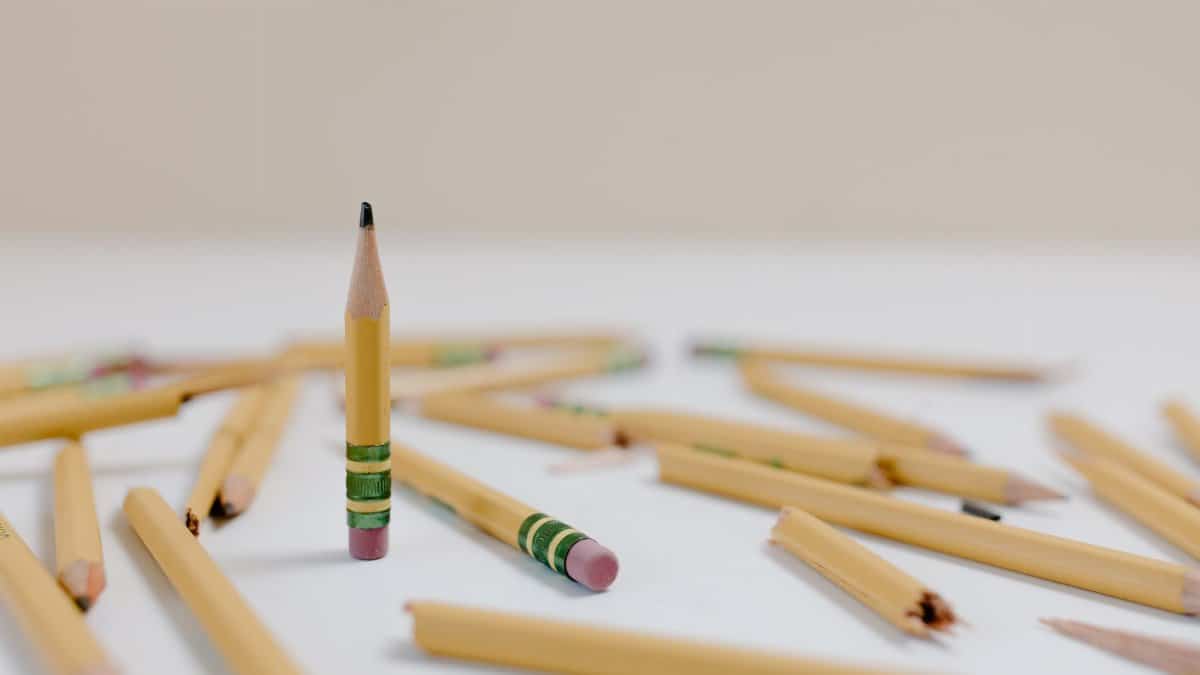
On a gray morning in Old City, a pencil is still the quietest tool on a desk. You press the wood, you make a mark, and when the mark is wrong you turn the pencil and rub it out. That small reversal feels inevitable now, as if graphite and rubber had always shared a single stick. They had not. The pencil eraser patent was filed in Philadelphia on March 30, 1858, by the stationer Hymen L. Lipman, and it tried to fix a daily annoyance with a piece of India rubber set into the end of the pencil itself. The claim was modest. The fight that followed was not. A city of printers, lawyers, and shopkeepers turned a schoolroom habit into a question about what counts as an invention at all.
A stationer in a city of paper

Hymen L. Lipman was not a lonely tinkerer in a garret. He was a Philadelphia stationer, the sort of merchant who understood envelopes, ledgers, ink, and the small goods that keep an office from stalling. Old City in the middle of the nineteenth century was thick with that trade. Printers needed reliable supplies. Clerks needed tools that would not fail in the middle of a column of figures. Children in the new public schools needed something cheaper than a fresh sheet every time a sum went wrong.
Before Lipman put rubber on the pencil, erasure was a separate act. A writer kept a crumb of rubber in a pocket, or a block on the desk, and hunted for it when a line had to disappear. The hunt was trivial until it was constant. Lipman looked at that friction the way a shopkeeper looks at a slow counter: as lost time that might be designed away. His answer was not a new substance. Rubber already erased. Wood already held graphite. He proposed a marriage of the two, with the rubber fixed where the hand already was.
What the filing actually claimed
The pencil eraser patent, recorded as United States Patent No. 19783, described a pencil with a groove or cavity at one end, into which a piece of rubber could be inserted and held. The point of the claim was attachment, not chemistry. Lipman did not pretend to have discovered India rubber, and he did not pretend to have invented the lead pencil. He argued that combining them in one object was itself a useful improvement, one that a manufacturer could make and a buyer could recognize.
That kind of claim was common in an age when workshops improved familiar goods faster than laboratories named new elements. A better latch, a better envelope flap, a better way to keep two known materials in one hand: patent examiners saw such filings every week. Philadelphia, with its machine shops and its stationers, produced them in volume. Lipman’s paper was short. Its commercial life would be long, and then suddenly over.
Readers who want the original language can find the grant in the federal patent record, including the copy preserved by Google Patents at patents.google.com/patent/US19783A/en. The drawings are plain. A cylinder of wood. A dark plug at the blunt end. Nothing in the sheet suggests a lawsuit that would reach the highest court in the country.
A sale that looked like proof

For a while the market treated the idea as valuable in the most literal sense. Joseph Reckendorfer, a New York entrepreneur in the pencil trade, acquired rights connected to the Lipman grant and pressed them hard. Contemporary accounts, repeated in later histories of the case, put the price of the patent interest at one hundred thousand dollars, a sum that in 1858 could buy a small factory and a reputation besides. Whether every dollar changed hands in a single dramatic payment or through a web of assignments, the figure did its cultural work. It told other merchants that a stationery improvement could be a fortune.
Philadelphia liked that story, and still does. A local man, a local filing date, a national object. The pencil with an eraser on its end became one of those civic anecdotes that sit beside the softer myths of cheesesteaks and brotherly slogans, except this one has a docket number. The pencil eraser patent let the city claim a role in the ordinary tools of American literacy, not only in constitutions and bells.
The court that unmade the monopoly
Ownership of a patent is not the same thing as a settled right to exclude everyone else. Reckendorfer’s effort to enforce the grant ran into a rival view of invention, and in 1875 the Supreme Court sided with that rival view in Rubber Tip Pencil Company v. Howard. The opinion, still readable through the court’s public archive and through summaries such as the one at Justia’s report of 87 U.S. 498, held that the combination did not amount to a patentable invention.
The justices did not deny that a pencil with rubber on the end was handy. They denied that handiness, by itself, created a new thing in the eyes of the law. Rubber erased. A cavity could hold rubber. Putting the cavity on a pencil was, in the court’s framing, an aggregation of old elements doing what each element had always done. No new mechanical result appeared. The rubber did not sharpen the lead. The lead did not change the rubber. They merely shared a handle.
That reasoning still startles people who live among products that are mostly clever assemblies. A phone is glass, metal, and code. A suitcase is fabric, zippers, and wheels. The 1875 opinion drew a line that later patent lawyers would argue over for generations: when does a combination cross from convenience into invention? Lipman’s pencil landed on the convenience side. The monopoly fell. The object remained.
After the law, the object kept winning
Invalidation did not send the eraser back to the pocket. Manufacturers had already learned that buyers wanted the combined tool, and once the patent no longer blocked them, more makers could offer it. The legal defeat of the pencil eraser patent was, in a practical sense, a gift to the trade. What one stationer had tried to own became a standard feature, then a childhood expectation, then something so normal that people forget it ever needed a filing date.
Other improvements arrived around the same habit. Better graphite. Better wood casings. Metal ferrules that gripped the rubber more tightly than a simple cavity. Those ferrules, associated in popular memory with later makers, solved a problem Lipman’s groove only partly solved: rubber that loosened, fell out, or wore unevenly. The modern pencil is a crowd of small solutions, not a single Eureka. Lipman’s name sits near the front of that crowd, even if a court refused to let his name sit on a perpetual license.
Schools finished the job the market began. A pupil who could correct a sum without asking for a separate eraser could work faster and with less fuss. Teachers gained a quieter room. The object taught a tiny ethic as well: mistakes are expected, and the tool for undoing them should be within reach. That lesson is not in the patent claims. It is in the way the pencil came to be held.
Philadelphia’s claim, and its limits

Civic pride has a way of sanding complications off a good story. Lipman was a Philadelphian, and the filing date belongs to this city. He was also a man of business in a national market, and the buyer who tried to make the grant pay was a New Yorker. The rubber itself came from a global trade in India rubber, with all the extraction and shipping that phrase conceals. The Supreme Court that struck the patent sat in Washington. The pencil eraser patent is a Philly story in the way many American stories are local at the point of filing and continental at the point of consequence.
Still, the local detail matters. Stationers here were close to printers, close to the port, close to a legal culture that treated commercial paper as serious work. Lipman moved in that world. He is remembered less for a laboratory notebook than for a counter intuition: if people keep losing the eraser, sell them a pencil that cannot lose it. Cities are built on intuitions like that, most of them never patented, many of them never named.
A museum, a date, and a small honor
The milestone has been marked again in the place that filed it. A National Liberty Museum event in Philadelphia honored the March 30, 1858 filing and the Old City stationer behind it, treating a stationery patent as part of the city’s public memory rather than a footnote for specialists. That choice fits a museum concerned with liberty in a broad sense. The freedom to correct a line, to try a sentence twice, to keep a ledger honest, is not the freedom of a founding document. It is the freedom of ordinary competence, and it depends on cheap tools.
Such events also correct a distortion. Patent history is usually told through telegraphs, reapers, and electric lamps, objects that changed the skyline. A pencil changes the desk. Honoring Lipman asks visitors to look down, at the object already in the hand, and to ask who decided it should work this way. The answer is not only one man. It is a shop, a filing, a purchase, a lawsuit, and then millions of buyers who kept reaching for the rubber end.
What the case still says about invention
I keep a pencil on the desk for the same reason clerks in Lipman’s city did: it does not need a charge, and it forgives. The forgiveness is the part the Supreme Court called obvious. Maybe it was. Obviousness is not an insult. It is often the highest praise a tool can earn, the moment when a solution feels as if it had been waiting in the materials all along. The legal system has to police that feeling, or every handy pairing of old parts would lock up a market. The culture does not have to police it the same way. We can admit that Lipman saw something useful, and also admit that the law was right to refuse him a permanent fence around it.
That double judgment is the grown up version of the story. Children are told that a Philadelphian put the eraser on the pencil. Lawyers are told that the patent did not hold. Both sentences are true, and neither is the whole of the other. Between them sits the actual object, still sold by the box, still losing its rubber before its lead in the pockets of people who press too hard.
The mark that remains

Walk past a stationer in Old City now and the pencil with an eraser is not displayed as a marvel. It is displayed as a refill, a dozen for a few dollars, cedar smelling and slightly imperfect. That ordinariness is the victory. The pencil eraser patent tried to capture a habit and, after a bright commercial season, lost the capture. The habit stayed. Every time a hand flips a pencil and rubs out a word, it repeats a Philadelphia filing without knowing the name on the paper.
Lipman does not need a monument taller than that. A patent that fails in court and succeeds in the world is a strange kind of legacy, but it is an honest one. The city that filed it can claim the date, the shop counter, and the argument. It cannot claim that no one else would have joined rubber to wood. Someone would have. Someone here wrote it down first in the form the law then understood, and then the law changed its mind. The eraser, indifferent to both, stayed on the end.