
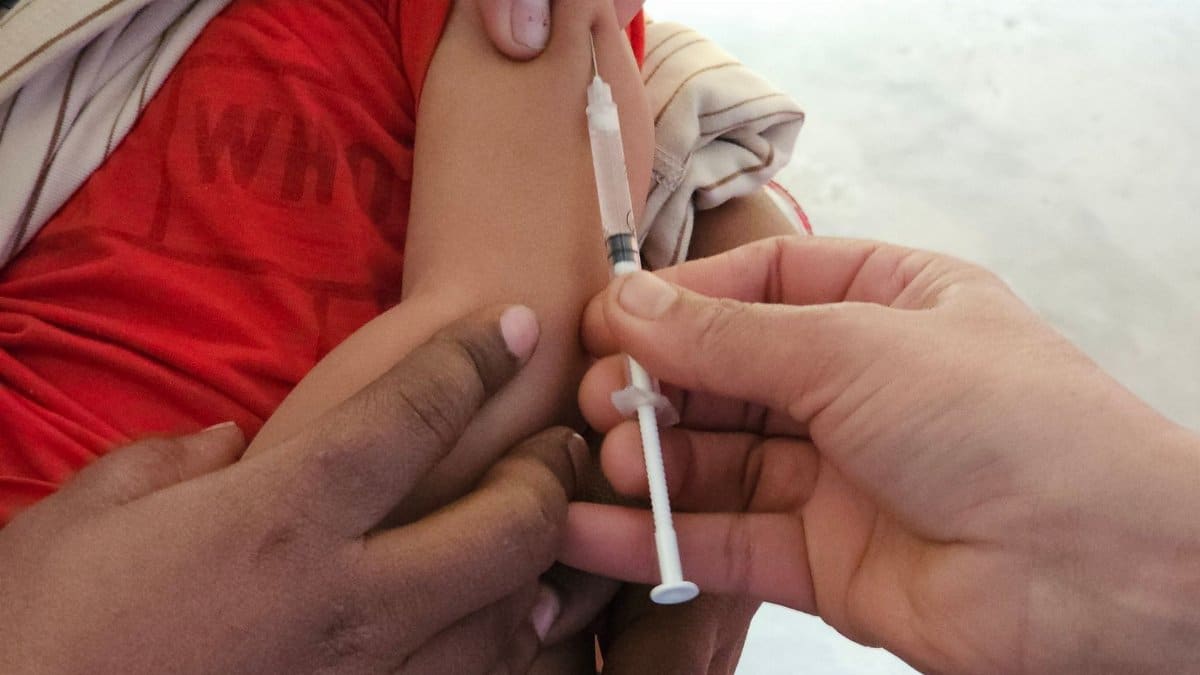
On a bright September morning, a kindergarten teacher in Philadelphia takes attendance and does not think about measles. The children line up for a story, share crayons, and cough into their sleeves. Somewhere in that ordinary room, the invisible math of immunity is already at work. Public records now show that Philly school measles vaccination rates have slipped in enough buildings that the familiar safety margin is no longer a sure thing.
The line health officials still treat as a floor
Measles is among the most contagious viruses known to medicine. A single infected person can pass it to most unprotected people nearby. That is why epidemiologists have long treated 95 percent coverage with two doses of the measles, mumps, and rubella vaccine as the practical floor for community protection in schools. Below that line, a spark can travel. The Centers for Disease Control and Prevention describes measles as a virus that spreads through the air and can linger in a room after an infected person has left, which is why classrooms, buses, and cafeterias are such efficient settings for transmission. The agency also notes that vaccination remains the central tool for prevention.
The 95 percent figure is not a moral grade for parents. It is a population target. A school can sit just under the line and still have many careful families. The risk is collective. When enough children lack documented protection, an exposure does not stay a private matter. It becomes a notice, a quarantine list, and a scramble for records.
What the latest kindergarten snapshot shows

A Philadelphia Inquirer review of school level data found that nearly 250 kindergartens in the broader region had measles vaccination rates below 95 percent in 2025. That count is the clearest recent signal that the problem is not confined to one neighborhood or one type of school. It is a regional pattern with local peaks and valleys. Readers can explore the reporting and the underlying database through the Inquirer health desk at https://www.inquirer.com/health/vaccination-rates-philadelphia-schools-database-20261009.html.
Kindergarten is the year when states and districts most often publish a clean vaccination snapshot. It is also the year when children spend long hours together for the first time. A rate that looks acceptable on a district average can hide a building where coverage is far thinner. Averages comfort administrators. Outbreaks follow the building with the gap.
Why a city average can mislead a parent
Philadelphia has a dense network of pediatric clinics, hospital systems, and school nurses. On paper, access looks better than in many rural counties. Access on paper is not the same as a completed record on the first day of school. Families move. Insurance lapses. A first dose is given, and the second dose waits for a visit that never gets scheduled. A form sits in a backpack. A nurse spends the opening weeks of school chasing signatures instead of teaching children how to wash their hands.
Philly school measles vaccination rates therefore need to be read school by school, not as a single civic boast or a single civic failure. A charter in one zip code and a district school a few blocks away can tell different stories. Suburban districts with high overall wealth can still have pockets of delay. Urban schools with strong clinic partnerships can post rates that would satisfy any health department. The useful question is not whether the region cares. It is which rooms are protected this fall.
The second dose is where many records stall

The standard childhood schedule calls for a first measles vaccine dose in early childhood and a second dose before school entry. The second dose is not a casual booster for people who already feel safe. It is the dose that raises protection for the small share of children who did not respond fully to the first. When that dose is late, the child is not necessarily opposed to vaccination. The child is simply unfinished.
Unfinished is a kinder word than unprotected, and it is often the more accurate one. Clinics that text reminders, schools that host catch up days, and pediatricians who check the registry before the summer ends can close a large share of the gap without a single argument about belief. The CDC maintains plain language guidance on measles vaccination for clinicians and families at https://www.cdc.gov/measles/hcp/vaccine-considerations/index.html, including the role of the two dose series. The public overview of the disease itself is at https://www.cdc.gov/measles/about/index.html.
What a lapse costs beyond a rash
Measles is sometimes remembered as a childhood rash from an older generation. That memory is incomplete. The infection can bring high fever, pneumonia, and swelling of the brain. Pregnant people, infants too young for the vaccine, and people with weakened immune systems carry the heaviest risk. A school exposure can pull those vulnerable people into the circle even if they never set foot in the classroom, because siblings go home and parents go to work.
There is also a quieter cost. When a case appears, unvaccinated or undocumented students may be excluded for weeks. Learning stops. Working parents rearrange shifts. Nurses and principals become contact tracers. The academic year bends around a virus that a completed schedule would usually have kept outside the door. Communities that have already lived through a local outbreak do not need a lecture to remember the disruption. They need the records to be current before the next exposure, not after it.
Outbreaks have a way of returning to familiar ground
The United States declared measles eliminated as a continuously circulating disease at the turn of the century, a milestone built on high vaccination coverage. Elimination never meant the virus vanished from the planet. Importations still happen. When they land in a pocket of low coverage, they spread. Recent national clusters have followed that pattern, often beginning with travel and then moving through under vaccinated communities, schools, and households.
Philadelphia has its own memory of how quickly a case can multiply in close quarters. That history should make the current kindergarten numbers feel less abstract. A region does not need a crisis to justify routine protection. The crisis is what arrives when routine slips. Philly school measles vaccination rates below the herd threshold are an early warning, not a curiosity for the health page.
Trust is built in clinics, not in slogans
Some families delay because of fear, some because of logistics, and some because a past encounter with a clinic felt rushed or dismissive. Public health campaigns that scold tend to harden the delay. Campaigns that make the next appointment easy tend to shrink it. School nurses already know which students are missing a dose. Pediatric offices already know which charts are incomplete. The missing piece is often time, language access, evening hours, and a registrar who can accept a record without sending a parent back for a third copy.
There is a civic dimension here that sits close to how people understand care for one another. Protecting an infant in the next pew, the next apartment, or the next classroom is not an abstract policy preference. It is a practical form of neighborliness. Health departments can supply the science. Congregations, parent groups, and neighborhood clinics can supply the invitation. Neither replaces the other.
Exemptions and the paperwork that looks like refusal

State law allows medical exemptions, and in some cases nonmedical exemptions, for school entry. Those rules matter, and they should be applied honestly. They do not explain every missing mark in a database. A child counted as unvaccinated may have been vaccinated in another state, another country, or another clinic whose record never reached the school. Cleaning that data is not spin. It is accuracy. It also reveals the true size of the unprotected group, which is the only number an outbreak planner can use.
Districts that publish rates without explaining exemptions, transfers, and missing forms invite the wrong argument. Parents hear a accusation. Nurses hear a workload. A better report separates confirmed refusal, confirmed medical exemption, and simple absence of documentation. Philly school measles vaccination rates will look less alarming in some buildings once the files are reconciled, and more alarming in others. Both corrections are worth having before winter illnesses fill the waiting rooms.
What schools can do before the next exposure

The most effective steps are unglamorous. Send the reminder in the spring, not in October. Offer a vaccination clinic during kindergarten registration. Accept records in the languages families actually use. Give school nurses a direct line to the city immunization registry so a phone call can replace a scavenger hunt. Tell parents the date of the second dose in plain speech, and tell them what exclusion will mean if a case appears. None of this requires a new theory of public health. It requires a calendar and a budget for the people who already do the work.
Regional leaders can also stop treating a district average as the finish line. A superintendent can celebrate a 96 percent district rate while a single kindergarten sits at 88. That kindergarten is the story. Publishing building level figures, as the recent database does, lets families and boards see the gap while there is still time to close it.
A margin worth keeping

Measles vaccination is one of the clearest successes in modern medicine, and it is also one of the easiest successes to lose. The virus does not negotiate with a busy household or a short staffed clinic. It finds the unprotected child and moves on. The nearly 250 kindergartens under the 95 percent mark are not a verdict on the Philadelphia region. They are a map of unfinished work.
Parents who are current should stay current and help a neighbor find a clinic. Schools should treat the immunization file with the same seriousness they give a fire drill. Health departments should keep the numbers public, specific, and free of panic. If Philly school measles vaccination rates rise back above the line in the buildings that have slipped, the morning attendance ritual can remain what it ought to be: a story, a cough into a sleeve, and a room full of children who are simply there to learn.