
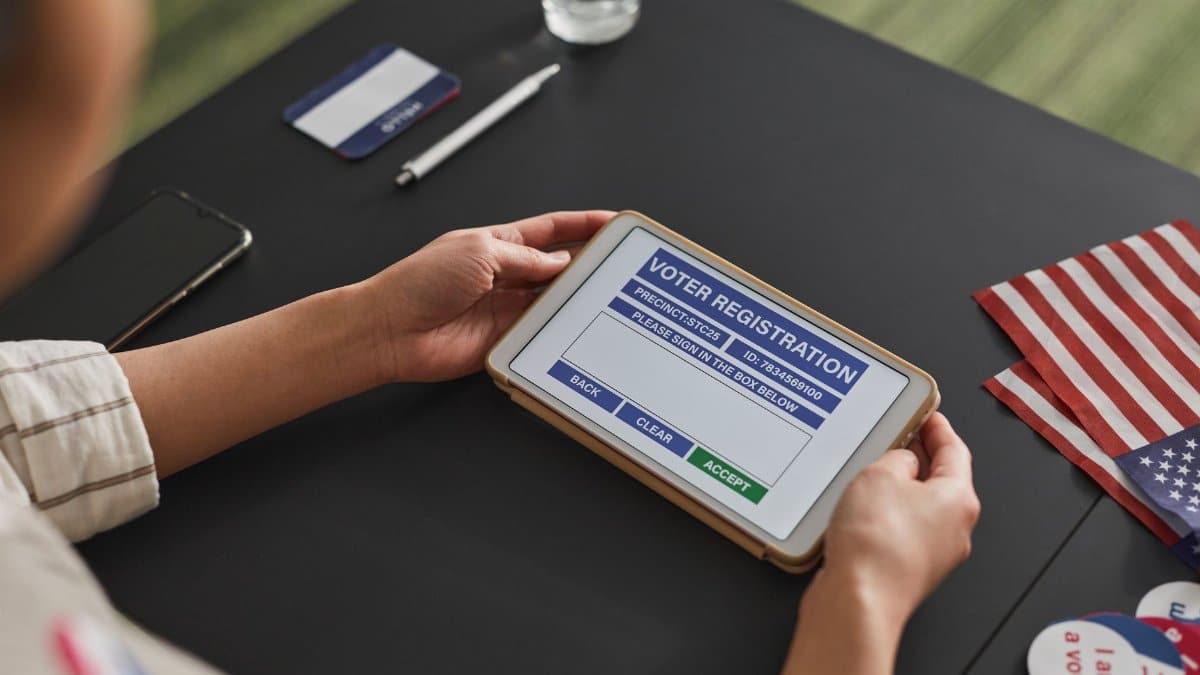
On a weekday afternoon in a county elections office, a student waited with a paper form, a pen, and a question that has trailed Texas campaigns for more than a decade. She could renew a driver license from her phone. She could not register to vote the same way. That gap is why Texas online voter registration is returning to Austin with a narrower pitch and a wider audience than in past sessions. When the Legislature convenes on Jan. 12, bills from Rep. John Bucy and Sen. Carol Alvarado will ask whether convenience, cost, and confidence can finally share the same agenda.
A rare opening in a divided Capitol
Texas politics does not often reward shared projects. Voting rules, in particular, arrive preloaded with suspicion. One side hears suppression. The other hears laxity. The result is a Capitol that can spend months arguing about ballots while the unglamorous work of registration stays stuck in envelopes, stamps, and data entry.
This winter looks slightly different, not because the parties have reconciled, but because the argument has gotten smaller. Supporters are not asking for automatic registration of every adult. They are not asking counties to abandon identity checks. They are asking the state to accept a secure online application that still feeds the same voter file clerks already maintain. In a session crowded with property taxes, schools, and border policy, a modest administrative bill can sometimes travel farther than a manifesto.
Veterans of the process describe the mood as cautious rather than converted. Republicans who once treated any digital step as an invitation to fraud are now hearing from local officials who are tired of retyping names. Democrats who once framed the issue only as a civil rights fight are learning to talk about error rates and overtime. Neither shift guarantees a vote. It does change the room.
Two Democrats and a narrower ask

Bucy, a House Democrat, and Alvarado, a Senate Democrat, are expected to carry companion measures when lawmakers return. Their names are familiar to anyone who has watched election bills die in committee. What may be less familiar is the tone around them. People who track the chamber say some Republicans are at least willing to read the text before reaching for a no.
The political logic is plain. A bill that dies on party lines teaches nothing. A bill that picks up a handful of Republican votes, even if it still fails, redraws the map for the next session. County judges, business groups, and election administrators have spent years saying the status quo wastes money. If those voices show up early, the sponsors will not be speaking only to their own caucus.
None of that makes passage likely. Texas has rejected online registration before, and leadership can still bottle a bill without a floor fight. The interesting question is not whether a press conference will declare victory. It is whether the hearing record looks different from the last time this idea appeared.
What the paperwork actually does

Under the system Texas uses now, a would be voter generally completes a paper application, signs it, and gets it to a county office by mail, in person, or through a volunteer drive. Clerks then enter the information, check it against existing records, and send a certificate if the application clears. The steps are lawful and familiar. They are also slow, and they multiply small mistakes.
A digital application would not erase those checks. In states that already offer the option, the voter still attests to eligibility, still provides identifying information, and still lands in a database that local officials control. The change is the front door, not the lock. A form filled on a screen can validate a date of birth before it is submitted. A paper form discovers the missing digit three weeks later, often after a letter has gone out and come back.
That distinction matters in hearings. Opponents sometimes describe online registration as if it were an honor system. Supporters answer that the honor system is already the paper system, plus a keyboard in a county office. The dispute is about the channel, and about how tightly that channel is tied to existing state records.
Clerks who want fewer envelopes

Ask an elections administrator what the last month before a deadline feels like, and the answer is rarely philosophical. It is boxes. It is temporary staff. It is handwriting that could be a seven or a one. It is applications that arrive after the cutoff because a stamp met a holiday.
Online filing does not end those pressures, but it moves some of them earlier and makes them legible. A clerk can see an incomplete field before the voter leaves the process. Duplicate applications are easier to spot when the data arrives structured instead of scanned. Counties that already struggle to hire seasonal workers have a practical reason to prefer fewer keystrokes, even if they never use the word reform.
Those officials are not a party. They answer to commissioners courts, to state law, and to voters who call when a certificate never shows up. Their testimony, if they give it, may be the most persuasive part of the file. Legislators can discount an activist. They have a harder time discounting the person who will implement whatever they pass.
The security argument, restated

The objection that has blocked this idea is not frivolous. Elections depend on trust, and trust is not a software setting. Critics worry that a website becomes a target, that personal data leaks, or that a bad actor submits applications in other people’s names. They also worry that a smoother front end will be sold, later, as a reason to loosen identification rules that many Republicans consider nonnegotiable.
A serious bill has to answer those fears in statute, not in a slogan. That means a system tied to information the state already holds, such as driver license or state identification records, rather than an open form that anyone can complete with a name found online. It means audit logs, penalties for false submissions, and a paper or digital record the voter can confirm. It means saying clearly what the bill does not do: it does not register noncitizens, it does not skip eligibility law, and it does not let a campaign harvest accounts.
Security experts who have watched other states note a paradox. Paper is tangible, which feels safe, but paper also gets lost, altered in transit, and misread. A well built portal can be attacked, and it must be defended. The adult version of the debate admits both facts. Texas online voter registration will rise or fall on whether drafters treat cybersecurity as a design requirement rather than a press release.
Voters the paper system still misses
The people most inconvenienced by paper are not always the people featured in campaign ads. Some are students who moved dorms. Some are new residents who have a Texas license and no local stamp. Some are shift workers who cannot reach an office before it closes. Some are older Texans who can navigate a phone better than a multi page form with tiny boxes.
Access arguments land differently depending on the listener. For Democrats, the missed registration is often a story about participation and history. For Republicans who represent fast growing suburbs, it can be a story about customers of state government. A resident who can pay a fee online and cannot complete a civic form online notices the inconsistency. That notice does not make anyone a partisan. It makes the state look behind its own technology.
None of this proves that online registration increases turnout by a set amount. People register and then stay home. What it does suggest is that the current bottleneck is partly clerical. Removing a clerical bottleneck is a smaller claim than transforming democracy, and smaller claims are easier to test.
Money, mistakes, and the mail

Cost is the argument that crosses the aisle without asking anyone to rewrite a worldview. Printing, postage, temporary labor, and corrected mailings are not free. When an application is rejected for a skipped line, the county often spends again to tell the applicant and wait for a fix. Multiply that by a presidential year and the waste stops looking theoretical.
Mail adds another variable that no party controls. Delivery times slip. Rural routes and urban sorting centers do not fail on a partisan schedule. A deadline written into statute assumes a postal system that behaves. When it does not, eligible people lose days they cannot recover, and clerks inherit the complaints.
A digital option will have its own costs: vendors, security reviews, accessibility work, and staff training. Honest fiscal notes should say so. The comparison is not free versus expensive. It is a stream of paper costs that recur every cycle versus a system cost that, if built once and maintained, replaces a slice of that stream. Lawmakers who demand offsets should demand them. They should also ask what the state already spends to do the same job more slowly.
What other states have already learned

Texas is late to this tool, not early. Most states already let eligible residents start a registration online, usually by matching information to a motor vehicle record or another state file. Their experiences are not identical, and they are not a mandate. They are a library. Texas can read it before writing its own chapter.
The useful lessons are operational. States that linked the application tightly to an existing identification record reported fewer junk submissions than critics predicted. States that launched without clear voter instructions created confusion that clerks then had to unwind. States that treated the portal as a campaign website, heavy on graphics and light on confirmation steps, learned to regret it. The boring versions worked better.
There is also a political lesson. In several capitals, the fight was loudest before launch and quieter after the first clean election cycle. That pattern is not destiny. Texas is larger, more scrutinized, and more willing to relitigate election mechanics than many of its peers. Still, evidence from elsewhere undercuts the claim that online registration is an untested leap. Texas online voter registration would be a late adoption of a known method, adapted to Texas eligibility rules, not an invention.
Identity checks without a new bureaucracy

Any bill with a chance will have to speak the language of verification. Texas already asks voters to prove who they are at key points in the process. A portal that ignores that culture will not survive a committee. A portal that uses it can.
The practical path is a match against records the Department of Public Safety or another state agency already keeps, followed by the same county review that paper receives. If the match fails, the applicant is sent back to a paper or in person route rather than waved through. That design will disappoint advocates who want every eligible person, including those without a state identification card, to finish online. It will also answer the objection that a website cannot tell a real applicant from a fabricated one.
Compromise has a cost. People without matching records would still use the slower path. That is not ideal. It is how legislatures move when one chamber will not trade away identification for convenience. The alternative, another session of all or nothing, has a cost too: nothing changes for anyone.
The calendar after Jan. 12

The Legislature convenes on Jan. 12. From that morning, time becomes the quiet opponent of every bill that is not a leadership priority. Committees fill. Deadlines stack. A measure can be popular in theory and still miss a cutoff because no one scheduled the hearing.
Supporters who want more than a symbolic filing will need early text, a fiscal note that does not surprise anyone, and witnesses who are not all from one party. They will also need a sponsor strategy in the chamber where the idea is weaker. A House hearing that goes well does not compel a Senate chair to post a bill. Counting possible yes votes before the session starts is not cynicism. It is how Austin works.
Opponents have their own calendar. If they intend to kill the idea, delay is enough. They do not need a dramatic floor speech. They need the weeks to pass. Anyone reading tea leaves should watch agendas, not tweets.
A test of whether convenience counts as integrity

The deeper argument is about what integrity means. For some Texans, integrity is friction. A process that is slightly hard proves the voter cared. For others, integrity is accuracy. A process that reduces bad handwriting, missed deadlines, and duplicate files protects the roll better than a ritual of paper. Both definitions can be held in good faith. They cannot both dictate the statute.
Texas online voter registration will not settle the larger wars over ballots, maps, or polling places. It might settle a smaller one: whether the state will let an eligible resident begin a lawful application on a secure site, subject to the checks Texas already believes in. If Republican votes appear, they will probably arrive for clerical reasons, not for a conversion narrative. That is still a kind of bipartisanship. It is the kind that fixes a form.
Voters who care about the outcome can do something unfashionable. They can read the bill, not the caption. They can ask whether the portal matches state records, whether false filings are punished, whether counties keep the final say, and whether people without a matching identification card still have a path. Those questions are more useful than another round of slogans. When the gavel falls in January, the state will show whether it can modernize a civic chore without pretending the chore is the whole of democracy.