
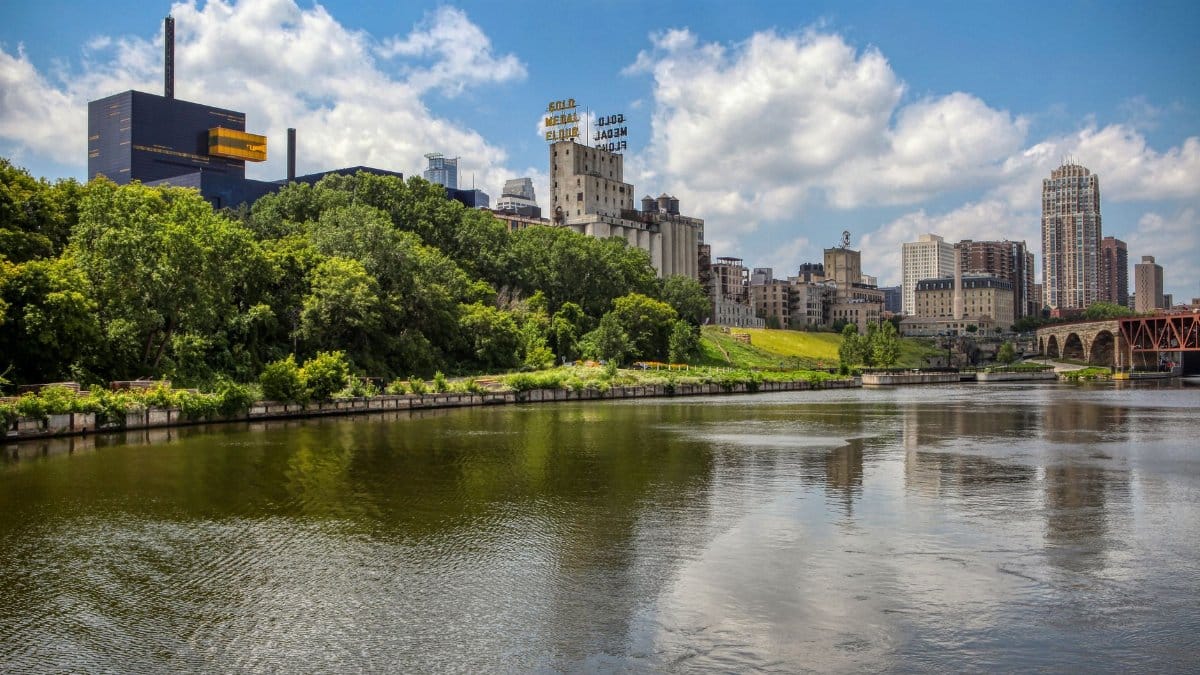
On a mild evening the Mississippi keeps its old pace past a bend that North Minneapolis could see for decades and seldom reach. Chain link, truck courts, and the hush of a working dock once stood between porches and open water. The Upper Harbor Park opening replaces that barrier with paths, lawn, and a shoreline people can walk without a work badge. Families test the slope. Cyclists slow down. A few elders stay longer than they meant to, as if confirming that the view will still be there when they turn around. A decade of argument sits behind a gesture that looks simple: going to the river because it is yours.
A terminal that taught the neighborhood to look away

The ground was not empty before it was a park. It was Upper Harbor Terminal, a city shipping site where barges took on and discharged cargo and where the river functioned as infrastructure rather than invitation. Industry had a logic. Grain, scrap, and bulk goods needed pavement, cranes, and a bank hardened against ordinary use. That logic also drew a line. North Minneapolis lived beside one of the great rivers of the continent and experienced it mostly as a rumor, a glint beyond fencing, a name on a map.
Residents did not need a planner to explain the injury. Rivers make cities legible. They offer air, light, a place to mark a birthday or to stand quietly after a hard week. When a neighborhood is cut off from that, the loss is practical and also intimate. People drive across town for a sunset other districts treat as a Tuesday. Children grow up knowing the Mississippi as something that happens elsewhere. The terminal did its job. It also taught a habit of looking away.
What the new park asks people to do with their feet

The Upper Harbor Park opening is, at bottom, a change in permission. About 20 acres of former dockland now read as public ground: places to sit, routes along the water, edges where restored bank replaces the sheer face of a working wharf. The design does not pretend the past was pastoral. Concrete memory remains in the grade, in the width of old approaches, in the way the site still feels large enough for machines. What changes is who is allowed to be idle there.
Idleness is an underrated public good. A park fails if it only works for programmed events and succeeds when a person can arrive with no plan. North Side residents have said for years that access means Tuesday afternoons, not ribbon cuttings. Early use will test that claim. If the paths feel safe, if bathrooms and shade hold up, if transit and parking do not sort visitors by income, the park becomes a habit. If those ordinary pieces falter, the view will belong mostly to people who already own flexible time and a car.
The argument over who the river is for
No one who followed the Upper Harbor project should confuse a park with a settled peace. The terminal site is larger than the lawn. Around it, the city and private partners have pursued housing, jobs, and a performance venue tied to a well known music brand. Each piece carries a promise and a threat. A venue can bring wages and a reason for the city to maintain the river edge. It can also price the evening, fill streets with outsiders, and treat the neighborhood as a backdrop.
Community voices spent years insisting that benefits be written down: jobs for people who live nearby, housing that a teacher or a nursing aide might afford, a real say when plans shift. Those demands are not nostalgia. They are a reading of Minneapolis history, in which amenities arrive and longtime residents are invited to admire them from a greater distance. The park is the piece that most clearly belongs to everyone. That is why neighbors watch the rest of the site so closely. A public shore next to a private party is not the same as a shore.
A civic ritual that does not require a creed

This page’s category leans toward spiritual news, and the fit is less strange than it sounds. Rivers have carried prayer, migration, mourning, and celebration in every tradition that touched this water, Indigenous long before Minneapolis had a name for itself. The park does not baptize anyone. It does not replace a church, a mosque, or a sweat. What it offers is closer to attention: a place where the body meets a current older than zoning.
People already use riverbanks this way, without announcing it. A person walks a grief down to the water and walks a lighter version back. A congregation picnics after service. Teenagers dare each other and, in the daring, learn the shape of home. The Upper Harbor Park opening gives North Minneapolis a stage for those unscheduled rites. Planners can plant trees. They cannot schedule meaning. Meaning shows up when the gate is open and the place does not hurry you.
There is a discipline in that. Spiritual life, broadly understood, is often the practice of returning. Weekly. Seasonally. Without a headline. A park that supports return, in January as well as June, does more for the soul of a city than a single unveiling. Maintenance, lighting, and winter paths are therefore not mere operations. They are how a promise stays true after the speeches end.
Design that keeps the industrial scar visible

Good river parks in old industrial cities rarely wipe the site clean. Erasure flatters the present and lies about the cost of the past. At Upper Harbor, the honest move is to let visitors feel the scale of what barges required and then notice what has been given back: soil where pavement ruled, a bank that can flood and recover, plantings that belong to a floodplain rather than a corporate plaza. The contrast teaches. Commerce used this bend hard. The public is now asked to use it lightly, which is its own kind of skill.
Light use is not the same as timid design. People need places to gather in numbers, not only a scenic path for solitary walkers. North Minneapolis has a deep culture of reunion: family days, music, church cookouts, political rallies that double as social hours. A river park that cannot hold a crowd will be loved by photographers and neglected by the neighborhood it claims to serve. The test is whether big gatherings and quiet hours can share a calendar without one erasing the other.
Housing, music, and the price of arrival

Talk of reconnection can turn soft if it ignores rent. A beautiful edge raises the value of nearby blocks. That is not a moral failing of grass. It is how land markets work when a city spends public effort on a long neglected shore. Without firm housing policy, the people who fought for the view may watch it from a new address farther out. Leaders have spoken of affordability and of jobs tied to construction and to events. Residents will measure those words against leases, pay stubs, and who gets hired when the venue lights come on.
Music is the sharpest symbol. Minneapolis understands stages. It also understands what happens when a beloved room becomes a destination and the people who built the sound can no longer live near it. A river amphitheater can be a gift if neighborhood artists are on the bill and if late nights do not dump every cost onto adjacent streets. It becomes extraction if the water is scenery for a ticket that locals cannot buy. The park, being free, is the counterweight. Its credibility depends on staying free in practice: no creeping fees for the best lawn, no security posture that treats Black youth as a problem to be managed.
Ecology is not a backdrop

The Mississippi at this bend is wildlife corridor, drinking water source downstream, and a system under stress from heat, heavier rains, and a century of hard edges. A park that merely decorates the bank misses the assignment. Native plantings, a softer shore, and room for high water are public safety as much as scenery. They also restore a kind of literacy. Visitors who can name a floodplain learn to see the river as a being with seasons, not a blue stripe beside a trail.
None of this requires mystical language to matter spiritually. Care for a watershed is a form of neighbor love extended in time. The person who keeps trash out of the current is doing something for a stranger in a town they will never visit. North Minneapolis, asked for generations to absorb industrial burdens, has every right to demand that restoration be real and not a veneer of shrubs over the same sealed earth. If the habitat work is thin, people will notice. They have been reading landscapes for a long time.
What an opening can and cannot finish

Openings are poor historians. They compress years of frustration and craft into an afternoon of speeches and then leave. The Upper Harbor Park opening will be remembered for weather, for who stood on the microphone, and for whether the neighborhood felt hosted or managed. The more important record will be written in ordinary months. Does the bus get you there. Do the lights work. Can a church hold a baptismal picnic without a permit maze. Do adjacent construction fences become the new wall.
Accountability has a local shape. Park boards, the city, developers, and community organizations each hold a piece. When something breaks, residents should not have to become amateur detectives to learn who must fix it. Clear stewardship is part of dignity. So is the right to criticize a place you love. Loyalty to North Minneapolis does not require applause for every rendering. It requires watching whether the riverfront remains a commons after the donors go home.
A North Side claim on a national river
Other cities have spent a generation buying back their waterfronts from ports and highways. Minneapolis has done versions of that work downtown and along lakes the region already celebrates. Upper Harbor matters because it shifts the map of who is assumed to belong in those celebrations. A national river runs through a neighborhood that has carried more than its share of disinvestment and scrutiny. Giving that neighborhood the bank is not charity. It is a correction of a boundary that should never have been drawn so hard.
Correction is slow. One park does not unwind unequal investment in schools, streets, or safety. It does change the daily imagination. A child who grows up able to walk to the Mississippi will hold a different picture of the city than a child who knew the water only from a bridge. That picture is political, because people defend what they have been allowed to love. It is also, quietly, spiritual: a training in scale, in beauty that no household owns, in the relief of standing beside something that does not ask for your productivity.
How to arrive without turning the place into a show
Visitors from elsewhere in the Twin Cities will come, and they should. A public river that only the nearest blocks may see is another kind of fence. The manner of coming is the point. Come without treating the North Side as an exhibit. Spend money at businesses that have been here, not only at whatever pops up for event nights. Learn whose land this was before terminals and plats. Leave the bank cleaner than you found it. If a gathering is underway, do not assume you are the audience.
Residents, for their part, deserve the unglamorous luxury of ignoring the narrative. The park does not need to symbolize resilience every time someone wants a walk. It can simply be where you go when the house feels small. That ordinariness is the victory hiding inside the Upper Harbor Park opening. After the decade of plans, the measure is whether a person can forget the history for an hour and still be held by it, gravel underfoot, water moving, the city audible and not in charge of the current.
The Mississippi will not comment on our policies. It will keep sliding past the bend, as it did when the dock was loud and as it will when today’s saplings are broad. What we add is the choice to stand there together, North Minneapolis first in line, everyone else welcome on those terms. A park cannot redeem a city. It can tell the truth about who is invited to the water. At Upper Harbor, that invitation is finally printed on the ground itself.