
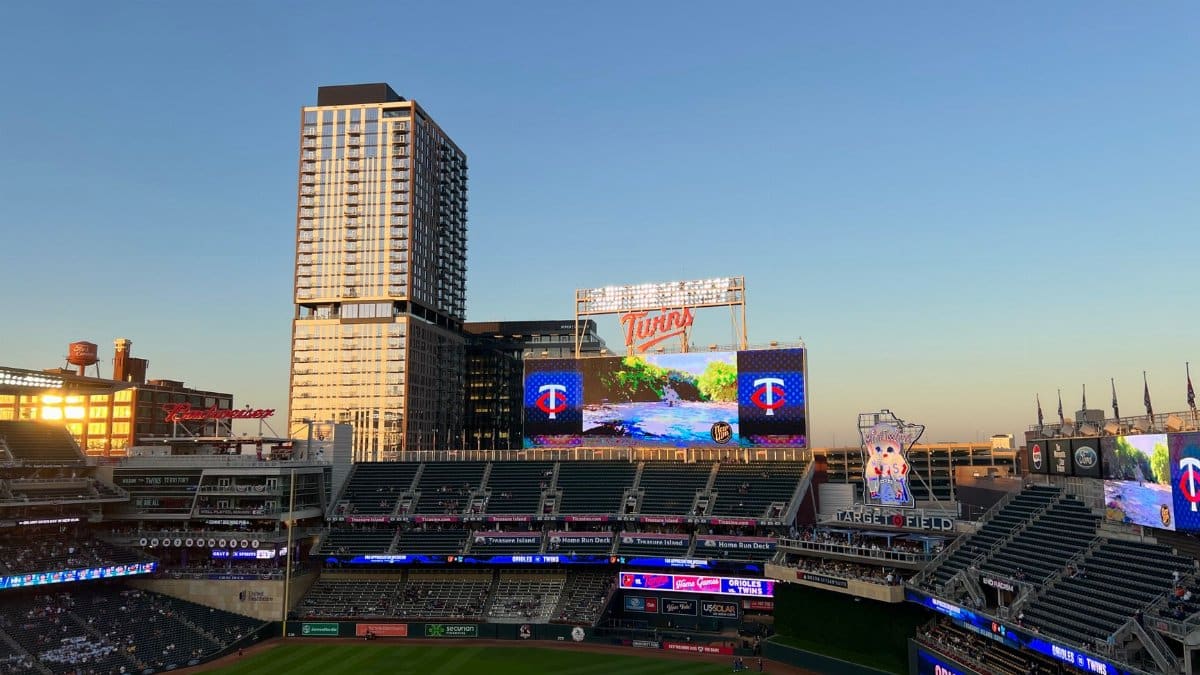
The lights at Target Field were still bright when much of Minneapolis had already treated the evening as finished. In the thirteenth inning, with the score level and the stands reduced to people who would not leave, Victor Caratini stroked a single that closed a long, tense argument between two clubs. The Twins Yankees walk-off did not arrive as spectacle so much as release, the sound a ballpark makes when hours of restraint finally find an exit. What remained was not only a result. It was a record of attention: pitchers laboring, hitters shortening their swings, and spectators bargaining with fatigue. A game that lasts that long stops being a diversion and becomes a small public ritual, one that asks everyone present to stay honest about hope.
A result that took all night to earn

Minnesota beat New York 5 to 4, and the winning run came on Caratini’s single in the thirteenth. That sentence is tidy. The night was not. Extra innings strip a baseball game of its usual manners. Starters are gone. Bullpens thin. Defensive alignments grow cautious, then desperate. Every ball in play carries the threat of ending someone’s evening in the worst available way.
For the Twins, the single was enough. For the Yankees, it was the margin by which a long road night slipped away. Neither club could claim the game had been decided by one swing alone. Thirteen innings means dozens of earlier choices, from a pitch left over the plate to a runner not advanced, had already shaped the ending. Caratini supplied the period. The paragraphs belonged to everybody who had taken the field.
Why the thirteenth inning feels different
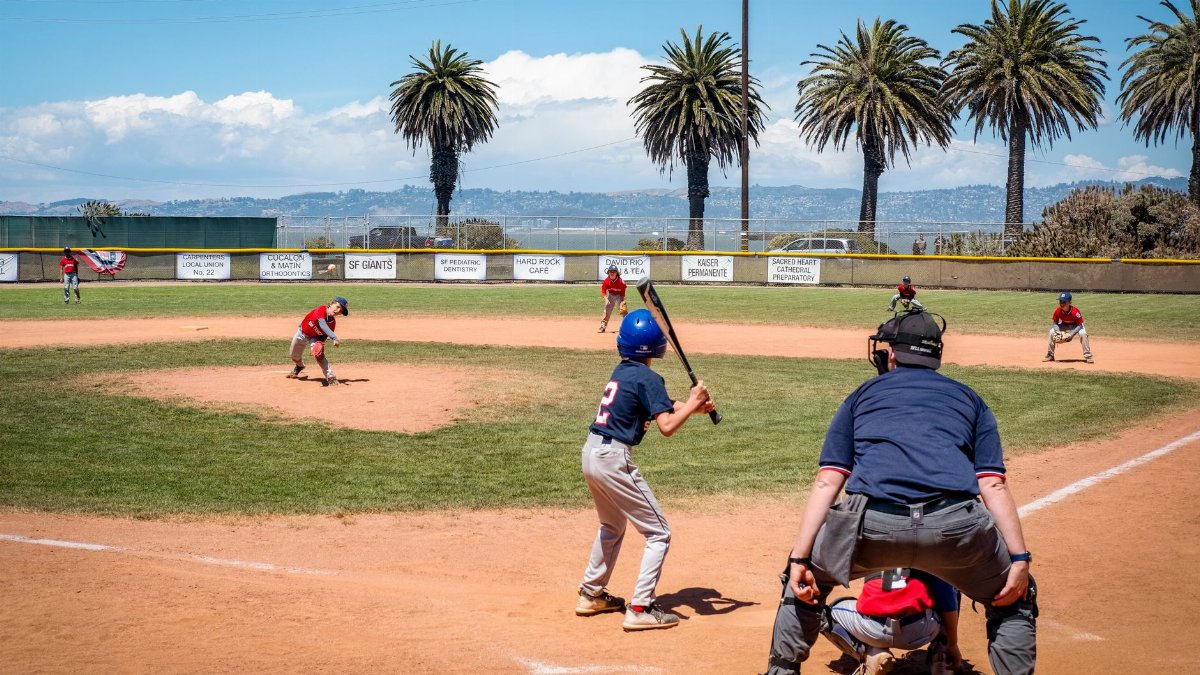
Baseball advertises itself as a game without a clock, which is true and also incomplete. There is no horn, yet there is a human clock. Legs heavy. Hands cold. A crowd that arrived for an ordinary weeknight begins to negotiate with work the next morning. By the thirteenth, the sport has shed casual company. What is left is a narrower congregation.
That narrowing changes the mood. Cheers get sharper. Groans last longer. A foul ball that would have been background noise in the fourth inning becomes a moral event. Fans do not merely want a win. They want the waiting to have meant something. The Twins Yankees walk-off answered that want for one side and denied it to the other, which is the ordinary cruelty of a sport that cannot split the last run.
Victor Caratini and the value of a plain single
There is a temptation to dress a winning hit in grandeur. Caratini’s single does not need that costume. A single in the thirteenth is already large because the situation is large. It asks for contact, for a ball placed where a glove is not, for a runner who can move. It is the opposite of a souvenir swing. It is a professional solution to a crowded problem.
Catchers and veteran hitters often live in that kind of solution. Their value is easy to miss on a highlight show and hard to miss in a clubhouse that has just escaped extra innings. Caratini did not need to reinvent himself in the moment. He needed to be exact. Minnesota, which had spent the night surviving New York’s lineup and its own missed chances, received exactness at the only hour it still counted.
Target Field after the casual fans go home
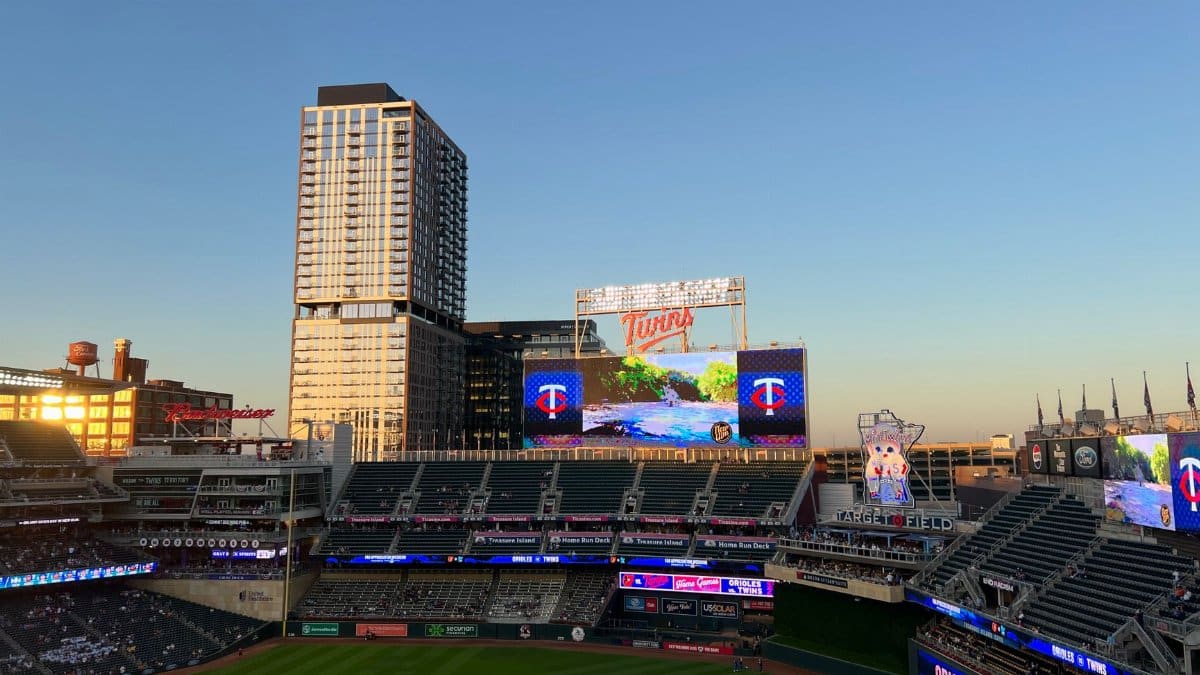
Target Field is a handsome park in daylight and a different room after midnight. The river is out there in the dark. Downtown lights compete with the bank of bulbs over the infield. The people who remain are not a demographic so much as a temperament. They include parents with sleeping children, season ticket holders who treat departure as a personal failure, and visitors in Yankees caps who stay because leaving early would feel like a small surrender.
I have always thought extra innings reveal a park’s real acoustics. With fewer bodies, individual voices carry. You can hear a coach. You can hear a bat knock against a helmet. The Twins Yankees walk-off landed in that clearer air. The roar was not the roar of a packed opener. It was concentrated, almost grateful, as if the building itself had been holding its breath since the eighth.
New York and the long habit of almost

The Yankees do not travel as an ordinary opponent. They travel as a history, a payroll argument, and a measuring stick that other clubs resent and invite at the same time. Losing in thirteen innings on the road does not rewrite that history. It does add a particular sting. A team built to shorten games with power had to live inside a game that refused to shorten.
Almost is a harsh word in October and a common one in June, July, and August. New York had enough to keep the score within a run for a very long time. Enough is not the same as a lead that survives the last plate appearance. The visitors will file the loss under endurance and move to the next city. The people who watched it will remember the single longer than the clubhouse will discuss it.
Patience as a kind of faith

It is unfashionable to talk about sports in spiritual language, and easy to do it badly. Still, a thirteen inning game is one of the few civic events left in which strangers agree to wait without a guarantee. Nobody in the stands could force the next pitch to be the last. They could only remain. That remaining is not doctrine. It is a practice.
Minnesota’s win will be entered as a line in a standings table. The practice will not. Yet the practice is what made the line possible to witness. Fans kept a kind of lay faith in sequence: this hitter, then that pitcher, then one more chance for the ball to find grass. When Caratini delivered, the faith looked rewarded. On another night the same patience ends in a strikeout and a quiet walk to the parking ramp. The discipline is the same either way.
What a bullpen learns when the night will not end

Modern baseball asks relievers to be specialists and then, in extra innings, asks them to be generalists again. Roles blur. A pitcher who expected one inning inherits another. A manager starts counting not only outs but arms he can still trust tomorrow. The box score will not fully show those private calculations. It will show runs and the name attached to the final hit.
Both clubs lived inside that arithmetic. Holding a game at 5 to 4, or at whatever deadlock preceded the last run, is a collective act of refusal. Refusal to give in. Refusal to expand the strike zone out of boredom. Refusal to treat a late inning as lesser because the television window has closed. The Twins Yankees walk-off was the moment refusal stopped working for one side. Until then, it had worked remarkably well for both.
The crowd as a witness, not a noise machine

National highlights will compress the night into a swing, a trot, and a celebration near first base. That compression is useful and false. Useful because people far from Minneapolis deserve to know who won. False because it implies the previous innings were preamble. They were the substance. Every stranded runner, every well turned double play, every pitching change that drew a murmur instead of a cheer belonged to the same story.
A crowd in that setting is less a noise machine than a witness. Witnesses do not control the verdict. They do confirm that the event occurred in public, under lights, with rules both sides accepted. There is something steadying in that, especially in a culture that often confuses reaction with presence. The people who stayed had presence. They can tell the morning version without inventing drama the night did not supply.
How a single game enters a season

One win does not settle a pennant, and one loss does not define a roster. It would be dishonest to load Caratini’s single with destiny. It is enough to say that Minnesota took a game it could easily have handed back, and that New York played long enough to make the taking difficult. In a sport of 162 games, difficulty is the real currency. Easy wins are forgotten by Friday. Hard wins linger in the way a team carries itself to the next first pitch.
For readers who do not follow every series, the useful fact is simple. At Target Field, the Twins beat the Yankees 5 to 4 in thirteen innings. Victor Caratini drove in the winning run with a single. The rest is atmosphere, memory, and the private scorekeeping fans do when they replay a night on the drive home.
What remains after the lights drop

When the park empties, the spiritual claim of the evening, if it has one, is modest. No one was transformed into a better person by a baseball game. Some people were reminded that attention can be shared, that patience can be public, and that an ending delayed is not the same as an ending denied. Those are small goods. They are also rare enough to notice.
The Twins Yankees walk-off will live on as a phrase in a search bar and a line in a recap. Under that phrase is a more ordinary human picture: a hitter who put the ball in play, a defense that could not quite turn it into an out, and a city that stayed up later than it planned. In a loud sports culture, that picture is worth keeping intact. Not every memorable night needs a myth. Some need only an accurate last sentence, written after everyone has finally been allowed to go home.