
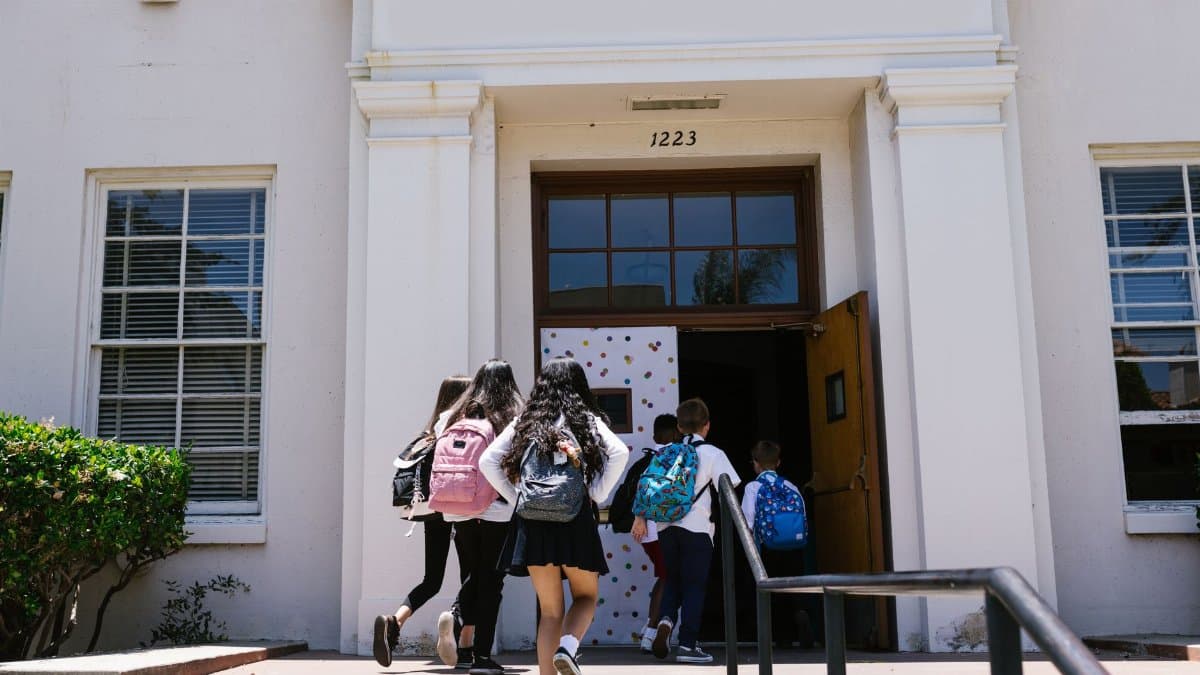
On a Tuesday morning in North Philadelphia, a school staff member stands on a porch with a clipboard and a short list of names that never made it onto a classroom roll. The child was enrolled last spring. The family moved, or the phone failed, or nobody answered the calls that followed. Before Pennsylvania takes its official snapshot of who is in school, the district is sending people into neighborhoods to look for those children in person. The Philly school enrollment canvass is a blunt tool for a delicate problem: students who should be in class and are not on the books that decide money, staffing, and attention.
Why the first of October still rules the calendar

In Pennsylvania, the fall count is not a clerical courtesy. It is the moment when a district tells the state, with some precision, how many children it is responsible for educating. That figure feeds formulas for basic education funding and shapes how federal dollars are allocated in the months that follow. A student who is living in the city but missing from the roll does not simply inconvenience a principal. The absence can shrink the resources attached to a building for the rest of the year.
District leaders have treated the weeks before that date as a search, not a waiting period. Rosters from the previous spring are compared with new registrations. Gaps become walking lists. The work is unglamorous, and it is also one of the few times the system goes looking for children rather than waiting for children to find the system.
What the canvass looks like on a city block
The visits are not raids and they are not sales calls. Staff members, sometimes joined by community partners, carry school information, enrollment forms, and questions that have to be asked without sounding like an accusation. Is this child still at this address? Has the family left the city? Is there a younger sibling who should be registered for kindergarten? The conversation, when it happens, often lasts only a few minutes on a step or in a hallway.
Many doors do not open. People work odd hours. Some buildings have broken buzzers. Some families have learned, from experience with other agencies, that a knock can mean trouble. The Philly school enrollment canvass depends on persistence more than on charm: a second visit, a note left behind, a call from a number the family might actually recognize.
The students who vanish between June and September

Disappearance from a roll is rarely a single dramatic event. A lease ends. A relative takes a child in for the summer and the arrangement becomes the school year. A parent starts a job across the city and the bus route no longer works. A teenager who struggled in June decides, quietly, not to return. None of those stories begins as a funding problem. All of them can become one if nobody notices until November.
Philadelphia has long lived with high student mobility. Families cross district lines, shift among charter and traditional schools, and sometimes leave the formal system for a time. A summer of silence can hide any of those paths. The canvass is an attempt to sort temporary absence from a child who has slipped out of sight.
Money follows a head count, not a hope

Advocates often say that funding should follow the child. In practice, funding follows the child the state can see. If thousands of eligible students are uncounted, the district argues from a smaller base even while teachers still meet the children who do show up, often with greater needs and thinner support. The political fight over Pennsylvania school funding has made that arithmetic feel less abstract. Every missing name is a missing claim on a formula that many educators already consider inadequate.
That does not mean a canvass is a budget trick. Finding a student and enrolling that student is also how a school learns who needs a seat, a bus, a language assessment, or a counselor. The ledger and the classroom are tied together whether anyone likes the knot or not.
Trust is the real currency at the door

A clipboard can read as care or as surveillance, depending on who is holding it and what the last official visit felt like. Immigrant families may fear that school questions lead to other questions. Parents who owe back rent may not want a stranger noting who lives in the apartment. Teenagers who have been pushed out, formally or informally, may not believe the district wants them back.
Staff who do this work well tend to lead with practical help: how to register, where to get records, which school is closest, what to do if the family is in a shelter. They do not lead with threats about truancy court. The Philly school enrollment canvass succeeds only to the extent that it feels like an invitation rather than a summons. That tone is hard to train and easy to lose on a hot afternoon when nobody answers.
Language, housing, and the paperwork wall

Enrollment is simple only for families who already know the system. Proof of address, immunization records, guardianship papers, and prior transcripts can stop a registration cold. A family staying with friends may have no lease. A child who arrived midyear from another country may have no documents that match what a clerk expects. A parent who speaks a language other than English may never have received the summer reminder in a form they could use.
Housing instability multiplies every one of those barriers. When an address changes twice in a season, mail from the school becomes fiction. The canvass is, in part, a correction for a bureaucracy that still assumes a stable mailbox and a parent with time to sit in an office. Knocking does not erase those rules. It can at least tell a family which rule is blocking the door to a classroom.
What an empty chair costs inside the building

Teachers feel absence before finance offices do. A chair that stays empty in September changes group work, reading groups, and the mood of a room. Counselors lose track of students they had finally reached in the spring. Special education plans sit in files with no child attached. For a teenager, a few unmarked weeks can become a lost semester, then a lost year, then a story about how school was not for them.
The public conversation often treats enrollment as an administrative headline. Inside a school it is a relationship that either continues or breaks. Finding a student in October is better than finding that student in January. Finding that student in August would have been better still. The canvass is late by the standard of a child, and early by the standard of a budget cycle. Both clocks are real.
Charters, traditional schools, and the shared city

Philadelphia does not have one school system in the way a smaller town might. Traditional district schools, charter schools, and a small number of other options draw from the same neighborhoods and sometimes from the same families in different years. A child missing from one roll may be sitting, quite legally, in another building. Or the child may be in none of them.
That fragmentation makes a citywide search both necessary and incomplete. Lists do not always talk to each other cleanly. A family can believe a child is enrolled because a sibling is enrolled, or because a charter application was submitted and never confirmed. The canvass has to tolerate that confusion without treating every mismatch as neglect. Sorting a transfer from a disappearance is slow work, and it is the work that matters.
The limits of a knock

No porch visit repairs a school that feels unsafe, a bus that never comes, or a special education process that takes months. Some families have left not because they forgot the date but because the last year convinced them the building could not hold their child. A canvass that only counts, and does not ask why people stepped away, will refill rosters with students who leave again by winter.
There is also a capacity problem on the district side. The people walking blocks are finite. The lists are long. Buildings with the highest mobility often have the least spare staff for follow up once the child is found. Discovery without a seat, a schedule, and an adult who knows the students name is only half a rescue.
What would make the next September quieter

Educators who have watched this pattern for years tend to name the same remedies, none of them glamorous. Keep contact through the summer with texts families actually read. Station enrollment help in libraries, clinics, and shelters rather than only in school offices. Share data carefully among schools so a transfer is not mistaken for a vanishing. Fund family liaisons as a normal part of a building, not as a seasonal scramble.
Those steps will not eliminate mobility in a city where housing is unstable and work is irregular. They can shrink the number of children who are present in Philadelphia and absent from every roster. The Philly school enrollment canvass is a response to a failure of continuity. It should not become the only continuity the district offers.
A civic question hiding in a clipboard

A city reveals itself in whom it goes looking for. Philadelphia is choosing, for these weeks, to treat missing students as a public responsibility rather than a private lapse. That choice sits beside harder arguments about guns, housing, transit, and whether schools are places families trust. The search will not settle those arguments. It can still put a child back in a room where an adult is paid to know that childs name.
When the count is finalized, the headlines will favor a number. The more honest measure is smaller and harder to publish: how many of the students found in September are still there in June, and whether anyone knocked only to count them or also to keep them.