
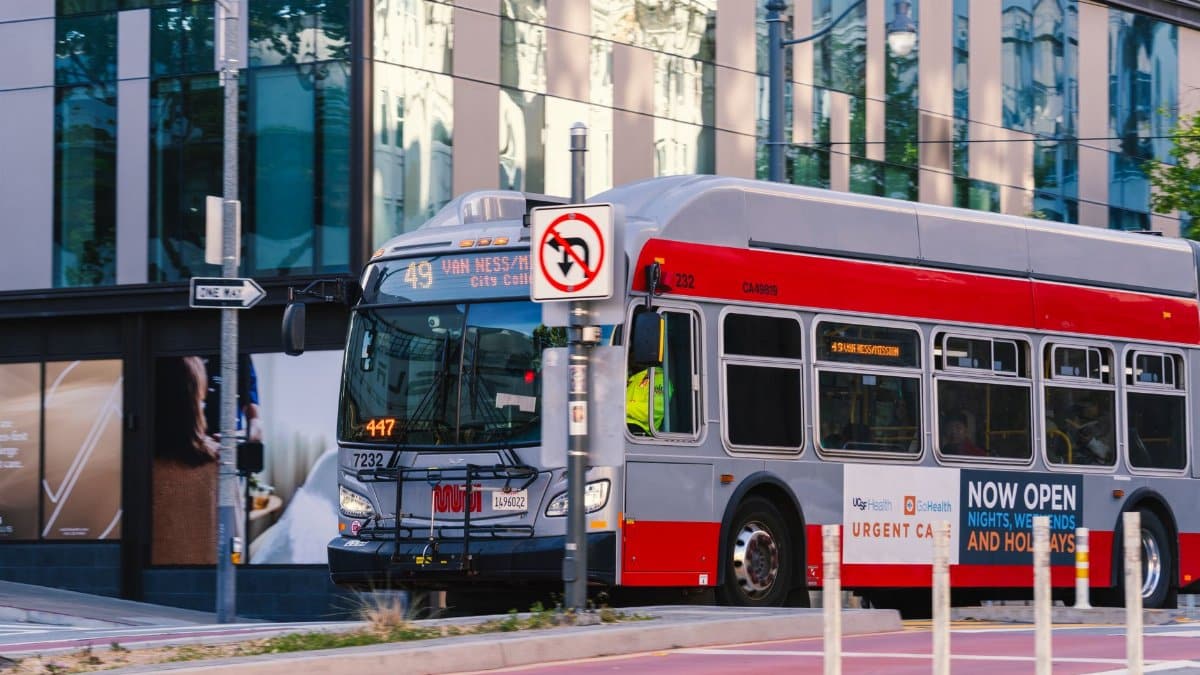
On a foggy weekday morning, a packed bus climbs a San Francisco hill while a driver calls out the next stop and riders check the time. For many of them, the ride is not a lifestyle choice. It is how they reach a hospital shift, a classroom, or a job that starts before the city fully wakes. That ordinary scene is now tied to an extraordinary civic question: whether homeowners will accept the Muni parcel tax 2026 as the price of keeping those buses, trains, and streetcars on the street.
A tax measured in dollars and in minutes
The November measure would ask property owners to fund the Municipal Transportation Agency with a parcel tax expected to raise about $187 million a year. For most homes, the bill would come to $129 annually, a figure small enough to sound modest on a campaign mailer and large enough to sting in a city already famous for costly housing. The political fight will turn on whether voters see that sum as a fair contribution to a shared system or as one more levy stacked on property taxes, bond debt, and special assessments.
Transit advocates argue that the alternative is slower service, thinner routes, and a spiral in which fewer riders produce less fare revenue, which then justifies still fewer trips. Critics answer that City Hall has asked residents to trust new revenue before proving that existing dollars are spent with discipline. Both claims can be true at once. San Francisco has a transit system people depend on and a budget culture people distrust.
How the parcel tax would actually land
A parcel tax is not a tax on income and not a sales tax at the register. It is a charge tied to property. In this case, most single family homes would pay the same headline amount, which makes the proposal easy to explain and also easy to attack as blunt. A modest house in the Excelsior and a much larger home in Pacific Heights could face a similar base bill, even though the owners live in very different economic worlds. Apartment buildings and commercial parcels would be treated under separate schedules, so the burden would not fall only on people who receive a residential tax bill in their own name.
Renters will hear that they are not the ones writing the check. Landlords and tenant lawyers know the story is rarely that clean. Over time, operating costs find their way into rents, especially in buildings where owners already face insurance hikes, maintenance backlogs, and financing costs that rose after interest rates climbed. The measure may be sold as a homeowner tax. Its economic footprint will be wider.
Why Muni is staring at a deficit
The agency’s trouble is not a mystery, even if the politics around it are messy. Fare revenue fell when downtown offices emptied and has not fully returned. Federal relief that carried transit systems through the pandemic years is gone. Labor, fuel, parts, and paratransit contracts cost more. Meanwhile, riders who came back often travel at different hours and to different neighborhoods than the old commute pattern assumed.
Muni is not a luxury amenity in the way a festival or a stadium subsidy can be. It is the circulation system for a city of steep hills, limited parking, and a large share of residents who do not drive every day. Students, older adults, restaurant workers, and people traveling to medical appointments use it because the alternative is a car they cannot afford or a street they cannot safely bike. When frequency drops, the people with the least flexibility absorb the delay.
What $129 buys and what it does not
Supporters describe $129 a year as less than the cost of a single monthly parking garage bill, or a few rideshare trips across town. That comparison is rhetorically useful and economically incomplete. A household that already owns a car, pays for insurance, and rarely boards a bus may feel it is subsidizing someone else’s convenience. A household that sold its car because the 14 or the N Judah made ownership unnecessary may see the tax as cheaper than the vehicle it replaced.
The money would not build a new subway from scratch. It is aimed at stopping a deficit from becoming a service collapse: keeping operators on runs, maintaining vehicles, and preserving routes that do not pencil out on fares alone. Capital dreams, from faster rail to cleaner bus yards, still depend on other funds. Voters who expect a gleaming new network in exchange for this tax are likely to be disappointed. Voters who expect the network they already use to remain recognizable have a clearer claim on what the revenue is for.
Frequency is the product riders actually buy
People do not ride a budget. They ride a promise that a vehicle will come. When that promise weakens, behavior changes quickly. A nurse who misses a connection starts driving. A student who waits twenty five minutes in the dark asks a parent for a ride. Each of those private solutions is rational. Together they thicken traffic, raise emissions, and drain the very ridership that makes frequent service viable.
San Francisco has spent years talking about a downtown recovery. Offices, shops, and theaters do not recover if the trip downtown feels unreliable. The Muni parcel tax 2026 sits inside that larger bet. A city that wants workers back in offices, customers back on commercial streets, and tourists moving beyond a few famous blocks cannot treat transit as an optional line item that shrinks whenever the books look ugly.
The case from people who rarely board
There is a selfish argument for the tax that does not require anyone to love buses. Every car trip replaced by a train is a car that is not circling for parking in front of someone else’s house. Every crowded bus that still runs is a set of workers who can staff a restaurant, a clinic, or a school without each of them needing a parking space the neighborhood does not have. Property values in a functioning city reflect that circulation, even if no appraisal lists Muni frequency as a line item.
Homeowners who plan to sell in a few years may still resent a recurring charge. Homeowners who plan to stay have a stake in whether the block remains reachable. The measure asks them to price that stake in public, on a ballot, rather than in the private calculus of traffic and time.
Tax fatigue is not a talking point. It is a condition
San Francisco voters have approved many bonds and taxes, and they have also started to say no. Schools, housing, parks, and street repairs all arrive with urgent language. After a decade of high housing costs and visible disorder on some sidewalks, a share of the electorate hears every new proposal as proof that leadership cannot live within its means. That mood will shape the Muni parcel tax 2026 more than any transit white paper.
Opponents do not need to argue that buses are unimportant. They only need to argue that this is the wrong instrument, the wrong amount, or the wrong moment. They will point to overtime, to capital projects that ran long, to fare evasion, and to routes that feel empty at midday. Some of those complaints are anecdotal. Some are grounded in audits and rider experience. A campaign that waves them away as anti transit hostility will lose voters who actually ride and still want an accounting.
Trust, oversight, and the fine print

If the measure reaches the ballot in the form its sponsors describe, the decisive middle will look for guardrails. Dedicated revenue sounds reassuring until voters remember that dedicated funds can still be surrounded by creative budgeting, with general fund support quietly reduced as the new tax arrives. A lockbox that does not protect service is a slogan. A reporting schedule that names canceled runs, hiring shortfalls, and maintenance delays is closer to accountability.
Sunset dates matter too. A tax that continues without a fresh vote invites complacency. A tax that expires too soon invites another fiscal cliff just as riders regain confidence. The design question is whether the city is buying stability or merely postponing a harder restructuring of routes, fares, and labor agreements. Reasonable people will disagree. They should still be able to read the rules without a law degree.
Labor, management, and the cost of a human system
Buses do not drive themselves in San Francisco, and they will not for the period this tax is meant to cover. Operators, mechanics, cleaners, and supervisors are the service. Their wages are also a large share of the budget. After the pandemic, hiring was hard, absenteeism was a daily operational fact, and riders felt both in the form of missing vehicles. Paying people enough to staff the system is not waste. Failing to manage overtime, safety, and scheduling is.
A honest debate holds both ideas. Cutting labor costs by letting positions sit empty is a service cut by another name. Protecting every work rule while asking homeowners for new money is a political risk the agency cannot afford. The parcel tax will be judged in part by whether management and unions treat the public as a partner or as a wallet.
If the measure fails
Defeat would not mean Muni vanishes in December. It would mean a sharper menu of cuts, higher fares, or a scramble for one time fixes that do not recur. Spare the popular lines and the pain lands on neighborhood routes. Spare the neighborhood routes and the trunk lines that carry the most people slow down. Raise fares and some riders leave, which narrows the base again. None of these choices is theoretical. Transit agencies across the country are walking versions of the same maze as emergency aid disappears.
Failure would also send a signal beyond one agency. Regional projects that assume San Francisco can hold up its end of the network become harder to finance and harder to explain. A city that cannot agree to $129 a year for basic local service will struggle to persuade anyone that it is ready for larger transformations.
The November argument in plain language

Campaigns will dress this up in slogans about climate, equity, and economic revival. Those themes are real. They are also easy to tune out. The plainer version is this: San Francisco built a life around transit, then watched the old funding mix break, and now must decide whether property owners will patch the hole. The Muni parcel tax 2026 is that decision, priced for most homes at $129 and scaled, if it passes, to roughly $187 million a year.
Readers who want the originating report can find the Chronicle account at sfchronicle.com. The numbers will be debated, amended, and advertised until they blur. The lived test will stay simple. Does the bus still come.
What a skeptical yes or a reluctant no requires
A skeptical yes would demand public dashboards, protection against backfilling games, and a clear statement of which routes and hours the money is meant to save. It would treat the tax as a bridge, not a blank check, and it would insist that fare payment, safety on vehicles, and basic cleanliness are part of the bargain. People will pay for a system they believe is trying.
A reluctant no would need an alternative that is more than anger. Cutting service, raising fares, consolidating lines, or seeking a regional tax are all policies with victims attached. Opposing this parcel tax without naming the victims is not a plan. It is a mood. San Francisco has had enough moods. It needs a network that works on Tuesday morning, in the fog, for people who cannot wait for a perfect institution.
The stake beneath the ballot language
Cities reveal their priorities when the easy money runs out. This vote will show whether San Francisco still treats collective movement as infrastructure, in the same family as water and streets, or as a program that can shrink until only the captive riders remain. The Muni parcel tax 2026 will not settle every argument about crime, housing, or downtown. It will settle whether the next round of missed trips is a choice the electorate knowingly made.
Most homes would pay $129 a year. That is the number on the kitchen table. The number on the street is harder to print: the minutes a city adds to ordinary lives when it lets a transit system thin out, and the minutes it gives back when it does not.