
On a bright morning in St. Peter’s Square, a man whose shoulders once filled television screens stood among pilgrims and waited his turn like everyone else. Lou Ferrigno, the actor and bodybuilder known to millions as the Hulk, had come to Rome for a general audience with Pope Leo XIV. For him the Ferrigno Pope Leo meeting was not a publicity stop. It was the closing of a circle that began in a churchgoing childhood, long before green body paint and comic book fame. The square was loud with languages, cameras, and folding chairs. Ferrigno, now in his seventies, looked less like a superhero than like a grateful guest who had finally reached a place he had imagined as a boy.
The morning in the square
General audiences are built for crowds, not for private conversation. Tens of thousands of people fill the square or the audience hall, depending on the weather and the season. Banners mark parish groups. Choirs practice a hymn they will sing once and then forget the key. Security moves in slow lines. The pope greets, blesses, and speaks in several languages while the rest of the morning belongs to patience.
Into that ordinary machinery walked a figure who is anything but ordinary in American popular memory. Ferrigno did not arrive as a head of state. He arrived as a Catholic who had wanted, since childhood, to stand in that square and see a pope with his own eyes. People nearby recognized the height, the chest, the familiar face. Phones came up. The recognition did not change the order of the day. He was still one pilgrim in a sea of them, which, by every account of his wishes, was the point.
A childhood shaped by silence and prayer
Ferrigno’s public story has always had two tracks. One is the body: teenage bodybuilding, Mr. Universe titles, the role that made him a household name in the late 1970s. The other is hearing. He lost much of his hearing as a small child after an infection, and he has spent a lifetime reading rooms, reading lips, and refusing the limits other people assigned him. That second track matters here, because devotion for him was never only spectacle. It was discipline learned early, in a family that treated faith as a weekly fact rather than a costume for holidays.
He has said over the years that church was part of the household rhythm in Brooklyn, and that the wish to meet a pope took root then, when Rome was an idea on a map and not a flight. Childhood wishes are easy to outgrow. This one stayed. It survived training camps, television sets, convention halls, and the strange second life of being forever associated with a character who smashes walls. The man who played rage wanted, in this one setting, quiet recognition from a church he never left behind.
What pilgrims actually do at a general audience
A general audience is not a summit and not a sacrament in the narrow sense. It is a weekly appointment the pope keeps with the church as a crowd. There is a catechesis, often on a theme that runs for weeks. There are greetings to groups. There is a blessing. People who have traveled from parishes, schools, and hospitals get a few seconds of eye contact if they are lucky, and a photograph if they are near the right aisle.
That structure explains why the Ferrigno Pope Leo meeting could feel both historic and modest. Historic because of who stood in the frame. Modest because the Vatican did not invent a new ceremony for a film star. He took part in a rite that exists whether or not cameras from entertainment desks show up. For readers who have never been, the useful picture is a parish picnic expanded to the scale of a city block, with older ritual underneath the bustle. You sit. You stand. You listen to a voice carried by speakers. You leave with a blessing you cannot put in a bag.
Fame that never quite left the parish
Ferrigno’s career never required him to perform piety for the press. He played the Hulk on television, later appeared in films and on reality shows, and remained a presence at comic conventions where fans still want the pose, the flex, the memory of a Saturday afternoon. Alongside that, he has spoken plainly about faith, family, and the marriage he has kept for decades with Carla Ferrigno, who has been both partner and manager. The Vatican visit sits in that longer pattern rather than outside it.
American celebrity religion often arrives as a rebrand. An actor finds a new audience, a new language, a new product. This visit did not look like that. There was no tour announced around it, no devotion packaged as content first and prayer second. The childhood wish was specific and old. Meet the pope. Stand in the square. Receive a blessing in the place where the office, not the personality, is what people have crossed oceans to see. Fame got him recognized. It did not get him a different liturgy.
An American pope meets an American myth
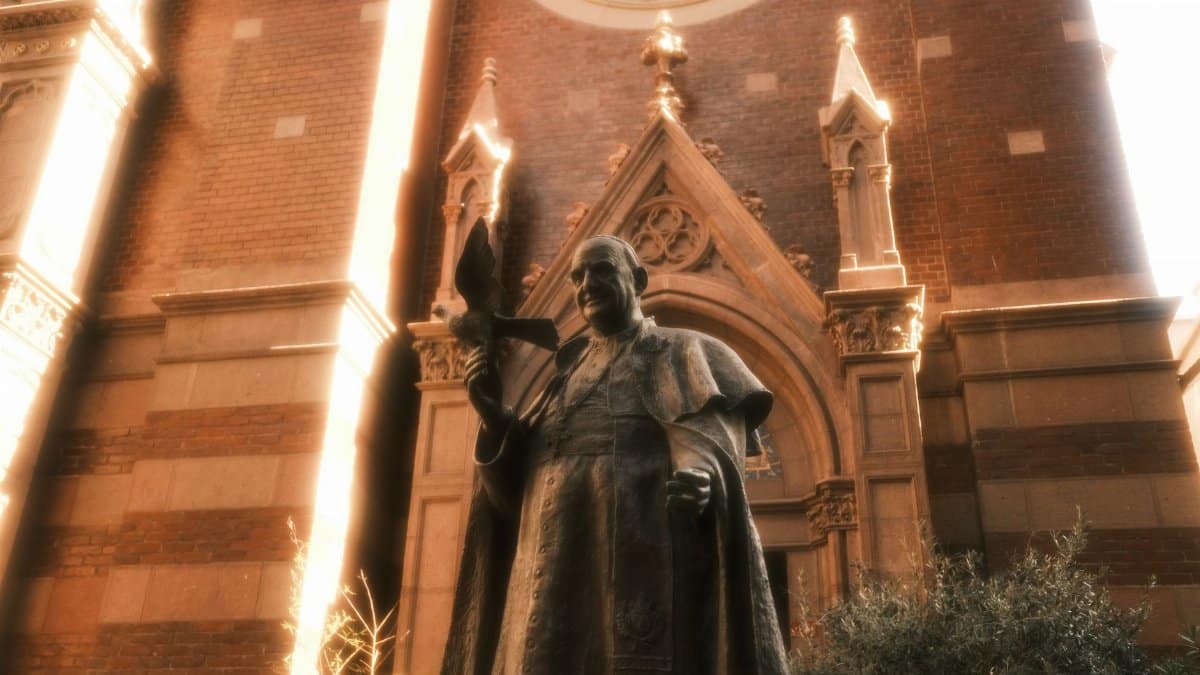
Pope Leo XIV draws American pilgrims for a reason that needs no footnote. An American born pontiff changes the emotional math for visitors from the United States. The office remains universal. The biography feels closer. People hear their own accent in the greeting and decide, sometimes for the first time, that Rome is not only for other people’s grandparents.
Ferrigno belongs to a different American myth, the one built in gyms and on small screens: the outsider who becomes enormous, literally, and still carries a private struggle. Putting those two figures in one morning invites easy headlines and lazy morals. The better reading is narrower. A pope whose ministry includes Americans who rarely fly to Italy met, in the course of an ordinary audience, an American whose body has been a public symbol for nearly fifty years. Neither man had to explain the other. The square did the explaining. People come because the office is there, and sometimes the people who come are famous.
The body as witness
There is something slightly comic, and then something serious, about the Hulk in a papal audience. The character is excess. The setting is restraint. Ferrigno has lived inside that tension since the makeup chair. He built a career on a body that reads, at a distance, as invulnerable. Up close, age, hearing loss, and the ordinary fatigue of travel tell a different story. Pilgrimage has always been a bodily act: sore feet, early alarms, the humility of waiting in a line you do not control.
In that sense his presence fit the square better than a red carpet would have. The church has spent centuries arguing about the body, honoring it, disciplining it, burying it, painting it. A bodybuilder kneeling or standing for a blessing does not settle any of those arguments. It does remind a secular audience that muscles and prayer are not assigned to separate zip codes. Plenty of people in that crowd had trained for marathons, survived surgeries, or pushed wheelchairs. His frame was simply the most recognizable.
Pictures, headlines, and the speed of devotion
Within hours the photographs moved faster than any homily. Entertainment sites, parish Facebook pages, and group chats passed the same image: Ferrigno, the pope, the square, the smile of a man who had gotten the thing he asked for as a child. That speed is the modern condition of any sacred visit by a known face. The blessing is brief. The caption lasts longer.
The risk is obvious. A Ferrigno Pope Leo meeting can be flattened into a curiosity, a crossover episode between comic books and cassocks. The reporting that treated it as a human interest item was not wrong. It was incomplete if it stopped at the oddity. What traveled online was joy, and joy is not nothing. For a figure who spent years associated with anger performed for the camera, a public picture of gratitude is its own correction. Fans who grew up fearing the Hulk and loving him at the same time got to see the actor choose a softer verb.
Why the meeting mattered beyond celebrity
Most readers will never meet a pope, and most will never be recognized in a crowd. The useful part of the story is not access. It is duration. A wish kept from childhood into old age is rare in a culture that treats attention as a renewable resource and memory as a feed. Ferrigno did not need Rome to complete a career. The career was already complete by any industry measure. He needed Rome because a promise made to his younger self had not expired.
That is a spiritual point without requiring anyone to share his creed. Institutions survive because people keep showing up for reasons that predate the news cycle. A general audience on an ordinary week is one of those showings up. When a famous person joins it without rewriting the script, the institution looks less like a backdrop and more like what it claims to be: a place that was already there. The Ferrigno Pope Leo meeting drew eyes. The eyes, if they stayed, found a crowd that would have gathered anyway.
A dream kept small on purpose
There will be more photographs, and there will be more famous visitors. Vatican schedules have absorbed athletes, actors, and politicians for generations. What distinguishes this morning is how little Ferrigno seemed to ask of it. No manifesto. No demand that the church comment on his films. A blessing, a meeting, a square he had pictured before he had the means to reach it.
In a season when religion headlines often arrive attached to conflict, money, or scandal, a fulfilled childhood wish can look slight. It is not a reform. It is not a doctrine. It is a man in his seventies standing where he hoped to stand, among people who did not come for him. That modesty is the detail worth keeping. The Hulk was a fantasy of unstoppable force. The pilgrim in St. Peter’s Square was something harder to costume: a person who waited, listened, and went home having kept a promise to a boy who could not hear well and still believed the trip was worth it.