
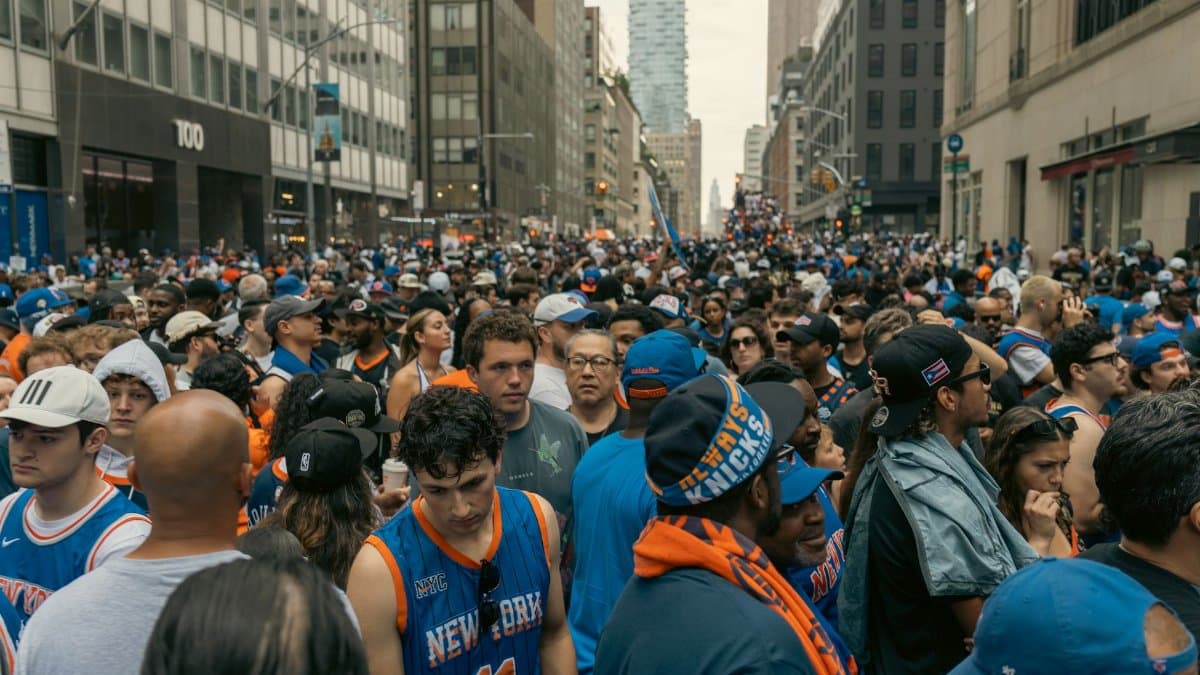
On a Tuesday night in Manhattan the noise arrived before the final horn, a rolling sound that rose from the lower bowl and kept climbing until even the quiet seats near the exits joined in. The New York Knicks had spent the opening stretch of the season looking for a foothold, and they found it against a Detroit team that had not yet lost. The final margin was 111 to 97, enough to end a three game slide and enough to make the building feel like itself again. For anyone who had watched the early misses and the late turnovers, the Knicks first win landed less like a surprise than like a correction, the kind of result a roster with this much experience is supposed to produce once the nerves settle.
How the night actually unfolded

The game did not announce itself as a turning point in the first quarter. Detroit arrived with the confidence of a club that had not been beaten, and the Knicks spent the opening minutes sorting out spacing and tempo. What changed was less a single burst than a steady refusal to let the visitors live in the paint. New York forced longer possessions, contested the corners, and turned a handful of live ball mistakes into early points the other way. By the middle of the second quarter the home side had a cushion that felt earned rather than gifted. The Pistons kept answering, as an unbeaten team will, but the answers grew shorter as the night went on.
Halftime did not produce a sermon from the bench so much as a reminder of habits. Stay in front. Finish the extra pass. Do not bargain with the shot clock. Those are ordinary instructions, and ordinary instructions are often what a talented group forgets when the season is still learning its own shape. The third quarter belonged to the home team in the only way that matters in November: they defended without fouling themselves into a parade to the line, and they scored without needing heroics on every trip.
A defense that finally closed the lane
Early losses had a familiar look. Opponents got to the rim, offensive rebounds became second chances, and the Knicks spent too much of the night defending in rotation instead of in stance. Against Detroit that pattern bent. Help arrived on time. Bigs stayed vertical instead of swiping at the ball. Guards recovered to shooters instead of admiring the drive they had just failed to stop. None of this is glamorous, and none of it shows up in a highlight that travels well on a phone. It is also the difference between a team that looks expensive on paper and a team that looks coherent on the floor.
Detroit still scored. An unbeaten start is not an accident, and the Pistons have athletes who can turn a cracked closeout into a layup before the help even finishes its first step. What New York denied them was rhythm. The visitors never stacked enough easy points to make the building nervous in a sustained way. When a defense holds a previously perfect record to 97, the number is not a moral victory. It is evidence that the scheme, for one night at least, matched the personnel.
Detroit and the weight of an open record
There is a particular pressure that comes with not having lost yet, even in the first week of a long season. Every opponent treats you as a measuring stick. Every missed box out feels louder. The Pistons played like a team that understood the assignment and still ran into a more physical night than the schedule had offered them so far. Their ball movement remained crisp for long stretches. Their young pieces did not shrink. They simply met a group that had grown tired of explaining why the wins had not arrived.
Losing an undefeated mark in Madison Square Garden is not a verdict on a season. It is a data point, and a useful one. Detroit will leave New York knowing which actions still work against length and which ones die when the help is early. The Knicks, for their part, will remember that an open record is not armor. It is an invitation.
The players who set the tone
Box scores from nights like this tend to crown one name and bury the rest. That would miss the point. The Knicks needed initiators who attacked without rushing, and they needed finishers who did not treat every touch as a personal referendum. Veterans set screens that actually freed a shooter. Wings ran the floor instead of jogging into a half court set already behind the play. When the ball stuck, someone cut. When the ball swung, someone was already in the corner with feet set.
I have sat through enough early season games to know that competence can look like brilliance when the alternative has been sloppy. This was better than competence. It was coordinated. The players who are paid to decide the game decided it without turning the fourth quarter into a series of isolations. That choice, more than any single make, is what traveling fans will remember when they try to describe the evening to someone who only saw the final score.
What the early losses exposed

A three game slide at the start of a season invites every old story about this franchise. Impatience. Fragile confidence. A crowd that can turn a ordinary miss into a crisis. Some of that talk is lazy, and some of it is earned by years of nights that slipped away for reasons that had little to do with talent. The losses before this one exposed real issues: late clock offense that settled, transition defense that jogged, and a habit of fouling jump shooters when the possession was already lost.
Those issues did not vanish because the scoreboard finally cooperated. They receded. Receding is not the same as disappearing, and any honest reading of the Knicks first win has to hold both ideas at once. The team looked like the version its roster suggests. It also looked like a version that still has to prove the look can survive a back to back, a hostile road gym, and a night when the shots do not fall in the first six minutes.
Inside a building that needed a release
Madison Square Garden does not do quiet gratitude. When the lead felt safe, the noise became something closer to relief than to celebration. Season ticket holders who have watched this club cycle through promise and disappointment know the difference. Relief sounds lower. It lasts longer. It does not require a poster or a coordinated chant. It is the sound of people who came expecting another evening of explanations and received, instead, a game that made sense.
The players heard it. You could see shoulders drop in a good way, the way they drop when a group stops playing as if the next mistake will define the month. Home courts are supposed to do this work. They cannot do it if the basketball does not give them a reason. On this night the basketball gave them a reason for most of the second half, and the building repaid the favor by staying with the details: a charge taken, a deflection, a kick out that became a corner three.
Late choices and a calmer fourth

The fourth quarter is where early season teams often undo their own good work. A lead shrinks, the offense grows selfish, and the coach is left choosing between a timeout that admits panic and silence that looks like neglect. New York avoided that trap. Possessions stayed shared. The defense did not gamble for steals that were not there. When Detroit made a push, the response was a patient trip down the floor rather than a heat check from 28 feet.
That composure is a skill, and it is also a choice. Young groups sometimes believe that energy alone will close a game. Experienced groups know that energy without spacing is just five men running into the same defender. The Knicks looked experienced in the final period. They looked, in the plainest sense, like a team that had talked about this exact situation and then recognized it when it arrived.
Reading the margin without romance

A 14 point win over a club that had not lost is a statement, and statements in November are easy to overread. The schedule will not grade on a curve. Opponents will scout the actions that worked and take them away. Role players who made open shots will face contests that arrive a half second earlier. None of that diminishes what happened. It places it. The honest sentence is that New York played a complete game against a legitimate opponent and won by a margin that did not require a miracle in the final minute.
Fans will want more than honesty. They will want a narrative in which this result unlocks the rest of the year. Narratives are how people survive an 82 game season. They are also how people get surprised in December. The better use of the night is narrower: keep the defensive habits, keep the ball moving when the lead is comfortable, and treat the next opponent as if the record is still blank.
Why one night does not rewrite a season
Franchises with this much history are always being asked to mean something larger than the score. A win becomes a symbol. A loss becomes a diagnosis. The healthier view is smaller and harder to sell. Basketball teams improve by repeating boring things until those things are no longer decisions. Close out hard. Talk on screens. Take the shot the defense gives you. The Knicks first win matters because it showed those things are available to this group, not because it guarantees they will be available on Thursday.
There is room, even so, for a measured satisfaction. Snapping a slide against an unbeaten visitor is not nothing. It gives a locker room a shared picture of what good looks like, which is more useful than another film session full of what bad looks like. Coaches live on those pictures. Players do too, especially the ones who have heard, for years, that this club cannot get out of its own way.
The road that still waits

The schedule does not pause to admire a box score. There will be a flight, a walk through, a night when the legs are heavier and the whistle is less friendly. Detroit will not be the last good team on the slate, and an unbeaten start elsewhere in the league will keep producing the same kind of test. What New York can carry forward is a template: protect the paint, share the offense, and let the building do its work only after the basketball has earned it.
For readers who follow this club the way other people follow the weather, the evening offers a simple update. The storm of the opening losses broke. The Knicks first win arrived in the form that matters, a double digit decision built on defense and enough offense to keep the opponent from believing. That is not a championship paragraph. It is a November paragraph, which is the only kind this date can honestly support.
What to watch the next time out

The next test is repetition. Can the same closeouts show up when the opponent hunts mismatches from the opening tip? Can the same patience survive a cold shooting start? Can the bench hold a lead without turning the game into a track meet? Those questions are more interesting than any proclamation about identity. Identity, in this league, is whatever you did on the last three trips down the floor, repeated often enough that opponents start to plan for it.
If the Knicks first win becomes a habit, the early slide will read as a preface. If it becomes an island, the preface will keep writing itself. The players know which version they prefer. So does the crowd that stayed on its feet a little longer than the final horn required, not because the season was saved, but because for one night the basketball looked like the sport they bought tickets to see.