
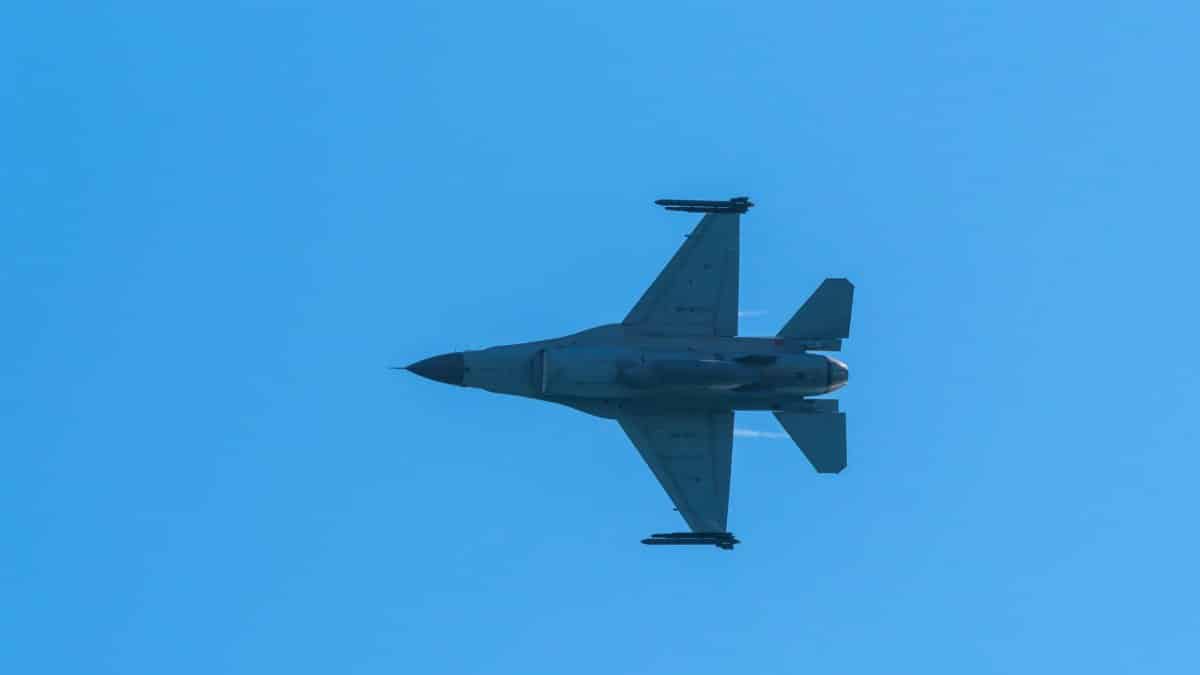
On a mild September evening near Traverse City, the sound that usually fades into the background of northern Michigan life did not fade. A training jet went down, and with the wreckage came a word most residents had never needed to learn. The Traverse City F-16 hydrazine scare sent 34 people through decontamination and left six in the hospital, a reminder that a routine military flight can carry a chemical hazard as well as a mechanical one.
A familiar roar that did not pass

People who live near the airfield know the pattern. Jets climb, bank, and vanish toward the bay or the inland woods. On September 17, that pattern broke. Witness accounts gathered by local reporters described a training flight that ended in a crash, then a scramble that looked less like a standard wreck scene and more like a hazardous materials call. Lights stayed on longer. Perimeters widened. Neighbors were told, in the plain language officials reach for when time is short, to stay back.
The details that matter most in the first hour are rarely romantic. Who is hurt. Where the fire is. Whether anything in the air or on the ground can harm the people running toward it. In this case the third question took over the story before the first two were fully answered in public.
Training flights and the illusion of routine

Military training is built on repetition. Crews practice the same approaches, the same emergencies, the same radio calls until the unusual becomes manageable. That discipline saves lives. It also breeds a civilian habit of treating the noise overhead as scenery. A crash punctures that habit. Suddenly the aircraft is not a shape in the sky. It is metal, fuel, and systems designed for war, sitting in a place where people walk dogs and drive to work.
Officials described the flight as training, not combat. That distinction matters for politics and for fear, but it does not shrink the physical problem on the ground. A jet that fails during practice can still burn, still scatter debris, and still release chemicals that crews treat with the same caution they would use after a mishap anywhere else.
Why this chemical changes the response
Most people hear crash and think fire, smoke, and twisted aluminum. Hydrazine asks for a different script. It is a liquid associated with certain emergency power systems on fighter jets, including aircraft in the F16 family. Federal health agencies describe it as toxic by inhalation and through the skin, irritating to eyes and airways, and capable of causing nausea, dizziness, and more serious effects at higher doses. It is also flammable. None of that requires a chemistry degree to respect.
The Traverse City F-16 hydrazine concern was not an abstract briefing item. It shaped who could approach the site, how long they could stay, and whether bystanders who had already come close needed to be washed down before anyone could say they were clear. That is a colder kind of emergency than a fire alone. You cannot see a dose. You can only follow the protocol and wait for symptoms, or for their absence.
Thirty four people in the wash line
The number that traveled fastest was 34. Thirty four people were decontaminated after the crash. Six remained hospitalized. Those figures, reported as the immediate toll of exposure concerns rather than of impact injuries alone, reset the scale of the night. A decontamination line is not a metaphor. It is water, removal of clothing, clinical observation, and the awkward intimacy of strangers deciding that your skin might be a problem.
Hospitals in a regional city are built for car wrecks, heart attacks, and the occasional industrial spill. They are not built, day to day, for a surge of possible chemical exposures tied to a military aircraft. Staff still know the playbook. Isolate. Protect themselves. Treat what they can see. Watch what they cannot. Six people staying overnight is not a mass casualty event in the grim language of disaster planning. It is still six families waiting on monitors and on a substance most of them could not have named at dinner.
Who gets washed and who gets sent home

Decontamination sounds absolute. In practice it is a judgment call made with incomplete information. Responders ask where you were, how long you stood there, whether you smelled something sharp or felt your eyes burn, whether you touched wreckage or only watched from a road. Some answers put you in the line. Others send you home with instructions to return if breathing changes or a rash appears.
That sorting is easy to second guess from a couch and hard to do in the dark with radios overlapping. The conservative choice is to wash more people than strictly necessary. The cost is indignity and worry. The alternative is missing someone who later becomes sick. Public health, at its least glamorous, prefers the first cost.
What hydrazine is, without the jargon

Strip away the acronyms and the picture is simple enough. Hydrazine is a manufactured chemical, not something a lake or a forest produces on its own. Industry and the military use it because it stores energy in a compact way. The same trait that makes it useful makes it unwelcome in a neighborhood. It does not belong on grass, in a ditch, or on a sleeve.
Health agencies have long listed it among chemicals that demand distance, gloves, and time. Odor is not a reliable alarm. Some people notice a sharp smell. Others do not, or notice it only after exposure has already begun. That is why crews do not wait for a consensus of noses before they set a cordon. The Traverse City F-16 hydrazine response followed that logic even while investigators were still mapping the wreckage.
The announcements residents actually heard

In the first reports, officials emphasized caution over certainty. Stay away from the site. Do not collect souvenirs from a field. If you were close and feel unwell, seek care. Those lines can sound boilerplate until you are the person deciding whether a headache is stress or something else. Clarity helps. So does honesty about what is not yet known, including how much of the chemical, if any, left the aircraft and where it went.
Local news outlets, including coverage that framed the morning after around chemicals as much as around the crash itself, carried those warnings to people who had slept through the sirens. A scare spreads on two tracks at once. One is physical, measured in hospital beds. The other is informational, measured in group texts and in the question every parent asks: is the air all right for school in the morning.
The person in the cockpit

A crash story that lingers on chemistry can forget the pilot. Training sorties are flown by people with names, families, and a narrow set of seconds in which to decide whether to stay with the jet or leave it. Public accounts in the first day did not settle every question about injury or ejection. What they did establish is that the human outcome and the chemical outcome are not the same story. A pilot can survive a departure from controlled flight and still leave a hazard for the people who arrive next. Conversely, a community can obsess over a plume and overlook a crew member in a trauma bay.
Both deserve a full accounting. Neither should be used to decorate the other.
A town that lives with jets
Traverse City is not a base town in the way some Southern cities are, but military aviation is part of the regional texture. Air shows, occasional deployments, and training traffic make the aircraft familiar. Familiarity is not consent to unlimited risk, and it is not ignorance either. Residents can hold two ideas at once. They can value the mission and still want a straight answer about what fell into their county.
That tension showed up in the way people talked about the night. Gratitude for crews who ran toward the site sat beside irritation at incomplete maps and beside a quieter unease. If a training mishap can put 34 people through decontamination, what does ordinary proximity really mean. The question is not anti military. It is civic. It asks institutions to treat neighbors as adults.
Hospitals after the rush

By the next day the spectacle thins out. The six who stayed hospitalized become charts, repeat labs, and conversations with specialists who may see hydrazine exposure a handful of times in a career. Discharge, when it comes, will not erase the memory of a shower that was not chosen. Primary care doctors in the region will field calls from people who were never in the formal count and who still want to know whether a cough belongs to September or to the crash.
Medicine is better at ruling out dramatic poisoning than at soothing ambiguous worry. That gap is where trust either holds or frays. Clear follow up criteria, a phone number that works, and a refusal to minimize symptoms all matter more than a polished statement.
What investigators still have to explain

Cause and chemical release are related but not identical. A mechanical failure, a bird, a maintenance issue, or pilot decision making can explain why an aircraft met the ground. A separate set of findings has to explain whether hydrazine tanks or lines stayed intact. Environmental sampling, if crews took it, will matter to people who live downwind and downstream. So will a timeline that says when the cordon shrank and why.
Until those answers exist, speculation will fill the space. Some of it will be informed. Some of it will be rumor with a confident tone. The responsible public posture is to separate what the night established from what the investigation has not yet published. Established: a training crash, a hydrazine concern serious enough to decontaminate 34 people, six hospital stays. Not yet a full public narrative of sequence and fault.
Fear, faith, and the morning after

Category labels sometimes file a story under trends of the spirit, as if every civic shock must yield a lesson about meaning. The more honest spiritual note, if one belongs here at all, is smaller. People checked on one another. Churches and neighborhood groups did what they often do after sirens, which is make coffee and offer rides and refuse to let the frightened stay alone with a headline. That is not a moral about jets. It is a description of how a place holds itself together when expertise is still en route.
I keep returning to the gap between the word on the scanner and the life it interrupts. Hydrazine is a technical noun. The evening it entered Traverse City vocabulary, it became a family word, spoken at kitchen tables by people who would rather have been talking about anything else.
Living beside a runway without looking away
Communities near training routes do not get to opt out of physics. They do get to insist on preparation that matches the aircraft overhead. That means local firefighters who have drilled with military hazardous materials teams, hospitals that know the exposure sheet before the ambulance radio crackles, and public messaging that names the chemical instead of hiding it behind a vague warning about fumes. None of that prevents a crash. All of it shortens the dangerous interval between impact and competent care.
The Traverse City F-16 hydrazine episode will fade from national attention quickly. It should not fade from local planning. Thirty four decontaminations and six hospital stays are a small disaster by the standards of a century that has seen worse. They are large enough to justify a review that is public, specific, and free of reassurance that outruns the facts.
A training flight is supposed to end with a landing and a debrief. This one ended with a cordon and a chemical name. The work now is to learn what failed in the air and what, if anything, must change on the ground so the next unusual roar does not teach the same lesson twice. Until investigators close the file, the fairest summary is also the most restrained. A jet went down near a city that knows jets. The Traverse City F-16 hydrazine scare that followed was real, measured in showers and hospital beds, and still unfinished as a story of cause.