
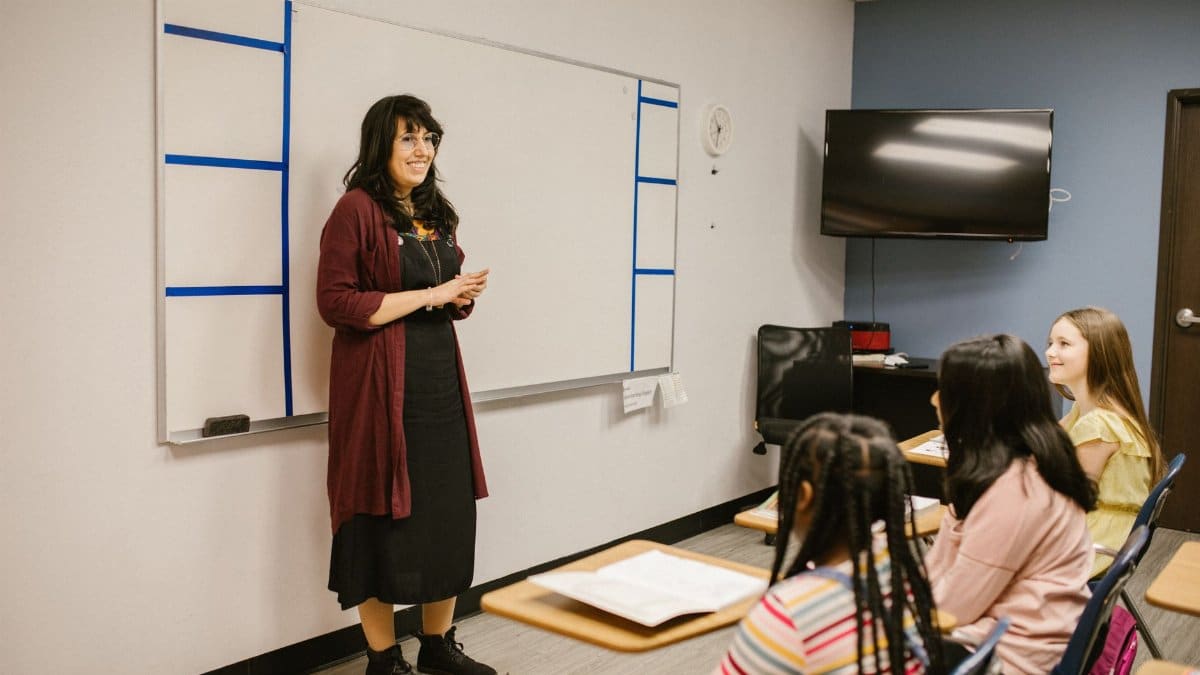
In a season when every Florida school board race seems to carry a national argument, one line has traveled farther than most policy memos. The debate over Erika Donalds classroom technology puts a blunt claim at the center of the room: even strong teachers, the argument goes, can stand between students and tools that might raise reading and math. I have sat through enough parent nights to know that sentence will not land softly. It treats the person at the front of the class as a bottleneck rather than a guide, and it arrives just as families are still sorting what screens did to attention, homework, and trust.
The claim and the room it entered

The premise is simple enough to fit on a campaign card. Technology, properly used, can lift basic skills. Teachers, even good ones, slow that adoption. The Miami Herald framed the argument in political terms because Erika Donalds is not a distant vendor. She is a former school board member, a prominent voice for school choice, and the wife of Representative Byron Donalds. When she speaks about classrooms, listeners hear both an education theory and a political project.
That mix matters. A product pitch can be tested in a pilot. A political claim about who blocks progress tends to harden into teams. One side hears a long overdue challenge to inertia. The other hears a dismissal of professional judgment dressed up as innovation. Neither reaction, by itself, tells a parent whether a given tool helps a third grader decode a sentence.
Who is speaking, and from where
Erika Donalds has spent years inside Florida education fights, from local board service to advocacy for alternatives to traditional districts. Supporters describe her as someone willing to say that the system protects adults. Critics describe her as someone willing to weaken public institutions in the name of choice. Both descriptions can be true in part without settling the narrower question of software, devices, and instructional time.
Her public profile also means her comments do not stay in a conference breakout. They move through partisan media, parent groups, and legislative talking points. A remark about teachers and tools becomes evidence in a larger case about who should run schools. That is why a technical argument about platforms now sits beside arguments about curriculum, charters, and classical models. The technology is never only the technology.
What the tools are supposed to do

Classroom software is not one thing. Some programs drill phonics for a few minutes a day. Some adapt math problems to a students pace. Some replace whole lessons with videos and quizzes. Some exist mainly to collect data for administrators. Lumping them together as tech makes the debate easier and the evaluation worse.
The optimistic case is familiar. A well built program can give immediate feedback, free a teacher to work with a small group, and notice a pattern of errors that a busy adult might miss. In reading, that might mean more practice on sound letter links. In math, it might mean fewer students sitting through a lesson they already know or cannot yet follow. The pessimistic case is equally familiar. Screens fragment attention, weaken discussion, and turn class into a queue of logins. Both cases have walked into real schools. The slogan rarely admits the split.
Why teachers become the obstacle in this telling
When advocates say teachers block tools, they usually mean something more specific than hostility to computers. They mean slow procurement, union rules, comfort with older methods, fear of being replaced, or a reasonable doubt that the next platform will survive the school year. From the outside, that can look like refusal. From the inside, it often looks like triage. A teacher who has watched three systems fail in five years is not automatically anti progress. She may be protecting instructional minutes.
There is also a status fight hidden in the language. If software is the hero, the adult in the room becomes a gatekeeper. If the adult is the hero, software becomes a supplement that must earn its place. Erika Donalds classroom technology, as a phrase in the current fight, leans hard toward the first story. It assumes the gains are available and the main variable is willingness. That assumption is the part worth testing, not chanting.
Reading and math as the only scoreboard that counts
The promise attached to these tools is not vague enrichment. It is higher reading and math performance. That is the right place to look, and also a hard place to look. National assessments have shown stubborn weakness in basic skills, especially after the pandemic years, and Florida has its own mix of gains and gaps depending on grade and subject. A statewide average cannot tell you whether a particular app in a particular classroom moved a particular child.
Parents still deserve a plain standard. Did more students read with accuracy and understanding. Did more students master the math the next grade assumes. Did the gain survive when the novelty wore off. A vendor dashboard that reports time on task is not that standard. Neither is a teachers impression alone. The useful middle is boring: a clear skill, a comparison group or at least a before and after, and a willingness to drop what does not work.
For a public picture of where American students stand, the National Assessment of Educational Progress remains the clearest shared reference, published through the National Center for Education Statistics at https://nces.ed.gov/nationsreportcard/. It will not bless or bury any one Florida platform. It does remind everyone that slogans about scores have to survive contact with actual scores.
Choice schools and the hope of a cleaner experiment

Part of the appeal of charters, microschools, and scholarship programs is the chance to try a model without waiting for a district consensus. Donalds and allied advocates have long argued that families should be able to leave schools that will not change. In that frame, technology is one more reason exit should be easy. If a campus will not adopt tools that raise results, parents should find a campus that will.
Exit can reveal preference. It does not automatically reveal quality. A new school can adopt devices quickly and still teach poorly. A traditional school can move slowly and still produce strong readers. The political energy around choice sometimes treats speed of adoption as a proxy for seriousness. Speed is a management fact. Learning is a different fact. Conflating them is how expensive pilots become permanent furniture.
The human friction no platform cancels

Even a strong program needs an adult who knows when to turn it off. A child who is guessing through a reading exercise is not practicing reading. A child racing math items for points may be practicing clicks. Teachers see that in the room. Engineers see aggregates later, if they see it at all. Calling that supervision an impediment flattens a real skill into obstruction.
There is another friction that software cannot charm away. Trust. Families who felt ignored during remote stretches are wary of anyone who sounds sure that more screen time is the path back to fluency. Teachers who felt blamed for every missed benchmark are wary of anyone who sounds sure the barrier is their attitude. Erika Donalds classroom technology becomes a proxy war for those feelings. The proxy is poor. Attitude and design both matter, and so does whether the tool was chosen by people who will live with the results.
What evidence can honestly carry

Some instructional programs have credible studies. Many do not. Education research is full of small samples, short trials, and results that fade when a motivated pilot teacher leaves. A careful reader looks for independent evaluation, not a brochure. The Institute of Education Sciences What Works Clearinghouse, at https://ies.ed.gov/ncee/wwc/, is one public place to see how uneven that record is. Absence from such a list is not proof of failure. Presence is not proof that a district should buy a thousand licenses tomorrow.
Honest advocacy would sound slower than a rally. Name the skill. Name the grade. Name the time taken from other instruction. Name what happens if the gain is small. The current claim, that teachers are the biggest impediment, skips those sentences. It locates the problem in a profession rather than in a product, a schedule, or a budget. That location is politically useful. It is analytically thin.
Politics at the kitchen table

Byron Donalds national profile guarantees that his wifes education comments will be read as party signaling, whether or not that was the intent on a given day. Democrats hear an attack on public school labor. Republicans hear a defense of parents against a system that will not modernize. Both audiences can quote the same sentence and leave the classroom untouched.
Kitchen table politics is less tidy. A parent may want school choice and still want a teacher, not an app, to notice that a child is guessing. A teacher may distrust a political brand and still want software that handles fluency practice so she can teach comprehension. The argument gets worse when each side requires the other to be either a hero or a villain. Impediment is villain language. It recruits. It does not diagnose.
A narrower test than the headline

If the goal is higher reading and math, the useful question is not whether teachers are the biggest barrier in the abstract. The useful question is which decisions, by whom, keep a proven practice from reaching students, and which decisions keep an unproven practice from wasting their time. Sometimes the block is a contract. Sometimes it is a skeptical veteran who has been right before. Sometimes it is a board member in a hurry.
I do not think families are served by pretending those cases are the same. A profession can be slow and still be the difference between a tool that teaches and a tool that occupies. A political movement can be right that some schools resist change and still be wrong about what the change should be. The adult task is to separate those errors.
What parents can ask without joining a camp

A parent does not need a theory of the whole system to ask practical questions. What skill is this program meant to move. How many minutes a week does it take. What do teachers see that the dashboard misses. What will the school stop doing if this does not work by a set date. Those questions are available in a district school, a charter, or a small private program. They do not require anyone to decide that teachers are the problem or that technology is the villain.
They do require adults to tolerate mixed answers. A tool can help fluency and hurt discussion. A teacher can be excellent and still cling to a weak worksheet. A politician can spotlight a real failure and wrap it in a claim too large for the evidence. Sorting that mix is the work. It is slower than a headline, and it is the only way the headline becomes useful.
Where the argument should go next
The fight around Erika Donalds classroom technology will not end with a white paper. It will keep showing up in hearings, donor briefings, and parent chats because it bundles choice, labor, and the fear that children are falling behind. The responsible move is to unbundle it. Credit the concern for basic skills. Refuse the habit of naming a whole profession as the obstacle. Demand proof that a specific tool, in a specific setting, does what its champions say.
Schools are full of impediments, and some of them wear no name tag. Outdated materials, chaotic schedules, weak training, and products sold on charm all get in the way. Teachers belong in that list only when the evidence puts them there, case by case. Until then, the more honest sentence is plainer. The biggest impediment to better reading and math is any adult, in any role, who will not show the work.