
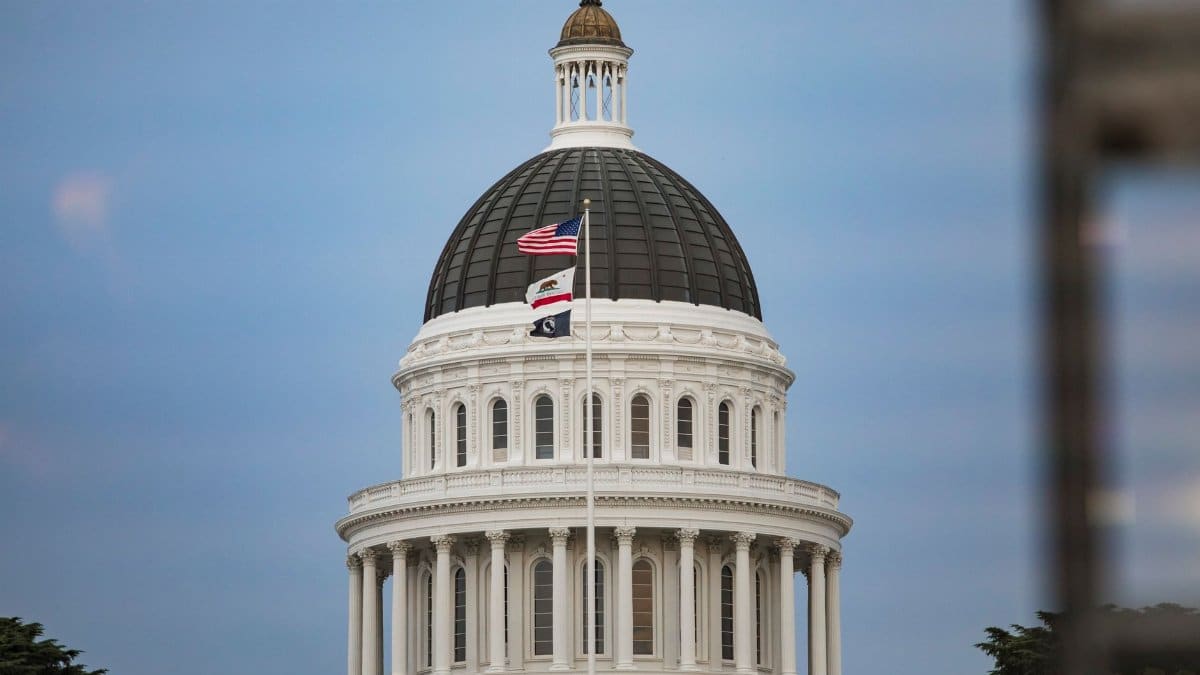
On a weeknight when many Californians were still adding up rent, gas, and the grocery run, two men with very different political biographies stood under studio lights and mostly talked past the state they hope to govern. The Becerra Hilton governor debate did not open new ground so much as it confirmed a campaign already narrowed to two attack lines. Xavier Becerra kept returning to Donald Trump. Steve Hilton kept returning to prices. Viewers who stayed through the hour heard variations on those themes, not a fresh map of how either man would run a state of nearly forty million people. The repetition was the story.
A stage built for contrast
Becerra arrives with the resume of a former state attorney general and a former United States health secretary. Hilton arrives as a commentator and a critic of the Democratic government that has run Sacramento for years. A meeting between those two figures could have been a hard look at power, competence, and ideology. The evening worked more like a sorting machine. Each candidate had a preferred villain, and the format let him return to that villain whenever a question started to drift. Contrast was promised. Discipline is what showed up.
Why Trump remained the Democratic refrain
For Becerra, the Trump line is not a stray applause line. It is a theory of the election. California Democrats have won statewide races for a generation by treating national Republican leadership as a threat to rights, climate policy, and the social safety net. His version of that argument asks voters to see the governor’s office as a firewall. The risk is just as familiar as the argument. A national villain can crowd out a state agenda. When every answer bends back toward Washington, a viewer in Fresno or Oakland still does not learn how the candidate would set a budget, staff a crisis, or bargain with a Legislature that is nothing like a debate stage.
Some of the stakes he invokes are real. Federal power reaches hospitals, campuses, immigration courts, and state budgets. A governor who pretends otherwise is selling comfort. A governor who talks about little else is selling a shortcut. The difference matters, and it is the difference a debate is supposed to force into the open.
Hilton and the daily bill
Hilton’s counter was equally disciplined. The cost of living is the grievance that crosses party lines in California, from renters in Los Angeles to homeowners shocked by insurance, from parents tracking child care to commuters who treat a tank of gas as a political fact. His attack treats Democratic governance as the author of scarcity: too much regulation, too little housing, too many promises that never lower a bill. That argument has force because people can check it against their own week. It also has a limit. A price tag is not a program. Saying life is too expensive does not specify which rules to scrap, which taxes to change, or which tradeoffs a governor would accept when builders, unions, cities, and the coast all claim a veto.
California’s prices are not a talking point invented for television. They are why people leave, why adult children stay in childhood bedrooms, and why a routine medical bill can wreck a month. A candidate who names that pain has earned a hearing. He has not yet earned a vote if the next sentence never arrives.
Repetition as strategy, not accident

Anyone who has watched a modern debate knows candidates are trained to pivot. What stood out in the Becerra Hilton governor debate was how little either man seemed interested in disguising the pivot. Repetition is a media strategy. Clips travel farther than nuance. A clean attack line can be replayed on a phone between shifts. Becerra’s Trump refrain and Hilton’s price refrain are built for that economy of attention. The trouble for voters is that a line designed to travel is rarely a line designed to govern. It names an enemy. It does not rank priorities when the budget cannot fund every promise.
Campaigns will call this message discipline. Sometimes that phrase means a candidate knows what he believes. Sometimes it means he has been told not to wander into an answer that cannot be cut into twenty seconds. The second meaning was the one the night kept suggesting.
What a useful hour would have demanded

A useful debate pushes a candidate off the prepared path. Housing requires a number and a place: how many units, where, and against whose objections. Homelessness requires a standard for care, compulsion, and cost. Energy requires a choice between speed and price. Water, wildfire, and insurance require a sentence a donor might dislike. None of those subjects is simple. That is why they matter in a governor’s race. If they function mainly as scenery for a larger attack, the public learns who is angry and not what would change on a Tuesday in Sacramento.
This is not a plea for wonkery for its own sake. Voters do not need a seminar. They need one verifiable commitment they can remember without a staffer’s help. The Becerra Hilton governor debate, as framed by the coverage that followed, kept offering the enemy instead.
Two parties, one habit

It would be easy to treat the night as a personality clash. Becerra is institutional. Hilton is insurgent in tone, even where a voter cannot yet inspect every policy detail. The deeper habit belongs to both parties. Democrats in this state often campaign as if the national Republican Party is the only subject that can mobilize a majority. Republicans often campaign as if naming the cost of Democratic rule is itself a governing plan. Both habits can win a news cycle. Neither habit answers a parent who wants a school, a clinic, and a lease that will still exist next year. The Becerra Hilton governor debate put that shared habit on camera.
What the office can and cannot do

The job is powerful and limited at once. A governor signs or vetoes bills, proposes a budget, appoints judges and agency heads, and becomes the face of disaster response. A governor does not set federal immigration law, does not print currency, and does not alone cut the price of eggs. Voters deserve candidates who mark that boundary out loud. When Becerra talks about Trump, part of the warning is legitimate. When Hilton talks about prices, part of the indictment is legitimate. The honest version of each attack would admit what Sacramento can do this year and what it cannot. The version built for a clip admits less, because admission sounds like weakness in a room trained to reward certainty.
The audience outside the studio

Debates are often graded by consultants before they are heard by anyone who works a night shift. That grading rewards a clean hit and punishes a pause. Yet the audience that will decide a California primary is larger than the room. It includes voters who mute politics until a ballot arrives, and voters who follow every endorsement. For the first group, a repeated attack may be the only impression that sticks. For the second, repetition can sound like avoidance. A campaign that speaks only to the clip risks teaching the careful viewer that there is no second paragraph waiting at home.
There is also a geographic audience the studio rarely flatters. The Central Valley does not hear a coastal argument the same way Los Angeles does. A renter in San Jose and a grower outside Fresno can both be angry about costs and mean entirely different remedies. A debate that flattens those differences into one villain is easier to produce. It is worse as a guide to governing.
If this was the only night

Coverage described the event as California’s likely only debate in the race. If that description holds, scarcity raises the cost of what goes unsaid. One night cannot cover a state this large. It can show whether candidates treat voters as adults. A single exchange that traded a slogan for a tradeoff would have been more memorable than another pass at the same target. Campaigns will say there is still time for policy papers and town halls. Those events draw the already convinced. A debate is one of the few rooms where rivals must share a clock and absorb the same question.
Scarcity also tempts exaggeration. Supporters will declare a knockout that neutral viewers did not see. Opponents will declare a collapse that the tape does not support. The plainer reading is less exciting and more useful. Two experienced talkers stayed inside lanes they trust. That can be competent politics. It is a thin public service when the lane is the whole hour.
The test that comes after the lights

The morning after a debate, staffers count mentions and donors count momentum. The more useful count is simpler. Did either candidate leave a voter with a sentence that could be checked later? Becerra’s sentence, stripped of theater, is that California needs a governor ready to resist Trump. Hilton’s sentence is that California needs a governor who will treat high prices as a failure of government, not as weather. Both sentences can be true as far as they go. Neither sentence tells a legislature what to pass in March.
Californians have lived through enough campaigns to recognize the pattern. National danger on one side. Household pain on the other. The pattern persists because it works on people who are busy, frightened, or simply tired of being asked to decode jargon. Recognizing the pattern is not the same as accepting it as the end of the argument.
What would break the loop

Breaking it would not require a personality transplant. It would require each man to spend his next public hour on the attack he likes least. Becerra would have to say, in numbers a budget writer could test, how a Democratic governor lowers a bill without pretending Washington is the only author of the bill. Hilton would have to say, in language a union hall and a planning commission could both understand, which protections he would keep when he promises to move faster and cheaper. Until that happens, the race will keep sounding like a closed circuit.
The Becerra Hilton governor debate did not push either man that far. Another forum still could: a long interview, a budget hearing, a town hall where the questioner is allowed a follow up. Voters should ask for that forum, and they should treat a recycled villain as incomplete until the second sentence shows up. California already knows the two attack lines. It is still waiting to hear what either candidate does when the line runs out.