
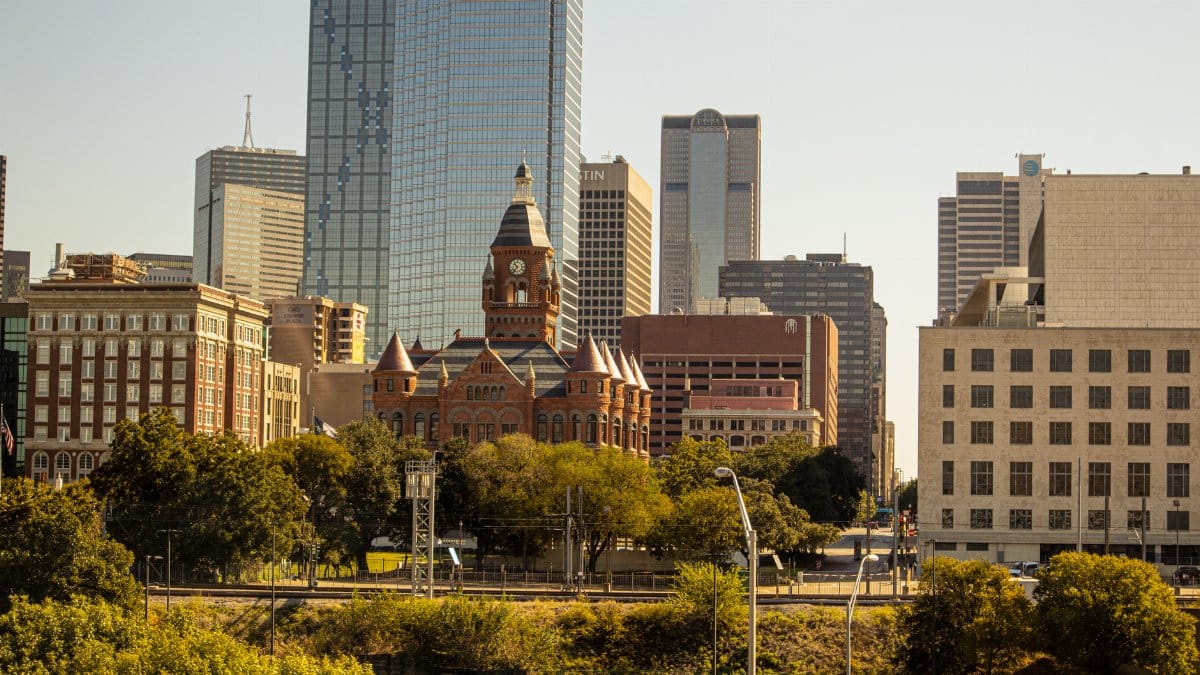
On a bright weekday morning the concrete plaza in front of Dallas City Hall still does what it was built to do. It gathers people, slows them, and makes the building behind them feel larger than any single meeting inside. A small group of volunteers stands near the steps with petitions, asking strangers whether the city should be required to consult voters before it abandons this address. Their effort, framed as a Dallas City Hall referendum, is an attempt to put a stay or go question on a future ballot and to force a public argument that has mostly lived in briefing memos and staff presentations. The landmark, designed by I.M. Pei and opened in the late 1970s, is both a working seat of government and a piece of civic sculpture. Supporters say that combination is worth a direct vote. Skeptics say memory should not dictate where a city does its business.
A petition that treats the address as a public question
The drive is simple in its ask and complicated in its consequences. Organizers want registered voters to sign a petition that would place a Dallas City Hall referendum before the electorate, with civic leaders pressing for a question in 2027 on whether municipal government should remain in the Pei building. The point is not to redesign the charter in one stroke. It is to interrupt a relocation conversation before land deals, moving plans, and architectural studies harden into a decision that feels inevitable.
In a city where major projects often advance through council votes, bond packages, and staff recommendations, a citizen petition is a slower instrument. It depends on clipboard work, neighborhood meetings, and the patience of people who may never attend a zoning hearing. That slowness is part of the appeal for supporters. They argue that a building this visible should not change roles without a broader consent than a single council term can supply.
Why the calendar points toward 2027

Timing is the quiet engine of the campaign. A ballot question in 2027 would arrive after the immediate scramble of budget seasons and after voters have had time to hear competing estimates of repair, relocation, and lost opportunity. It would also arrive before any move could be treated as a finished fact. Advocates want the interval used for plain explanation: what the building needs, what a new home would cost, and what the present site could become if government left.
Delay has a price. Concrete weathers. Mechanical systems age. Staff who work in awkward layouts do not experience the building as a postcard. Organizers accept that tension. They say a rushed departure would trade one set of problems for another, while a dated ballot gives residents a chance to judge the trade with more than a rendering in hand.
The building that still argues with the skyline
Pei’s City Hall is not a shy building. Its sloping facade, deep overhang, and broad plaza were meant to announce that Dallas had arrived as a city of ambition, not merely of commerce. For some residents the result still looks like confidence poured in concrete. For others it looks like a fortress that turns its back on the street and asks too much of anyone trying to find a hearing room.
That split is older than the current petition. Architectural fame does not guarantee affection, and affection does not pay for elevators, roofs, or accessible entries. The referendum push treats the split as something voters can hold at once. A landmark can be difficult and still be worth keeping. A landmark can also be famous and still be the wrong place to run a government in the middle of this century.
What staying would actually require

Remaining is not a romantic vote for the status quo. Anyone who has waited in a crowded lobby or hunted for a meeting on an upper floor knows the building asks for patience. Accessibility, energy use, security, and the ordinary wear of a public workplace all sit on the same ledger as the celebrated exterior. A decision to stay would be a decision to fund a long repair, not a decision to freeze the past in place.
Supporters of the petition do not pretend otherwise. Their claim is narrower. They say residents should see the repair bill beside the cost of leaving, and should be allowed to prefer the known building if the numbers and the civic meaning line up. In that framing, preservation is not a refusal to spend. It is a choice about where the spending lands.
What leaving would set in motion

A move would open more than a new front door. It would vacate a large public site near the center of downtown, invite developers and planners into a rare parcel, and scatter departments that now share one address even when they do not share an outlook. Some civic voices see that scatter as a chance to put services closer to residents. Others see it as a loss of a single, legible place where Dallas can be found.
There is also the matter of what replaces the building, or what happens if it remains standing without its original tenant. An empty icon can become a preservation puzzle of its own. A sold site can become housing, offices, or open land, each with champions and opponents. The petition does not settle those futures. It tries to keep them from being settled offstage.
Money, maintenance, and the language of necessity
City hall debates often slide into the language of necessity. Officials describe systems that are failing, layouts that no longer match the work, and estimates that make a new building look cleaner on a spreadsheet. Residents hear those warnings and also hear a familiar pattern: a hard number arrives late, a preferred option arrives early, and the public is asked to ratify a conclusion rather than to compare live alternatives.
The petition campaign is, in part, a protest against that pattern. It does not require voters to distrust every engineer. It asks them to treat cost as one fact among others, including the cost of disrupting a known civic address and the cost of undervaluing a work of architecture that other cities would struggle to replace. Whether that balance persuades a majority is precisely what a ballot is for.
Who is willing to stand with a clipboard

Signature drives reveal a city’s unglamorous politics. They favor people with time, people with networks, and people who can explain a complicated building in a sentence at a grocery line. The organizers behind this effort present themselves as civic leaders rather than as a single faction of preservationists. Their message is that the question belongs to renters and homeowners, downtown workers and neighborhood voters, not only to architects and former mayors.
That claim will be tested by the map of signatures. If names cluster in a few precincts, opponents will call the drive a boutique campaign. If they spread across the city, the council will have a harder time treating relocation as a technical matter. Either way, the petition is already doing cultural work. It is teaching people that the address of government is a political subject, not a facilities footnote.
How a ballot question would and would not bind the city
Voters sometimes imagine a referendum as a magic switch. In practice, a Dallas City Hall referendum would direct policy within the limits of the charter, the budget, and the courts. A vote to remain would still require appropriations, design work, and years of construction inside an occupied building. A vote that failed to block a move would not, by itself, design the next city hall or assign the old site to a particular use.
Clarity on the ballot will matter as much as passion in the campaign. A muddy question invites litigation and buyer remorse. A plain question, asking whether the city should stay in the Pei landmark rather than relocate its seat of government, gives both sides a fair fight. Organizers say that plainness is the standard they want. Opponents will watch the wording with equal care, because a loaded phrase can win a signature and lose a lawsuit.
Memory is not the same thing as a plan
Middle aged Dallas residents can remember the building as a backdrop for protests, inaugurations, holiday crowds, and ordinary errands that happened to require a city stamp. Younger residents may know it mainly from photographs or from the inconvenience of parking. Both memories are real. Neither is a capital plan.
The mature argument, the one this petition is trying to force into daylight, separates affection from analysis without discarding either. A city can honor a landmark and still conclude that government should sit elsewhere. A city can also conclude that the landmark’s inconveniences are the price of a public room that still means something when people gather in front of it. Pretending the choice is only sentimental, or only financial, flattens a decision that will shape downtown for decades.
The risk of turning a workplace into a symbol

There is a fair critique of the whole effort. City employees need desks, secure records, accessible counters, and meeting rooms that do not exhaust the people who use them. A referendum can elevate symbolism until the daily work of government becomes an afterthought. If the campaign speaks only about Pei and never about permits, juries, and public meetings, it will deserve that critique.
The stronger version of the stay argument treats workers as part of the public, not as an obstacle to beauty. It asks whether a repaired building can serve them better than a relocated one, and whether the plaza’s civic role is worth the trouble of construction that must happen around a living institution. That is a harder speech to give at a petition table. It is also the speech that will matter if the question reaches a ballot.
What other cities have learned the hard way
Dallas is not the first city to discover that a famous city hall can become a maintenance crisis and a political identity at the same time. Elsewhere, governments have restored difficult modern buildings, sold them, or abandoned them to uncertain second lives. The lessons travel poorly when they are reduced to slogans. Climate, charter rules, downtown land values, and the local appetite for taxes all change the arithmetic.
What does travel is the process lesson. Cities that hide the alternatives until a preferred deal is nearly closed tend to breed distrust that outlasts the building itself. Cities that put the tradeoffs in public, even when the numbers are unwelcome, tend to get a sturdier mandate. The petition is a bet that Dallas still prefers the second habit, or can be pushed back toward it.
A question of trust as much as of concrete
Underneath the architecture is a trust problem that many American cities would recognize. Residents are asked to believe long range estimates from institutions they also blame for short term frustration. They are asked to care about a downtown landmark while worrying about streets, schools, and safety closer to home. A ballot measure cannot repair that distrust by itself. It can, at least, refuse to add a new grievance: the sense that the city’s front door was moved while people were looking elsewhere.
That is why the signature drive matters even before it succeeds or fails. It is a demand for a hearing in the one format that cannot be adjourned by a committee chair. Whether the hearing is granted depends on names, deadlines, and legal sufficiency. Whether it is useful depends on how honestly both sides describe the building they are fighting over.
What to watch as the petitions move
The next months will be less photogenic than the plaza. Watch the signature count, the legal review, and the exact sentence voters might someday read. Watch whether council members treat the drive as a nuisance or as a reason to publish clearer comparisons of staying and leaving. Watch whether repair plans and relocation plans are described with the same level of detail, because unequal detail is a form of argument.
If the Dallas City Hall referendum reaches a 2027 ballot, the city will have chosen a slow argument over a quiet departure. If the petition falls short, the debate will not disappear. It will return to briefings, budgets, and the private calculations of people who know how hard it is to move a government and how hard it is to keep a famous building honest about its age. Either path leads back to the same plaza, where the concrete still gathers strangers and asks them, without sentiment, what this city owes its own front door.