

At a gate in Chicago, the departure board did not go dark all at once. It simply stopped making sense. A flight to Denver sat at the jet bridge with the door open and the cabin crew waiting for a clearance that never arrived on their screens. Passengers refreshed airline apps and watched the same estimated time hold still. What began as a routine Monday morning became, for more than ninety minutes, a United Airlines outage that delayed departing flights across the carrier network, days after a separate failure inside the Federal Aviation Administration had already reminded the country how little slack exists in the sky.
A morning when the screens stopped agreeing

Travelers described a peculiar kind of stillness. The airport itself was loud. Carts rolled. Announcements continued for other carriers. Coffee lines moved. Yet United gates developed the hush that arrives when nobody in a uniform can say when a door will close. Estimated departure times froze, then jumped, then froze again. Some customers received text messages about delays. Others learned the news only when a gate agent stepped to the podium and admitted that company computers were not responding as they should.
That gap between what a phone shows and what a person at the counter can confirm is now a familiar feature of modern travel. Airlines have spent years pushing customers toward apps, kiosks, and automated rebooking. Those tools are fast when the underlying systems are healthy. They are mute when they are not. On Monday the mute period lasted long enough to turn a technical stall into a visible operational one. Aircraft that were otherwise ready to leave remained at the gate because the paperwork of flight, much of it digital, could not be completed with confidence.
Departures stalled while arrivals kept moving
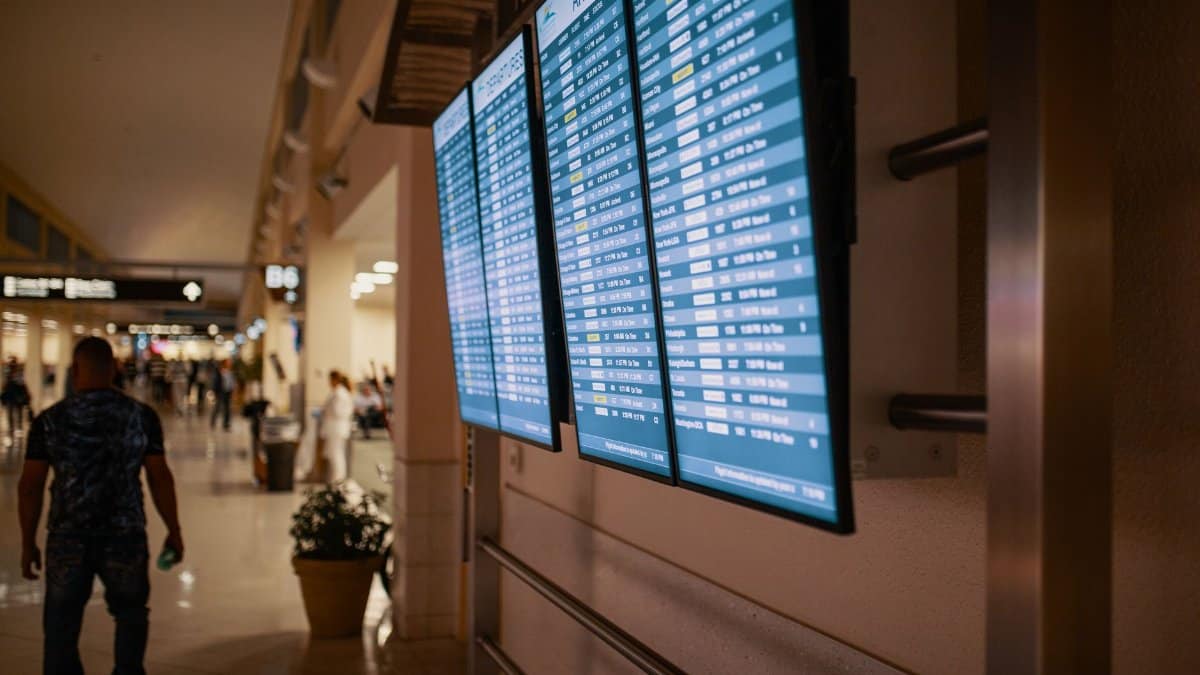
The shape of the disruption mattered. Reports from airports and from the airline itself pointed to departing flights as the flights held back, rather than a blanket order that every United jet stay on the ground. Arrivals could still taxi in. Bags could still come off belt loaders. The problem was getting the next trip released. In airline operations that distinction is everything. A delayed departure is not only a late takeoff. It is a late aircraft for the next city, a crew whose legal duty day keeps shrinking, and a gate that cannot accept the airplane scheduled to use it an hour later.
An outage of roughly ninety minutes sounds brief if you are sitting at a desk. In a bank of morning departures it is an eternity. United runs a dense schedule through hubs in Chicago, Houston, Denver, Newark, and San Francisco, among other cities. Miss the first wave and the second wave inherits the damage. Even after computers return, the recovery is not a switch. It is a negotiation among gates, crews, fuelers, and air traffic control, conducted while thousands of people refresh a screen and hope their name is not the one that rolls to the next day.
The memory of a nationwide ground stop

The timing made the morning feel larger than a single carrier glitch. Only days earlier, a failure in an FAA network had triggered a nationwide ground stop, the rare order that tells airlines to keep flights from departing until controllers and dispatchers share a reliable picture of the sky. That episode was not a United problem. It was a public infrastructure problem, and it grounded the industry in a way passengers still felt in rebooked itineraries and thin spare aircraft.
Two failures in close succession do not prove a single cause. They do prove a shared vulnerability. Commercial aviation depends on layers of computers that passengers never see: flight planning, weight and balance, crew legality, maintenance signoff, gate assignment, and the messages that pass between an airline and the air traffic system. When any important layer hesitates, the airplane, which is a physical object of extraordinary reliability, waits on a data path. The public experiences that wait as confusion. The industry experiences it as a reminder that software has become as operational as the engine.
What the airline could confirm
In the first hours, confirmation was thinner than rumor. Airline statements in events like this tend to be short on purpose. A carrier will say that a system issue is affecting departures, that safety is not in question, and that teams are working to restore service. Those sentences are true and also incomplete. They do not tell a family in a connecting city whether the inbound crew will time out. They do not tell a business traveler whether the afternoon bank will run or merely pretend to run.
What could be said with care was this. The United Airlines outage lasted long enough, more than an hour and a half, to force delays of departing flights on a Monday. It was a company system problem, distinct from the FAA network failure that had produced a nationwide ground stop days before. Safety officials did not describe it as an airworthiness emergency. The harm was measured in time, missed meetings, hotel nights, and the slow unsnarling of a schedule, not in injuries. That is a mercy. It is not a small thing.
How a single system can freeze a fleet
People outside the industry sometimes imagine that a pilot can simply decide to go. In practice a departure is a stack of permissions. Dispatch releases the flight. A load planner closes the weight numbers. Maintenance releases the aircraft if any item was open. The gate agent closes the flight in a reservation system so that the passenger count matches the manifest. Crew scheduling confirms that the pilots and flight attendants are legal to work the trip. If one of those systems cannot answer, the stack stops, even if the sky is clear and the engines are fine.
That architecture is not an accident. It exists because aviation learned, over decades, that informal workarounds cause worse harm than delays. A wrong weight figure or an illegal crew pairing is not a customer service issue. It is a safety issue. So when computers fail, airlines are right to refuse improvisation that bypasses the record. The cost of that caution is visible at the gate. The benefit is mostly invisible, which is why travelers understandably experience caution as bureaucracy. The honest description is stricter. The United Airlines outage showed a system choosing delay over an incomplete departure, and then struggling to explain that choice in plain language while the line grew.
The hidden work of getting crews legal again

Once service returns, the clock does not reset. Federal duty rules limit how long pilots and flight attendants may work, and those limits do not pause because a vendor server was slow. A crew that boarded on time and then sat for ninety minutes may no longer be legal for a long segment, or may be legal only if the airline trims the rest of their day. Finding a replacement crew in a hub at midmorning is possible. Finding one in a smaller city, after the only scheduled pairing has already been broken, is harder. Deadheading a reserve crew burns another seat and another hour.
Aircraft face a similar puzzle. A jet delayed in Chicago is not sitting in Denver for its next departure. Schedulers pull spare aircraft when they have them. On many weekdays they do not, because airlines have spent years flying fuller fleets with fewer idle tails. That efficiency looks brilliant in a quarterly report. It looks brittle when ninety minutes of computer silence ripples into a dozen cities by dinner. Recovery then depends on cancellations chosen with a cold logic: protect the banks that feed the hubs, and strand the thinner routes. Passengers on those thinner routes experience the logic as abandonment.
Passengers left to improvise
Customer obligations during an airline caused delay are clearer than they used to be, and still easy to get wrong in the moment. A long delay can entitle a traveler to a refund if the traveler chooses not to fly, even on a nonrefundable fare, under federal rules that treat a significant schedule change as a broken bargain. Meal vouchers, hotel rooms, and rebooking on another carrier are more often matters of policy than of statute, and those policies vary by the cause the airline assigns. A computer failure inside the company is harder to wave away as weather. It is also harder, in the first hour, to code correctly in the reservation system, which is the very system having a bad morning.
That is why the practical advice from veteran travelers sounded almost old fashioned. Keep the boarding pass screenshot. Ask the agent for the delay code when the computers return. Photograph the departure board. If a connection is doomed, do not wait for an app to notice. The United Airlines outage was short by the standard of multi day meltdowns that have scarred other carriers in recent years. It was long enough to separate people who could absorb a lost morning from people who could not: the wedding, the medical appointment, the cruise transfer, the last flight that still made a job interview possible. Those differences do not appear in an operations summary. They are the story.
What resilience should mean after two failures
It would be a mistake to treat Monday as proof that flying is newly unsafe. The opposite reading is available and more precise. Crews and dispatchers declined to launch on incomplete information. The airplanes stayed put. Nobody was asked to trust a shrug. The failure was in availability, not in the decision to wait. Availability, though, is now part of safety in the broad sense passengers mean when they buy a ticket. A network that cannot depart for ninety minutes is a network that has already spent its margin.
After an FAA ground stop and a carrier specific stall in the same stretch of days, the useful questions are unglamorous. Which systems have a tested manual path that crews actually practice, rather than a binder nobody opens? How fast can an airline tell the truth at the gate when the app is wrong? How much spare crew and spare aircraft is enough, given that software will fail again? Regulators have spent appropriate energy on mechanical reliability and on controller staffing. They have spent less public energy on the ordinary commercial systems that decide whether a legal, airworthy flight may leave the gate.
United will owe a plainer accounting than a first morning statement can provide. So will the vendors behind whatever process seized. Travelers do not need a schematic. They need to know whether the United Airlines outage was a contained fault with a known fix, or a symptom of systems that have grown faster than the procedures around them. Until that accounting arrives, the scene at the jet bridge remains the clearest evidence. The door was open. The crew was ready. The clearance on the screen was not. For more than ninety minutes, that was the whole national story of one airline, told quietly, one delayed departure at a time.