
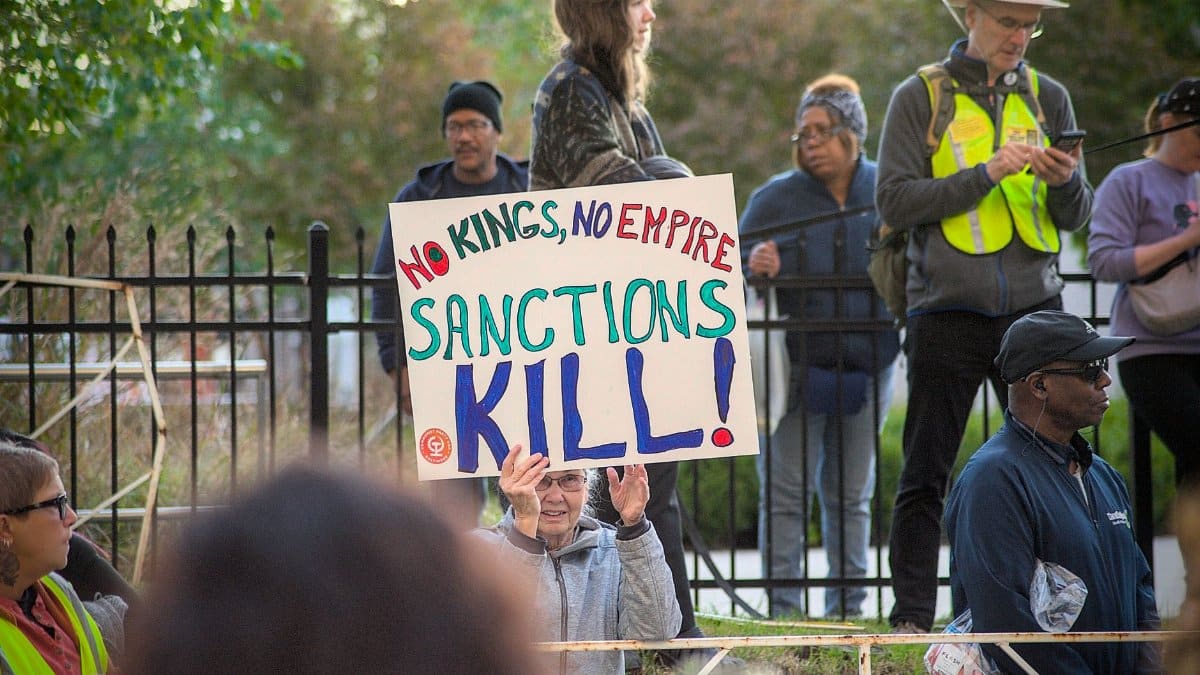
In a notice sent to Capitol Hill this week, the White House told lawmakers that a fresh set of penalties on Moscow would not take effect on the schedule Congress wrote into statute. President Trump signed the measure, then used executive authority to freeze its start, arguing that immediate enforcement would undercut talks and other tools still in play. The phrase that has stuck in Washington is simple and blunt: Trump Russia sanctions hold. For allies who spent months pressing for tougher pressure on the Kremlin, the pause lands as both a legal fact and a political signal. It does not erase the law. It delays the moment when banks, shippers, and energy traders must treat the new rules as binding.
A signed law that does not yet bite

Signing a bill and enforcing it are not the same act. The statute now on the books authorizes or requires restrictions aimed at Russian revenue, procurement networks, and the firms that help move oil, metals, and dual use goods around formal bans. Those restrictions were written to start on a calendar Congress set, with waivers that are narrow and time limited in the text lawmakers passed. The executive order does not repeal that text. It tells agencies to stand down for now, on the ground that immediate application would harm the national interest.
That distinction matters for anyone who has to comply. A bank compliance officer cannot treat a paused rule as if it were already in force, and cannot treat it as if it will never arrive. Lawyers will read the order for its duration, its conditions, and the reports it requires. Diplomats will read it for what it says about leverage. The public will mostly hear a simpler version: the president put the penalties on ice after putting his name on them.
What Congress thought it was buying
The measure grew out of frustration that existing restrictions had not changed Russian behavior in the war against Ukraine, and that evasion through third countries had become routine. Sponsors argued that clearer mandates, tighter definitions, and less room for quiet waivers would force the executive branch to act even when negotiations looked promising. They wanted a floor under policy, not a menu.
Members who voted yes did not all share a theory of victory. Some wanted to starve the war economy. Some wanted to answer European calls for American leadership. Some wanted a record they could defend at home. What they shared was an expectation that a signature would be followed by implementation. A hold, even a lawful one, reopens the argument they thought they had closed. Staff on both sides of the aisle are already asking how often a president can invoke national interest before the statute becomes advisory.
The national interest argument
The White House case, as described to Congress, is that timing is part of strategy. Officials contend that slamming new restrictions into place while channels remain open could harden Moscow, spook partners who still buy Russian energy under price rules, and reduce the value of any later threat. In that telling, a pause is not softness. It is sequencing. Pressure kept in reserve can be more useful than pressure spent on a date chosen by statute rather than by events.
Critics answer that reserve pressure is pressure the target learns to discount. If every hard deadline can be moved by executive order, the Kremlin has less reason to treat deadlines as real. They also note that national interest is a wide phrase. It can cover diplomacy, oil prices, election year politics, or a judgment that allies are not ready to match American steps. Without a public accounting of which interest is being served, and for how long, the phrase explains less than it appears to.
Europe hears a mixed message

European capitals have lived with American sanctions policy as both shield and complication. They want Washington firm on Ukraine, and they also want warning before rules that hit shipping, insurance, and refining. A pause can look like courtesy if it is short and explained. It can look like drift if it stretches while Russian strikes continue.
Officials in Berlin, Paris, and Warsaw will ask practical questions. Will American agencies still police existing bans with the same energy? Will secondary sanctions threats against facilitators stay credible? Will the pause be paired with fresh military or financial support that allies can point to? If the answer to those questions is yes, the hold may be absorbed as tactics. If the answer is vague, governments that already face domestic fatigue will find it harder to argue for their own next round of restrictions. Coordination has always been the fragile part of this regime. Uncertainty in Washington travels quickly across the Atlantic.
Banks, oil, and the cost of uncertainty

Markets do not need a moral theory to react. They need a date. When a rule might start in weeks or might start in months, traders price the ambiguity. Freight rates, insurance premia, and the discount on Russian crude all move with expectations about enforcement, not only with the words in a statute. A hold can ease an immediate squeeze and still raise the long run cost of doing business, because firms hate rules that flicker.
I have watched compliance teams treat ambiguity as a reason to overcomply, not undercomply. Global banks often exit a sector rather than guess where a paused order will land. That can shrink Russian access to finance even before a formal start date, which is a real effect. It can also push trade into smaller, less transparent channels, which is the opposite of what careful sanctions design intends. The Trump Russia sanctions hold therefore cuts two ways in the private sector: it delays a legal trigger, and it invites a scatter of private decisions that no executive order fully controls.
The legal room to wait

Presidents have long claimed space to time foreign policy tools, including restrictions rooted in statute. Courts are slow to second guess national security judgments, and Congress rarely writes sanctions laws with no waiver, delay, or reporting clause at all. The question here is narrower than a constitutional crisis. It is whether this order fits the discretion the new law actually grants, and whether the notice to Congress meets whatever standard the statute sets for explanation.
If the law allows a defined pause and the order stays inside that fence, the fight is political. If the order stretches past what the text allows, members can seek a legislative fix, hold oversight hearings, or, in a sharper clash, try to force implementation through appropriations or a new mandate with fewer escape hatches. None of that happens overnight. Meanwhile agencies must decide how to brief staff, what to tell industry, and how to handle cases already in the pipeline. A hold is an administrative event as much as a diplomatic one.
What the Kremlin is likely to infer

Moscow reads American paper closely, and it reads American hesitation even more closely. A signature followed by a freeze can be spun at home as proof that Washington lacks staying power, or as proof that Washington is saving a blow for later. Russian officials have used both stories before. The more useful inference for them is operational: which entities were about to be named, which banks were about to lose correspondents, which shipping workarounds were about to become too expensive.
A pause gives those networks time. It also gives them a warning. Sophisticated evaders do not wait for the Federal Register. They move contracts, rename vessels, and reroute payments as soon as a bill looks likely to pass. The hold does not rewind that preparation. It may, however, slow the next wave of designations that would have made preparation insufficient. That is the practical stake, beyond the rhetoric of resolve.
Politics at home and the voters who notice

Foreign policy rarely dominates a news cycle unless prices, casualties, or a clear betrayal are in view. This episode has a cleaner hook than most sanctions fights because the sequence is easy to explain. The president signed a Russia bill. Then he stopped it from taking effect. Supporters will say he refused to let Congress box in a negotiation. Opponents will say he signed with one hand and undid the point with the other.
Voters who follow Ukraine aid debates already sort themselves by instinct. Some want maximum pressure and see any delay as a gift to Moscow. Some want fewer foreign commitments and see new sanctions as another open ended entanglement. Many in the middle want consistency: if the government threatens a penalty, it should either impose it or explain, in concrete terms, what it expects in return for waiting. The national interest claim will be judged by whether that explanation arrives, not by whether the phrase sounds serious.
Allies, adversaries, and the credibility ledger

Sanctions work, when they work, because targets and third parties believe the United States will follow through and will coordinate with others who control chokepoints in finance and shipping. Credibility is a ledger. Entries include past waivers, past surprises, and past cases where pressure was sustained for years. A single hold does not zero the ledger. A pattern of holds would.
Adversaries other than Russia are watching the same notice. Governments that face their own restrictions will ask whether statutory deadlines in Washington are firm or negotiable after signature. Partners in Asia who have been asked to limit certain exports will ask whether American patience with Moscow implies patience elsewhere, or whether Ukraine is a special case. The answer should be spoken plainly. Silence lets everyone write the story that suits them.
What would make the pause defensible

A delay can be defended if it is bounded, explained, and tied to a visible test. Lawmakers and allies can reasonably ask for a sunset measured in weeks, not in a vague review. They can ask which diplomatic step the pause is meant to enable, and what happens if that step fails. They can ask which existing enforcement actions will intensify so that the hold is not read as a general easing. They can ask for a public description of the sectors still under active investigation, without tipping every target.
None of that requires the White House to conduct diplomacy on live television. It does require more than a formula. National interest is a conclusion. Congress and the public are owed the facts that support it, within the limits of genuine secrecy. If those facts are thin, the political cost of the pause will exceed any tactical gain.
The clock that still runs

Wars do not pause because statutes do. Ukrainian cities remain under fire. Russian revenue still depends on buyers willing to take legal and reputational risk. European inventories, American politics, and battlefield events will keep moving while lawyers parse an executive order. The Trump Russia sanctions hold is a choice about sequence, not a choice to leave the field.
The next markers are concrete. Watch the length of the order and any renewal. Watch whether agencies issue guidance that narrows or widens the practical effect. Watch whether Congress accepts the explanation or rewrites the mandate. Watch whether partners match, exceed, or quietly relax their own steps. And watch whether Moscow offers anything measurable in return, or simply banks the time.
Presidents are allowed to judge timing. They are not allowed, in a durable political sense, to treat a signature as theater. If the hold serves a defined national interest, the record will show it soon enough. If it does not, the same record will show a law that was enacted, celebrated, and then set aside, with the costs borne by people who took American commitments at face value.