
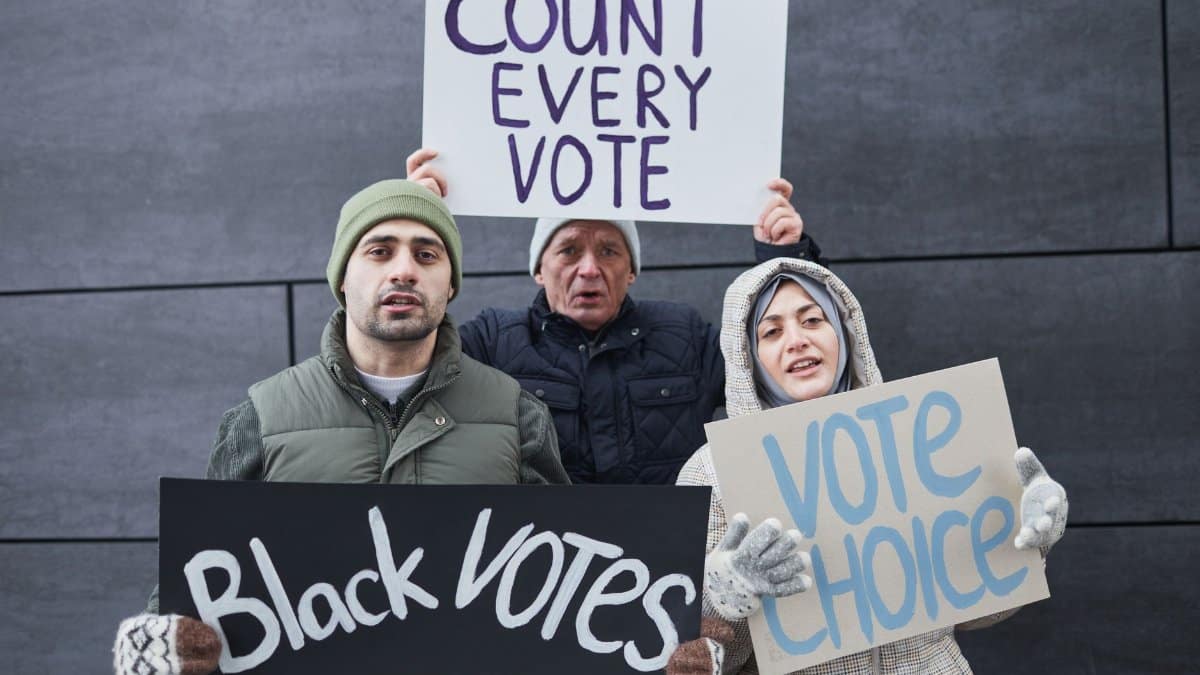
On a quiet Friday in Austin, a legal fight that had hovered over a Latino civic organization for two years simply stopped. Texas Attorney General Ken Paxton dropped the Jolt Initiative lawsuit, closing a case that had sought to dissolve the group over claims of illegal voter registration. For people who spend their weeks urging young Latinos to fill out forms and show up at the polls, the notice felt less like a parade than like a door that had finally stopped rattling. The paper war was over. The argument underneath it was not.
What the case asked a court to do

Dissolution is an unusual remedy in a dispute over how a civic group does its work. Ordinary enforcement might mean a fine, a consent order, or a demand that records be produced and practices changed. A suit that asks a judge to put an organization out of existence treats the group itself as the problem, not a particular form, training session, or volunteer. That is the posture the Jolt Initiative lawsuit took when it was filed. The state did not merely question a stack of registration cards. It asked, in effect, whether the organization should be allowed to keep operating at all.
For readers outside Texas politics, the distinction matters. A nonprofit can survive a penalty and reform a process. It cannot easily survive a judgment that erases its legal life. Staff lose a workplace. Donors lose a vehicle. Young people who had treated the group as a first door into public life lose the room where someone explained a ballot in plain language. Even if a later court had rejected the request, the filing alone told every similar organization that the outer boundary of state power was being tested.
Who Jolt Initiative is

Jolt Initiative is a Latino civic group whose public mission centers on participation, especially among younger Texans who are often told that politics happens somewhere else. Its work, as described by the organization and by news accounts of the case, includes voter registration and the ordinary labor of civic education: explaining deadlines, answering questions about identification rules, and treating a first vote as something a person can learn rather than something a person is born knowing.
Groups of this kind rarely look powerful from the outside. They run on small staffs, borrowed church halls, campus tables, and the patience of volunteers who can explain a form without talking down to the person holding the pen. Their influence is cumulative. One Saturday does not swing a statewide race. A decade of Saturdays can change who feels entitled to stand in line. That slow accumulation is precisely why fights over registration work draw so much heat. The prize is not a single election night. It is the shape of the electorate over time.
The attorney general and the filing

Ken Paxton has made election enforcement a defining part of his public identity. As attorney general he has repeatedly framed strict oversight of registration and voting as a defense of lawful elections, and he has used the civil powers of his office against groups whose methods he disputes. Supporters hear in that record a promise that rules will be enforced without apology. Critics hear a pattern in which Latino led and Democratic leaning civic work draws disproportionate suspicion.
The filing against Jolt sat inside that larger argument. It did not require a reader to pick a side in order to see the stakes. An attorney general has tools that private critics do not: subpoenas, court complaints, and the ability to force an organization to spend money on lawyers instead of organizers. Those tools are lawful when used within their bounds. They are also heavy. A two year case can exhaust a group even if the group ultimately wins, or even if the state later decides the case is no longer worth pressing.
Claims about voter registration

The core accusation, as summarized in public accounts of the dispute, was illegal voter registration. That phrase covers a wide field, and the width is part of the problem. It can mean forged cards, pressure on people who are not eligible, or sloppy handling of forms that the law treats as the responsibility of the person or group collecting them. It can also be invoked, fairly or not, against aggressive but lawful outreach in communities where registration rates have historically lagged.
Texas law places real duties on anyone who helps another person register. Deadlines, delivery rules, and eligibility standards are not suggestions. A civic group that treats those duties casually invites legitimate scrutiny, and no serious defense of voting rights requires pretending otherwise. At the same time, an accusation is not a finding. For two years the claims hung over Jolt without a final judgment that would have told the public, in a durable way, what had been proved and what had not. Dropping the case ends the threat of dissolution. It does not publish a verdict.
How the group answered

Jolt and its allies treated the suit as an attempt to punish lawful participation rather than to correct a discrete violation. Their public posture, reflected in coverage of the fight, was that registering Latino voters is not a suspect act and that the state had chosen a remedy out of proportion to any alleged mistake. They argued in the court of public opinion, and presumably in actual court filings, that civic organizing should not be equated with fraud simply because the people being organized are young and Latino.
That answer has a moral force and a practical limit. Moral force, because citizenship in a diverse state cannot mean that some communities are welcomed to the polls only if they arrive already registered and already confident. Practical limit, because a press statement does not substitute for clean records. The strongest version of the group’s case was never that oversight is illegitimate. It was that oversight had been converted into an existential threat.
Why a dissolution suit carries unusual weight

Most regulatory disputes assume the regulated party will still exist when the dispute ends. The Jolt Initiative lawsuit did not make that assumption. By seeking to dissolve the group, the state raised the cost of being wrong, or even of being slow, for everyone watching. A volunteer who might have staffed a table on a Saturday now had to wonder whether that table could be recast, months later, as evidence in a case aimed at erasing the organization.
Chilling effects are easy to invoke and hard to measure. They do not require a judge to grant the remedy. They require only that reasonable people notice the remedy being requested and adjust their behavior. Some will keep working and dare the state to prove its case. Others will choose a quieter form of citizenship, or none at all. A dropped suit cannot rewind those private calculations. It can only stop adding to them.
The decision to walk away

Paxton’s office dropped the case, ending the two year fight. Public reporting, including the Texas Tribune account of the move, records the withdrawal. It does not, on the facts available in a short news summary, supply a full confession or a full vindication. Governments abandon cases for many reasons: a thin record, a shift in legal strategy, a calculation that a trial would be worse than a retreat, a change in personnel, or a judgment that the original theory no longer holds.
Readers should resist the urge to fill that silence with the story they already prefer. Dropping the Jolt Initiative lawsuit means the state is no longer asking a court to kill the organization over the registration claims it had advanced. It does not, by itself, prove that every registration card the group ever touched was flawless. It also does not prove that the filing was a pretext. What it proves is narrower and still important. The most severe request the state made will not be granted, because the state is no longer making it.
Latino civic life in Texas

Texas is not a side stage in the national story of Latino political power. It is one of the main rooms. Population growth, internal migration, and a rising share of young eligible voters have made Latino participation a structural fact, not a seasonal talking point. Parties and advocacy groups know this. So do election administrators, who must run a system large enough for a state that keeps adding people faster than it adds consensus about the rules.
Civic groups sit in the gap between a legal right and a lived habit. A person can be eligible to vote and still never have seen a sample ballot, never have been told which identification a particular county expects, never have heard a neighbor say that the line is worth the hour. Organizations like Jolt try to close that gap. When the state treats that work as presumptively suspect, the gap does not close on its own. It widens, quietly, in households that decide the trouble is not worth it.
What remains unresolved

An ended case is not a settled argument. Election lawyers, county officials, and organizers still disagree about where help with a registration form becomes improper influence, and about how aggressively a state should police that line. Those disagreements will outlast any single docket number. They will return in legislation, in attorney general opinions, in local disputes over a stack of forms delivered a day late or a signature that does not match.
The Jolt Initiative lawsuit will be cited in those later fights, by both sides, as a cautionary tale. One side will say the withdrawal shows that sweeping accusations against Latino civic groups cannot survive contact with a real defense. The other will say the withdrawal shows only that this particular case, at this particular moment, was not the vehicle the state wanted. Both uses will flatten a more ordinary truth. Litigation is a blunt instrument for questions that are often about training, supervision, and the dull work of getting forms right.
A wider climate for voting groups
Across the country, disputes over registration drives, drop boxes, mail ballots, and voter identification have become a standing feature of election years rather than an occasional flare. Texas has been an active participant in that climate, with laws and lawsuits that supporters call integrity measures and opponents call barriers. The vocabulary is now so familiar that it can hide the human scale. Behind every brief is a person who either gets a ballot or does not.
In that climate, the choice of target sends a message as clearly as the choice of legal theory. A case aimed at dissolution tells peer organizations to hire lawyers early and to assume that good intentions will not be a shield. Some of that caution is healthy. Record keeping should be boring and complete. Some of it is costly. Money spent on defense is money not spent explaining a bond election or a school board race to a first time voter who has every right to understand both.
What organizers can reasonably do next

The practical path forward is less dramatic than the lawsuit was. Groups that register voters in Texas can treat the end of this case as permission to keep working, not as permission to be casual. Written procedures, prompt delivery of forms, clear training on who is eligible, and a habit of documenting what volunteers were told are not concessions to an hostile state. They are the minimum a serious organization owes the people whose names appear on the cards.
Public officials have a parallel duty. If the state believes a group has broken registration law, it should say so with evidence that can be tested, and it should seek a remedy that matches the proof. Existential claims require existential facts. When those facts are not there, or are no longer worth pursuing, withdrawal is the honest move. Honesty would also include a plainer public account of why the case ended, so that neither organizers nor voters have to guess.
A quieter kind of ending

There will be no courtroom scene in which a judge reads a moral into this story. The docket closes because the plaintiff walked away. Jolt Initiative remains, at least for now, a going concern rather than a defendant fighting for its charter. That is a real outcome for the people who work there and for the young Texans who use its tables as a first step into civic life. It is also an incomplete one.
Middle aged readers who have voted for decades can underestimate how fragile a first registration feels. A form is a small piece of paper. The decision to fill it out is not small. It depends on a belief that the system will take the name seriously and will not treat the act of signing up as a kind of trouble. For two years, a dissolution suit pressed against that belief. Its withdrawal gives the belief some room again. Whether Texas keeps that room open will depend less on any one dropped case than on whether the next fight is aimed at real violations, and sized to match them.