
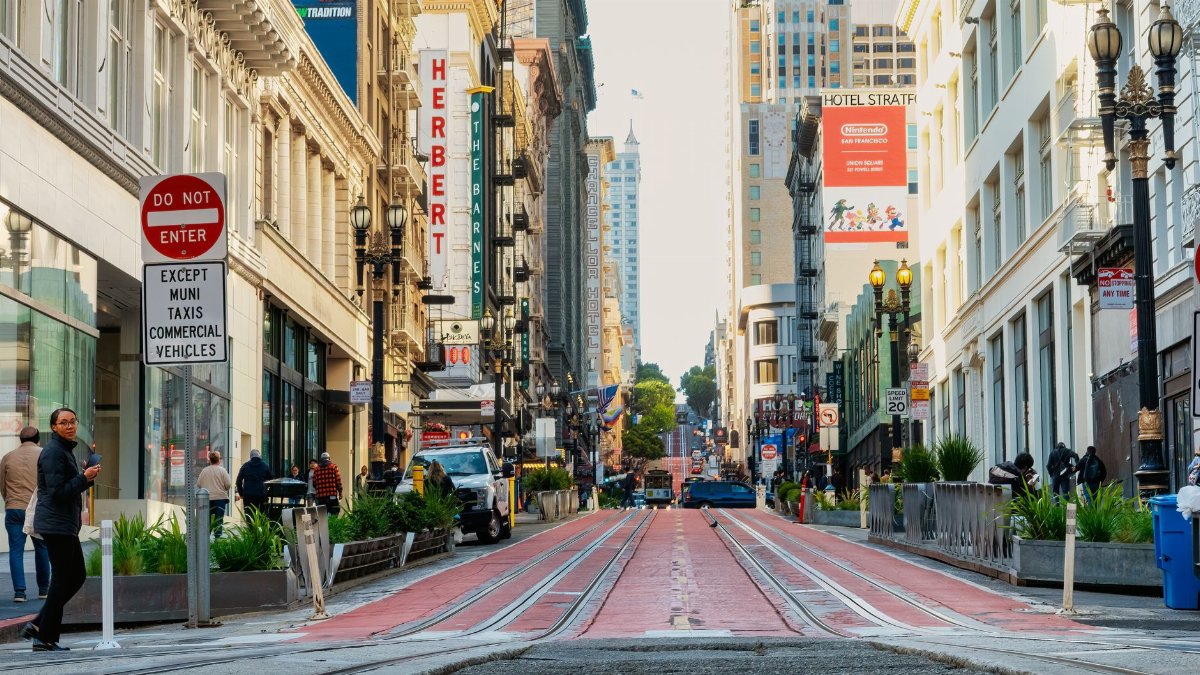
On a bright afternoon in Union Square, the windows along Stockton Street still do a kind of quiet work. They ask people to slow down. Next year one of those windows is set to belong to a company better known for search boxes than for shopping bags. Google Store Union Square is planned for 222 Stockton St., in the space formerly occupied by Tory Burch, and it will be the company’s first retail store in San Francisco. Landlords and city leaders have spent years trying to refill this district with tenants who can draw both locals and visitors. A technology giant taking a prime corner is a real signal. It is not a cure. The harder question is what kind of public room the company intends to build, and whether the square still has the daily life to make that room feel necessary.
A corner with a long memory
Union Square has always been more than a park with a column in the middle. For generations it has been the city’s formal living room for commerce, a place where holiday lights, hotel doormen, and luxury windows taught visitors what San Francisco wanted to be. Department stores rose and thinned. Designers arrived, stayed, and sometimes left. The square absorbed each fashion as if the next tenant could reset the mood of the sidewalk.
That confidence has been tested. Remote work emptied weekday lunches. Tourism returned in uneven waves. A run of visible disorder made some shoppers choose other neighborhoods, or other cities. None of this erased the square’s advantages. It still sits at the meeting point of hotels, transit, and a compact walk to the Financial District. A store here is not hiding in a mall corridor. It is asking to be judged in daylight, by people who may have no interest in a new phone and every interest in whether the block feels cared for.
What the company is putting on the sidewalk
Google already lives in pockets and bags across the city. Its software organizes commutes, mail, photos, and the small bargains of ordinary days. A store converts that invisible presence into tables, cables, and staff who can answer a question without a chat window. If the San Francisco shop follows the pattern of the company’s other retail rooms, visitors should expect phones, watches, earbuds, laptops, and home devices set out for touching rather than for a quick transaction at a counter.
The point of such a room is demonstration. A screen in an advertisement cannot show how a watch sits on a wrist or how a speaker fills a corner of a room. Retail gives the company a stage where skepticism can be answered in person. It also gives Google a place to repair trust when a device fails, which matters more than any window display. People forgive a brand that can look them in the eye and fix the thing they paid for.
Why this would be a first for the city
Google’s campus world is south of the city, in towns that grew up around office parks and shuttle buses. San Francisco has long been the cultural capital of that economy without hosting the company’s own shop. Opening here closes a strange gap. The firm that helped define the region’s wealth has been easier to encounter in New York than on a San Francisco sidewalk.
A first store carries symbolism that later stores will not. It tells employees that the city is not only a recruiting backdrop. It tells residents that the company is willing to pay retail rent and accept the ordinary frictions of a street: deliveries at dawn, tourists with questions, neighbors who judge the lighting. Software can scale without those frictions. A shop cannot. That vulnerability is part of the appeal. A company that meets the public only through terms of service never has to hear the sigh of someone who waited twenty minutes for help.
The room a fashion house left behind
The address, 222 Stockton St., already knows how to perform. Tory Burch used it as a polished stage for clothes and accessories, the kind of room where materials and manners did as much selling as the products. Taking over a fashion space is not the same as building a sterile electronics counter. The bones of the room, the ceiling height, the glass, the relation to the square, will shape whatever Google installs.
There is a cultural handoff in that sequence. A clothing label sells identity you can wear out the door. A technology company sells tools that slip into pockets and then disappear into habit. Both depend on desire, but they train desire differently. One asks you to be seen. The other asks you to be efficient, connected, and faintly optimized. Shoppers walking from a jewelry window to a phone table may feel that shift without naming it. The best retail designers will not pretend the two moods are the same.
Software companies and the old art of the shop
For years the technology industry treated physical retail as a relic, something department stores did while the future happened in browsers. Then the industry discovered that objects still need advocates. Apple proved that a store could be a civic landmark as much as a cash register. Other firms followed with mixed results, some building temples and some building warehouses with better lighting.
Google comes to this lesson later, and with a catalog that is wider and less unified than a single family of devices. Phones sit beside home sensors and computers that run on a different idea of simplicity. The staff will have to translate among those products without talking down to people who came in for one reason and leave curious about another. That translation is the job. If it fails, the store becomes a showroom nobody needed, a place to confirm a purchase already decided online.
Union Square and the hope of a tenant who stays

Neighborhood recovery is often narrated as a single turning point: one famous tenant, one reopened hotel, one season of strong holiday sales. Real recovery is duller. It is a sequence of leases, clean entrances, and weekdays that are merely fine rather than frightening or empty. Google Store Union Square can be one tile in that sequence. It cannot be the whole mosaic.
Still, landlords watch anchors because anchors change the math for everyone else. A busy store pulls coffee lines, makes a quiet Tuesday less quiet, and gives a leasing agent a sentence that is not about vacancy. The risk is that a technology shop draws a narrow crowd, heavy on product fans and light on the browsers who keep a district various. Union Square needs both the person who knows the model number and the person who wandered over from a museum or a train.
What a visit might actually feel like
Imagine the first months. A visitor steps in from Stockton Street and meets a room that is brighter than the sidewalk and quieter than the cable car noise outside. Tables are low enough to invite touching. Staff circulate instead of waiting behind a fortress counter. Somewhere a workshop or a short talk tries to turn a product demo into an hour that feels like a class rather than a pitch.
The success of that hour will depend on tone. San Franciscans have a low tolerance for being managed. They can tell when a greeting is a script. They also respond, sometimes against their own cynicism, to competence. If the people on the floor know the devices and know when to stop selling, the store will earn repeat visits from residents, not only from hotel guests killing time before dinner. Repeat visits are the only metric that matters once the ribbon cuttings are over.
Attention as a kind of civic ritual

There is a reason a retail opening can brush against questions that sound almost spiritual, even in a city that prefers its reverence ironic. A shop is a ritual of attention. You put down the phone, or you pick up a different one, and for a few minutes you let an object organize your senses. Union Square has hosted that ritual for more than a century, in cathedrals of merchandise and in modest counters. The decline of foot traffic was never only an economic story. It was a thinning of shared attention, fewer reasons to stand beside strangers and look at the same window.
Google occupies a paradoxical place in that story. Its products are built to fragment attention and also to restore it, to notify and to soothe, to track a walk and to narrate it. A physical store cannot resolve that paradox. It can only stage it honestly. If the room is calm, well staffed, and free of hectoring screens, it may offer a small counterpoint to the frenzy the brand helps create. If it is another funnel, visitors will feel the joke immediately.
Neighbors who have heard promises before

Around the square, merchants have learned to greet announcements with a practiced half smile. They have seen pop up concepts, luxury refreshes, and civic plans that looked sturdy in a press release and thin on a rainy Wednesday. Their test for Google Store Union Square will be practical. Do the lights stay on past the first season. Do delivery trucks respect the alley. Does the entrance feel welcoming to someone who is not already inside the company’s world.
Workers in nearby hotels and restaurants have their own test. A new store that brings guests who linger, tip, and walk the block after closing is a gift. A store that functions as a brief selfie stop is not. The difference will show up in ordinary ledgers, not in renderings. It is fair to hope and wiser to wait. Hope has been part of this district’s temperament for a long time. So has disappointment. Both deserve a hearing.
Privacy in a room built for touching

Any Google shop walks into a conversation the company cannot dodge. People will wonder what the room knows about them. Do cameras do more than prevent theft. Does a demo require an account. Can a person try a device and leave without joining a list. These are not niche worries in San Francisco, where arguments about data have moved from conferences into dinner talk.
The company does not need to pretend it is a charity. It does need clear answers at the door. A store that handles those questions plainly will seem more adult than a store that hides them in a poster about innovation. Shoppers can accept that a business wants their business. They balk when the business wants their business and also a silent dossier. The physical room is a chance to choose the first and decline the second, in view of anyone who asks.
The economy behind the glass
Retail jobs are not a substitute for the office employment San Francisco lost, but they are real work with real schedules. A flagship can employ specialists, managers, and the less visible people who receive shipments and reset tables after a crowded Saturday. Those jobs will not remake the city’s budget. They will matter to the people who hold them, and they will matter to the block if the wages and the training are serious.
There is also a tax and leasing story that city budget watchers follow more closely than product fans do. A filled storefront is assessed, patronized, and argued over in a way a dark one is not. None of that requires romance about corporations as civic saviors. It requires the plain observation that vacant glass is a kind of public cost, paid in mood as well as in revenue. Filling 222 Stockton St. spends against that cost. Keeping it filled is the harder payment.
What an opening day will not settle
Opening day will be photographed. There will be a line, a few executives, and a speech about community that sounds like other speeches. None of that will answer whether Google Store Union Square belongs to the city or merely occupies it. Belonging takes seasons. It takes a winter when the square is windy and the novelty is gone. It takes a summer when tourists and office workers and teenagers share the same entrance without a marketing plan to make them do so.
The honest forecast is modest. A well run store can make one important corner feel intended again. It can show that a company born in browsers still needs rooms, staff, and the unpredictability of a sidewalk. It cannot, by itself, restore a district or absolve a firm of arguments that began long before the lease. Those limits are not a reason to shrug. They are a reason to watch the ordinary days after the cameras leave, which is when a shop either becomes part of the city’s furniture or remains a headline that happened to have an address.