
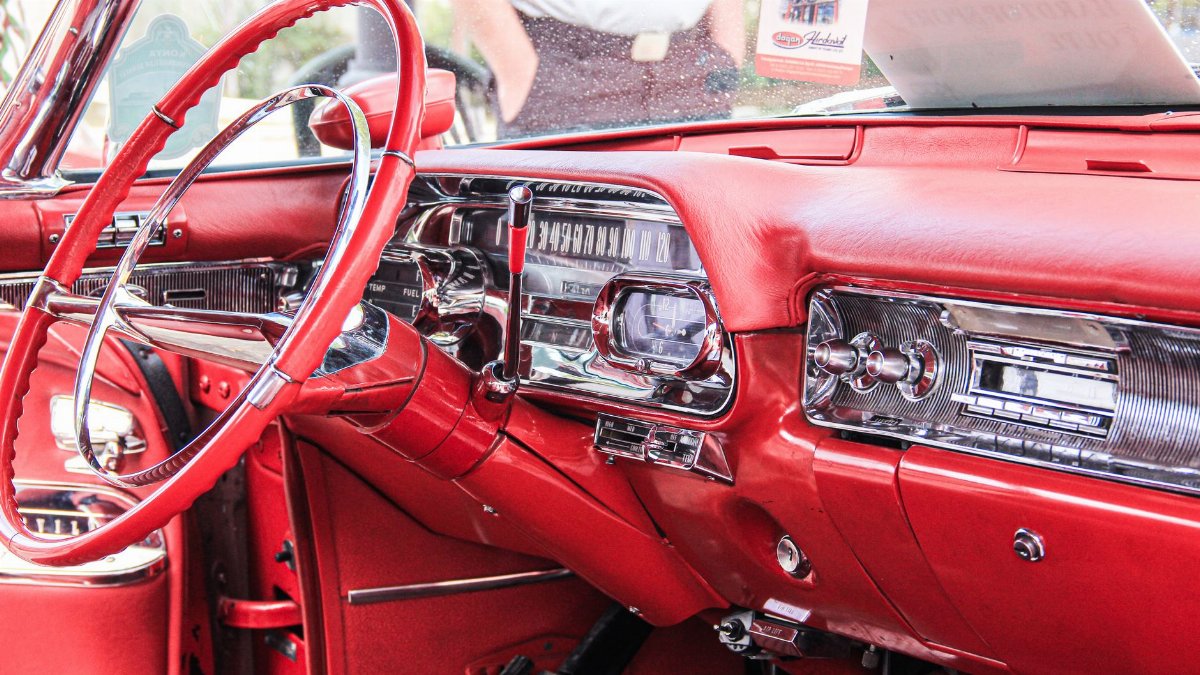
On a bright afternoon in the foothills east of Los Angeles, a sporty red Cadillac sat like a punch line nobody wanted to explain away. Nearby, residents who have already outlived a century gathered for ice cream and cookies, the kind of spread that would make a dietitian wince and a grandchild smile. The occasion was not a medical conference. It was a celebration of La Verne centenarians, people between the ages of 100 and 107, honored at the Hillcrest retirement community for the ordinary stubbornness of still being here, still laughing, still insisting that youth is less a number than a habit.
A red Cadillac that refused to act its age

The car matters because it is not a metaphor invented by a columnist in a hurry. It is a specific object in a specific driveway culture, glossy, a little loud, and entirely unwilling to apologize. In a country that often treats advanced age as a problem to be managed, a sporty red Cadillac functions as a public argument. It says movement is still allowed. It says taste does not expire on a birthday. It says the person behind the wheel, or the person who once loved that wheel, has not agreed to become invisible.
Cars are easy symbols, and symbols can lie. What keeps this one honest is the company it keeps. The same afternoon that produced the Cadillac also produced paper plates, familiar hymns or familiar radio, and the small negotiations of a party: who wants vanilla, who wants chocolate, who is already full and will eat another cookie anyway. Youth, in that room, looked less like speed and more like appetite.
What Hillcrest chose to honor

Hillcrest, a retirement community in La Verne, did something both simple and rare. It put names and faces in front of neighbors and called the gathering what it was: an honor. Not a lecture on longevity. Not a product launch for a supplement. An honor. Ages ran from 100 to 107, a span that sounds tidy until you remember how many ordinary Tuesdays it contains. Wars, recessions, marriages, funerals, new freeways, old songs, and the slow renaming of the towns around the San Gabriel Valley all sit inside those years.
Public honor changes the temperature of a story. When a community claps for people who have reached a century, it refuses the quieter habit of speaking about elders only when they are ill, missing, or in the way. The applause does not erase frailty. It places frailty beside pleasure and says both can be true in the same hour.
Ice cream, cookies, and the rebellion of pleasure

Sweets are a terrible health plan and an excellent social plan. That distinction is worth keeping. No responsible writer should tell a reader that cookies are the reason anyone reaches 107. Bodies are not vending machines, and genetics, medicine, safety, and luck do not yield to frosting. Still, the menu at a party like this one carries a serious idea. People who have lived a very long time often describe rules they bent on purpose. A scoop of ice cream can be a vote for joy over performance. A cookie can be a way of saying the day is not only for monitoring.
There is a spiritual thread in that choice, even for readers who do not use church language. Gratitude is a discipline. So is permission. A community that serves dessert to its oldest members is practicing a kind of blessing: you are not here merely to be careful. You are here to be delighted, within the limits your own body sets. The La Verne centenarians were not presented as mascots for indulgence. They were presented as people whose long lives still had room for taste.
Faith that shows up in a chair, not a slogan

Ask enough people who have crossed 100 how they did it and the answers scatter. Some mention prayer. Some mention a spouse. Some mention work that started before dawn and never quite stopped. Faith, when it appears, rarely arrives as a theorem. It arrives as a practice: a psalm said at the same hour, a pew that knew their coat, a belief that the day was held by something larger than the day. In a category of news that watches spiritual trends, that pattern is easy to romanticize and easy to dismiss. Both mistakes miss the point.
Faith does not guarantee a century. Plenty of devout people die young, and plenty of skeptics live long. What gatherings like the one at Hillcrest reveal is narrower and more useful. Shared belief, or shared ritual, gives people a reason to keep showing up for one another. A hymn is a memory device. A blessing is a way of naming a person as more than a chart. In a retirement community, those habits can be as practical as a hand on an elbow in a hallway.
Family as the unglamorous engine

Family is the other answer that keeps returning, and it deserves suspicion as well as respect. Not every long life is wrapped in a loving clan. Some of the most durable people have survived families that failed them, or have built kinship from friends, congregations, and neighbors when blood was thin or cruel. Still, when elders talk about what kept them young, they often point to someone who called, someone who drove, someone who remembered the story the first time and asked to hear it again.
That is less a secret than a labor. Adult children and grandchildren do not extend a life by sentiment alone. They extend the social world in which a life can keep making sense. A visit is a calendar. A ride to a party is a proof that the outside still wants you in it. The sporty red Cadillac, if it belongs to a family story, is also a vehicle in the plain sense: it moves a person from a room to a larger room.
Rock and roll as evidence, not nostalgia

Music is the third item in the headline trinity, and it may be the most democratic. Rock and roll does not require a theology or a trust fund. It requires a beat that the body still recognizes. For people born in the years around the First World War or just after, the soundtrack of youth was not only Elvis and the radio that followed. It was church piano, dance halls, kitchen radios, and later the shock of a younger generation turning the volume up. To keep any of that music close is to refuse the idea that taste must freeze at 70.
There is research, widely discussed in gerontology, linking social and musical engagement with better mood and sharper daily function in later life. The mechanism is not magic. Rhythm organizes attention. Singing uses breath. Dancing, even in a chair, uses muscles and memory at once. A party that includes rock and roll is doing quiet clinical work without calling it clinical. It is also doing something no clinic owns: it is letting people feel like themselves.
Staying young without lying about the body

The phrase in the celebration, the idea that they got to 100 by staying young, can be misread as denial. It is better read as a posture. Staying young, in the mouths of people who have earned the right to say it, seldom means pretending the knees are new. It means keeping a stake in tomorrow. It means a joke that lands. It means a preference, a grudge, a favorite flavor, a car color, a song that still raises the pulse. Old age becomes a costume only when the person inside is no longer allowed to choose.
Journalism should not sand this down into a list of hacks. Sleep, movement, not smoking, connection, and access to care all matter, and they matter unequally because money and neighborhood matter. La Verne is not every American town. A retirement community with the means to host a proper honor is not the same as a boarding house or a crowded apartment where an elder is alone. Celebrating La Verne centenarians should widen sympathy, not shrink it into a lifestyle brand.
What a younger reader can actually use

Middle age is a long hallway of postponed maintenance, and readers in that hallway often want a formula. The honest harvest from a party like this is smaller. Keep a pleasure that is yours and not only useful. Keep a person who expects you on a certain day. Keep a belief, religious or otherwise, that your hours are not random noise. Keep a body in motion at the scale your body allows. None of those promises 107. All of them make 70, or 80, or 90 more likely to feel inhabited.
There is also a civic use. Towns can copy the form even when they cannot copy the Cadillac. A public honor, a printed program, a song, a table of sweets, a microphone handed to someone who has outlived the century: these are cheap compared with the isolation they interrupt. Churches, mosques, temples, and secular clubs already know how to gather. They can aim that skill at the people most often edited out of the photograph.
The spiritual trend hiding in plain sight

Spiritual news often chases novelty: a new pew, a declining affiliation, a viral prayer. The Hillcrest afternoon points at an older trend that never left. Americans still mark sacred time with food, music, and the naming of elders. They still believe, unevenly, that longevity is a gift to be witnessed, not only a statistic to be managed. In La Verne that belief took a local shape. It wore red paint and powdered sugar. It sounded like rock and roll. It did not need a national brand to be real.
Witness is the spiritual act here. To look at a person of 104 and clap is to admit that a life is more than productivity. It is to say the years were not wasted even if they were hard, even if the theology was imperfect, even if the diet included more cookies than any brochure would allow. That admission is available to believers and to people who would never use the word blessing. It is a form of respect with a pulse.
Why the Cadillac should not become a cartoon

A single vivid object can swallow a story. The sporty red Cadillac will travel farther on the internet than any quiet fact about blood pressure, grief, or the staff who set the chairs. That is how attention works, and it is not entirely a loss. Attention is how a suburb east of Los Angeles gets a national reader to pause. The duty of the pause is to look past the paint. Who was honored. What they ate. Who sat beside them. What they still love. Whether the party will happen again next year, with some chairs empty and some new.
Commentary fails when it turns elders into proof of a theory. These lives are not evidence for ice cream, or for Detroit, or for any one faith. They are evidence that a community can still tell the truth in public: some of our neighbors have been here a very long time, and we are glad. The La Verne centenarians, gathered between 100 and 107, made that sentence visible. The rest of us can decide whether visibility is a one day event or a habit.
A closing look at staying young
Staying young, stripped of advertising, is mostly a refusal to exit your own life early. It is the Cadillac kept because it pleases. It is the song left on because the room knows it. It is the cookie taken without a speech. It is faith practiced in ordinary chairs, and family practiced in ordinary rides. None of it is guaranteed. All of it is available, in smaller doses, to people who will never see 100 and to people who might.
La Verne offered a picture, not a prescription. Hillcrest offered a room. The guests offered the only credential that matters in this kind of story: they arrived. If there is a lesson sturdy enough for a broad readership, it is that youth, late in life, is less a secret than a series of choices other people help you keep. Ice cream melts. Rock and roll fades into the next track. A red car eventually needs a mechanic. The honor, if a town is wise, does not.