
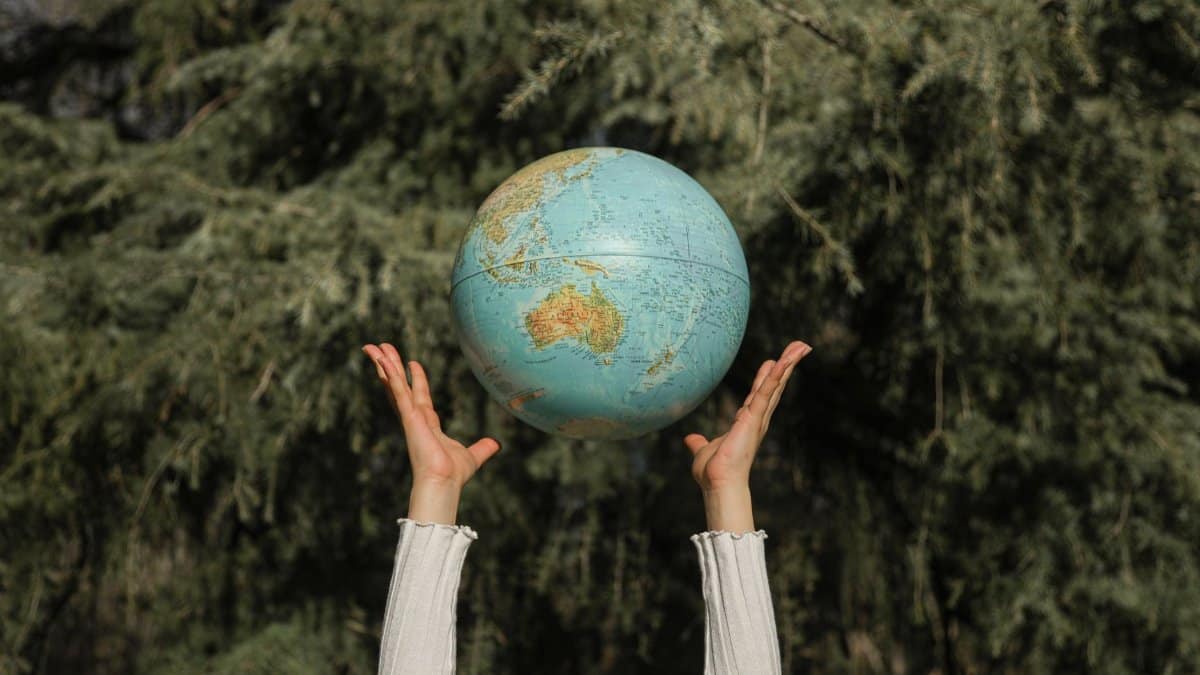
On a gray Seattle Sunday, people step out of the rain and into a room built for prayer, then stop because the usual sight line has been interrupted. Above the nave of Saint Mark’s Episcopal Cathedral hangs a glowing model of Earth, 24 feet across, lit from within and turning slowly enough that you notice the motion only after you have stood still. The Terra globe is open to anyone who walks in, believer or not, and this is the last day it will be here this year.
A planet where the eye expects stone
Cathedrals train the gaze upward. Columns, windows, and the long aisle do that work without asking. What is unusual this month is the object that meets that gaze. Instead of only vault and glass, visitors find a sphere the size of a small room, patterned with oceans and continents, suspended so that Africa or the Pacific might be the first thing you see depending on when you arrive.
The scale is the point. A globe on a desk is a tool. A globe you can walk under is an event. People circle it, then circle it again, trying to find a hometown that is suddenly a speck. Children point. Adults go quiet. The room does the rest.
Why this church said yes
Saint Mark’s sits on a hill with a reputation for music and for a welcome that does not stop at the parish roll. Hosting the Terra globe fits that habit. The cathedral has treated the installation as a public viewing, not a members only devotion. Doors open. No test of creed at the threshold. Staff and volunteers answer practical questions: where to stand, how long you may stay, whether photographs are allowed.
That openness matters in a city where many residents describe themselves as spiritual but unaffiliated, or as done with institutions entirely. A church that lends its most formal room to a picture of the whole planet is making a claim without a sermon. The claim is simple. Curiosity is a sufficient reason to come inside.
What the eye registers first
From the floor, the sphere reads as light before it reads as geography. The glow is even, closer to a lantern than to a screen. Coastlines sharpen as you move. Cloudless, the surface looks almost too clean, which is its own kind of honesty. This is not a weather report. It is a portrait.
Distance changes the lesson. Near the entrance the globe is an object among arches. Closer in, it fills the field of vision and the architecture recedes. People who came for the building stay for the planet. People who came for the planet notice, sometimes for the first time, how high the ceiling actually is.
Sunday as a deadline

Installations of this size do not linger. Rigging, insurance, and the ordinary life of a congregation all set an end date. Sunday is that end for this visit. Anyone who has been meaning to go has run out of later. In Seattle, later is a local art form. The forecast, the traffic on Interstate 5, the game, the errand. A firm last day cuts through that.
Expect a fuller nave than on a weekday morning. Families after services elsewhere. Neighbors who walk the hill. Out of town guests who were told this was the thing not to miss. The mood, from similar farewells, tends to be grateful rather than frantic. People know they are seeing something that will not be in this room tomorrow.
Faith is welcome and not required

The category that fits this visit is awkward on purpose. It is spiritual news, and it is also civic news, and it is also an art listing. The Terra globe does not preach. It also does not pretend that the room around it is neutral. Hymnals sit in the pews. Crosses remain. Anyone uncomfortable with that symbolism can still look up and leave. Anyone who finds the symbolism consoling can sit longer than the globe alone would ask.
That combination is rarer than it should be. Too many public art events treat religion as a costume. Too many religious events treat outsiders as a project. Here the arrangement is plainer. The church keeps its identity. The visitor keeps a choice.
Scale as a kind of instruction

A 24 foot Earth is large enough to humble and small enough to hold in one look. That double effect is why globes of this size keep finding audiences in museums, festivals, and now sanctuaries. You cannot study a coastline for policy detail. You can feel, in the body, how little of the surface any one life occupies.
Journalists sometimes overread that feeling. Awe is not a climate plan, and a beautiful object is not a substitute for hard choices about heat, water, and housing. Still, it would be dishonest to ignore what people report when they stand under the sphere. They talk about trips they took. They talk about places they have never seen and relatives who live on the far curve. They talk about smoke summers and the odd relief of seeing the planet without a headline attached.
Who actually walks in

The crowd is not one congregation. On recent days the mix has included parishioners who already know which door sticks, and strangers asking where the restrooms are. Students with sketchbooks. Retirees who treat the visit like a matinee. A few people who came because a friend sent a photo and the photo did not do the height justice.
Conversation stays low. The acoustics punish chatter, which turns out to be a gift. You hear shoes, a cough, the occasional child asking whether the globe is real. It is real as an artwork. It is not the Earth. Saying that out loud seems to help children more than it bothers adults.
A city already full of big views
Seattle does not lack for vistas. Ferries, mountains on clear days, the industrial glow of the port at night. What the cathedral adds is enclosure. Outside, a view competes with wind and errands. Inside, the Terra globe has your attention because the room was designed to hold attention. Rain on the roof only helps.
There is a local pleasure in that contrast. The same week you might have stared at a screen full of distant disasters and local arguments. Then you stand under a single lit sphere and the arguments do not vanish. They just get a frame. Some visitors will find that frame sentimental. Others will find it useful. Both reactions belong in the pews.
After the rigging comes down

When the globe leaves, Saint Mark’s returns to its ordinary grandeur, which was never slight. Concerts will fill the volume the sphere borrowed. Sunday liturgies will reclaim the sight line. People who missed the installation will hear about it and feel the small regret that cultural calendars always produce.
What may linger is the permission. A landmark church demonstrated that a visiting artwork about the planet can sit inside a Christian interior without either one being erased. Other congregations, and other cities, will notice if they are paying attention. Not every parish has the height, the budget, or the will. The example does not require imitation to be worth recording.
Science pictures in sacred rooms
Western churches have hosted images of the cosmos for centuries, usually as ceiling paint or as a scholarly aside. A contemporary globe is different mainly in its fidelity and its light. It arrives from a culture of satellites and classrooms, then hangs where older generations expected saints. The friction is productive. It asks religious visitors to look at a picture their tradition did not draw. It asks secular visitors to accept beauty in a room their habits usually skip.
No one needs a new doctrine to make use of that hour. You can treat it as art. You can treat it as prayer. You can treat it as a Sunday outing with a definite ending. The sphere does not grade the interpretation.
A practical case for going

If you live in the city or within an easy drive, the case is logistical as much as lyrical. The Terra globe is large, free to approach in a building that already knows how to host the public, and gone after today. Parking on Capitol Hill will be what it always is. The walk from the bus is uphill. Neither fact is a reason to skip something you will not get back this year.
I went expecting a novelty and stayed because the room made the novelty behave. That is the best version of this kind of visit. Not a spectacle that shouts over the architecture, and not a sermon that uses the planet as a prop, but a few quiet minutes in which Earth is simply, unmistakably, there.