
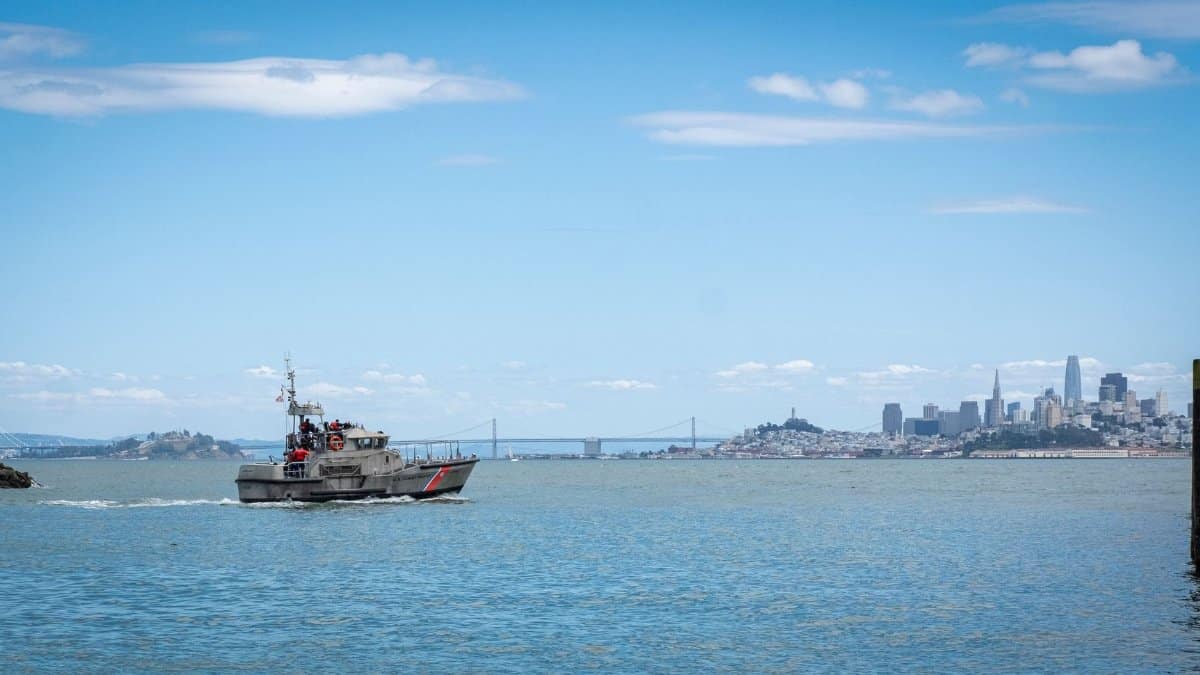
On a waterfront where cargo ships, ferry riders, and patrol boats share the same gray morning, a quiet personnel action can travel farther than a siren. The Coast Guard commander relieved of his post in San Francisco did not depart with a parade or a public explanation. Cmdr. Sean O’Laughlin had led Port Security Unit 312, a reserve formation whose work is to harden harbors when the country asks for it. Officials tied the move to a loss of confidence and to an investigation into allegations that have not been disclosed. For people who live beside the bay, that combination carries a particular weight. Security units are meant to be the steady hand on the railing. When that hand is removed, the city does not receive a diagram. It receives a notice, a name, and a gap where certainty used to sit.
What a short notice can and cannot say

Military services announce command removals in language that is deliberately narrow. A loss of confidence tells the public that senior leaders no longer trust an officer to hold a particular job. It does not, by itself, prove a crime, a moral failure, or even a finished finding. It is an administrative judgment about fitness for command, made inside a chain that must keep operating while questions remain open. Readers often want the notice to function like a verdict. It rarely does. The Coast Guard, like the other armed services, can relieve a commander quickly and explain slowly, or not at all, when an inquiry is still underway.
That gap is not a courtesy to the officer alone. It also protects people who may have brought complaints, witnesses whose names do not belong in a headline, and a process that can collapse if every detail is tried in public before investigators finish their work. The cost is real. Neighbors, employers, and fellow reservists are left to fill silence with rumor. A careful reader holds two ideas at once: the service has signaled serious doubt, and the public still does not know what the doubt concerns.
A unit built for harbors under strain
Port Security Unit 312 is not a downtown office with a view of the bridge. Units of this kind are built to deploy. They train for waterside patrols, shoreside defense, and the unglamorous work of keeping a working port usable when threat, disaster, or war makes ordinary schedules impossible. Many members are reservists. They leave civilian jobs, put on the uniform, and practice skills that most of the city never sees until something goes wrong.
San Francisco gives that mission a sharp local shape. The bay is a funnel for containers, fuel, commuters, cruise passengers, and the small craft that stitch the shoreline together. Bridges and tunnels make the geography feel permanent. It is not. A port is a system of people, radios, piers, and rules. A commander sits at the point where training plans, discipline, and judgment meet. Remove that person and the boats may still sail. The question is whether the unit still trusts the voice giving the order.
Loss of confidence as a tool, not a story

Loss of confidence is one of the bluntest instruments in military personnel practice. It allows a superior to act before a court martial, before a press conference, and sometimes before the officer has a full chance to answer in public. Services defend the tool because command is not an ordinary job. A weak or compromised leader can put crews, detainees, and civilians at risk faster than a paperwork error in a civilian agency. Waiting for a complete public narrative can feel like negligence to the admiral who owns the risk.
The same speed creates a fairness problem that thoughtful officers discuss in private. A Coast Guard commander relieved under that standard may later be cleared, reassigned, retired, or charged. The first headline does not record which ending is coming. Rank does not buy immunity, but it also does not buy a detailed defense in the initial announcement. The phrase is a door closing. It is not a transcript of what happened in the room.
Allegations the public has not been shown

The reported investigation concerns allegations that remain undisclosed. That single fact should slow every confident retelling. Undisclosed does not mean trivial. It also does not mean the worst thing a reader can imagine. Misuse of authority, hostile climate, mishandled property, false statements, and failures of judgment can all trigger inquiries. So can complaints that investigators later find unsupported. Until a charge sheet, a report, or an official summary appears, speculation is not journalism. It is a guess wearing a serious tone.
Families of service members learn this distinction the hard way. They hear a name on the news and cannot tell whether to prepare for a legal fight, a quiet career end, or a return to duty after months of limbo. Civic groups that follow the waterfront face a similar bind. They can ask the service for more, and they should. They cannot invent the missing pages and call the invention accountability.
Reserve life outside the gate

A deployable reserve unit lives in two calendars. One calendar belongs to the Coast Guard: drills, inspections, qualifications, and the possibility of a call that rearranges a household. The other belongs to schools, hospitals, warehouses, and offices around the bay. When command turmoil hits, it does not stay inside a fence. A petty officer may still have a Monday shift. A spouse may still have to explain a sudden change in weekend plans to a child who only knows that a parent packs a seabag.
Leadership in that setting is partly technical and partly pastoral, even when no one uses religious language. People follow a commander who seems steady under boredom as well as under alarm. They notice who gets heard, who gets protected, and who is asked to carry risk without backup. A relief tells those people that someone above them saw a break in that trust. It does not tell them how to talk about it at the next drill without harming an investigation or harming one another.
The harbor does not pause for personnel news
Commerce on the bay is indifferent to internal military process. Tides do not wait for a public affairs release. Ferry schedules, terminal shifts, and pilot boats continue. That continuity can look like indifference. It is also a kind of discipline. The point of a port security unit is that the city should not have to stop in order to feel guarded. Readers should not confuse smooth traffic with proof that nothing important has changed inside the unit.
Local leaders still have a legitimate interest in the seams. Who is acting in command. Whether planned exercises continue. Whether any allegation touches operations that intersect with city agencies, private terminals, or other federal partners. Those are practical questions, not gossip. They can be asked without demanding names of complainants or a premature verdict. A harbor city is entitled to know that the guard on the water is intact, even when the biography of the former commander is not yet a closed book.
Careers held in a bright and uncomfortable light

Command is a privilege that can end in an afternoon. The professional aftermath lasts longer. Fitness reports, promotion boards, and future assignments all read a relief as a mark that needs context. Context may arrive late, in a memorandum few civilians will ever see. Friends in the service will offer theories. Adversaries will offer worse ones. The officer, meanwhile, may be barred from discussing details that the public is hungry to hear.
When a Coast Guard commander relieved of a visible post tries to resume an ordinary week, the imbalance is obvious. The institution spoke first, in a sentence built for clarity and control. The individual answer, if it comes, will be slower and narrower. That is not always unjust. It is always lonely. People who have never worn a uniform sometimes assume the uniform itself is protection. In a loss of confidence case, the uniform is the reason the protection of ordinary employment law feels so far away.
How sister services use the same spare language

Navy, Army, Air Force, and Marine leaders relieve commanders with wording that citizens could swap from one press release to another. The repetition is not laziness alone. It is a shared doctrine: preserve the mission, limit prejudice to ongoing reviews, and avoid turning an internal judgment into a public trial. Scholars of civil military relations have long noted the tension. A democracy wants armed forces that obey law and answer to elected authority. It also accepts that some personnel decisions stay inside professional channels.
The tension sharpens when the unit sits in a major media market. A relief at a remote training base may draw a paragraph. A relief tied to San Francisco draws a wider audience because the place itself is a symbol of trade, protest, wealth, and vulnerability. Symbol is not evidence. The correct response is more reporting on process, not more color around an empty allegation. Process includes who has authority to relieve, what appeal routes exist, and when, if ever, findings become public records.
Trust as the cargo that actually matters

Security work fails in quiet ways before it fails in dramatic ones. A watch stander who doubts the integrity of the chain may still complete the checklist. The doubt remains. It shows up as hesitation, as whispered workarounds, as good people leaving at the first chance. Rebuilding after a relief is therefore not a matter of hanging a new name on the door. It is a matter of showing the unit that standards apply upward, that complaints have a path, and that rumor will not be allowed to write the next set of orders.
There is a civic version of the same task. Residents do not need every investigative detail to keep faith with the service. They do need reason to believe that concealment serves justice rather than convenience. Loss of confidence, stated plainly, can be that reason if later steps match the seriousness of the first step. If later steps never come, the phrase curdles. It starts to sound like a curtain rather than a standard.
What a patient public should watch for next

Several markers would turn this from a notice into a knowable story. An acting commander named in a durable way. A statement that training and deployment readiness continue under a specific authority. Any charge, clearance, or administrative result that can be released without harming privacy. A timeline, even a rough one, for when the service expects to say more. None of those markers requires a leak. All of them respect both the accused and the people who may have been harmed.
Until the Coast Guard commander relieved in this San Francisco case is attached to a finding the public can read, restraint is not softness. It is accuracy. I keep returning to the waterfront image because it resists melodrama. The bay looks the same on the morning after a relief as it did on the morning before. The difference is invisible and still decisive: whether the people tasked with guarding that water believe their leaders will tell the truth when the truth is finally allowed to speak.