
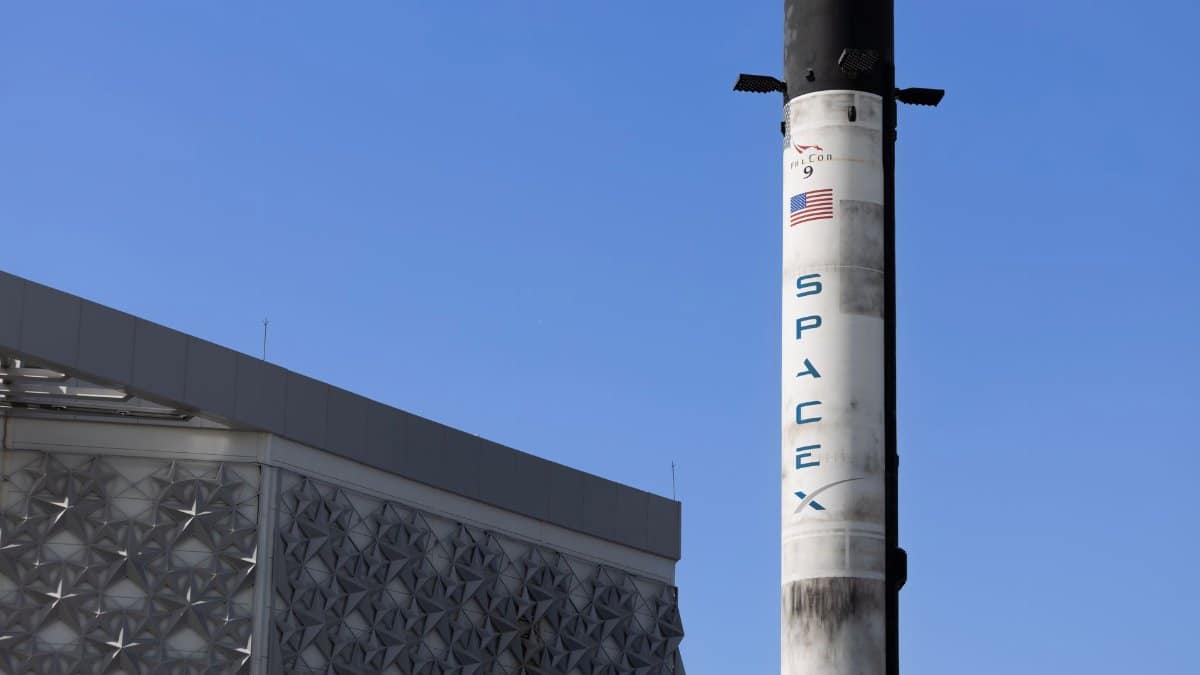
On a clear October morning in 2024, a steel tower on the Texas coast closed its arms around a falling rocket and held it still. The booster had left the pad only minutes earlier. Smoke drifted over the flats near Boca Chica as cheers broke out in control rooms and living rooms alike. Many people watching called the moment a SpaceX Starship catch, a shorthand that traveled faster than the technical notes. The image was simple enough for a phone screen and strange enough to stop a conversation. A machine the size of a building had come home to the same structure that sent it up.
What the cameras actually showed

The live pictures did not show a gentle landing on legs in the style of earlier Falcon rockets. They showed the Super Heavy booster dropping toward the launch tower, slowing on a final burn, and sliding into a pair of massive arms. Those arms, long nicknamed chopsticks by engineers and fans, took the load. The vehicle hung there, scorched and enormous, while the tower did the work that landing legs would have done on a smaller rocket.
That distinction is easy to lose once a clip starts circulating. The Starship system includes two main pieces: the Super Heavy booster and the Starship spacecraft stacked on top of it. The tower grab that made history that morning was a catch of the booster. It was still a first. No prior orbital class rocket had been plucked from the sky by its own launch mount in this way.
A name that outran the flight plan
Language compressed the event. Headlines and social posts folded booster and ship into one phrase, and the phrase stuck. A SpaceX Starship catch sounds, to many readers, like the upper spacecraft itself being snatched after a long stay in space. That is not what the October flight record shows. The ship did not spend a day in orbit and then fly back into the arms. It followed a shorter test path, reached space, and aimed for a controlled splashdown far from Texas.
The mismatch matters because the two jobs are not the same. Catching the booster proves the tower, the guidance, and the engine relight on a vehicle that returns within minutes. Catching the ship would require surviving a much harsher reentry, managing a different mass and shape, and trusting the tower with a vehicle that has just come through plasma. Treating those as one achievement flatters the footage and undersells the remaining work.
Why the tower was built to grab
SpaceX has argued for years that the cost of spaceflight falls only if hardware flies again quickly, with little refurbishment between trips. Falcon 9 already lands boosters on pads and ships. Starship is meant to be larger, flown more often, and built from stainless steel rather than the composites and alloys of earlier vehicles. Legs on a booster that size add weight. A tower that catches the rocket can, in theory, remove that penalty and put the vehicle back on the mount that will fuel it again.
The idea sounds theatrical. In practice it is a bet on ground equipment as much as on flight software. The arms must move with precision. The booster must arrive at a predicted point with engines that light when commanded. The structure must absorb a load that would crush an ordinary crane. Success on one morning does not erase the chance of a miss on the next.
The morning of the fifth integrated flight
The catch came on the fifth integrated test of the full stack, after earlier flights that ended in explosions, lost vehicles, or partial goals met. Those flights were not empty. They taught the company how the stack behaves at liftoff, how hot staging separates the ship while engines are still firing, and how tiles and flaps endure heating. By the fifth flight, managers judged the booster return mature enough to try the arms instead of diverting to the water.
Regulatory permission, range safety, and local notices all sat underneath the spectacle. Starbase is not a remote desert pad in the old sense. It sits near a wildlife rich coast, a beach community, and the shipping lanes of the Gulf. A catch attempt is also a decision about where a failure would fall. Diverting to the sea remains the conservative option when data look wrong. Choosing the tower means trusting the last seconds.
Where the spacecraft went instead
While the booster hung in the arms, the Starship spacecraft was still on its own trajectory. On that flight it was not asked to come back to Texas. It continued downrange, gathered the speed and heat of reentry, and targeted the Indian Ocean. A splashdown is a softer standard than a tower catch, and still a hard one. Tiles can fail. Flaps can lose authority. A ship that reaches the water under control has shown guidance and thermal protection, not reuse.
Some accounts have blurred this ending into a story of a spacecraft grabbed after more than a day aloft. That telling does not match the timeline of the October test, which measured the ship leg in a much shorter span. Readers deserve the plainer version. The historic grab and the ocean ending happened on the same morning, to two different vehicles, with two different grades of success.
The engineering bet behind the arms
Super Heavy flies with a large cluster of Raptor engines burning methane and liquid oxygen. Most of those engines shut down as the booster climbs. A smaller set must relight for the boost back and the landing burn. The catch is the last visible step in a chain that includes navigation, engine health, and a decision, made in software and by people on the ground, to commit to the tower or wave off.
The ship carries fewer engines and a heat shield of many tiles, plus flaps that steer it when the air thickens. None of that hardware was caught by the tower on the flight that made the famous clip. When people search for a SpaceX Starship catch, they are often looking for the clip of the arms. The fair description is that they will find the booster, and a separate story about a ship that still had to prove it could come home intact.
Risk on a working coast
Every test at Starbase lands in a community that did not ask to become a launch range in the way Florida did over decades. Road closures, sonic booms, debris from earlier failures, and concern for wildlife have all been part of the local argument. A successful catch reduces one fear, the fear of a booster falling uncontrolled near the pad, and raises another, the fear of trying the same stunt again and missing.
Federal regulators have treated these flights as experimental. That label is not a courtesy. It means the vehicles are not yet in the routine of carrying satellites or people. A clean catch is evidence. It is not a certificate that the next stack will behave. Neighbors are right to ask what a miss would do to the tower, the tank farm, and the beach. Engineers are right to answer with distances, abort rules, and the choice to aim for water when margins shrink.
What reuse would change if it holds

If boosters can be caught, inspected, and flown again on short notice, the price of lifting heavy cargo could fall in a way Falcon 9 only began. That is the commercial claim, and it is still a claim. One catch does not show turnaround time, engine life, or the cost of repairing a tower after repeated loads. It shows that the catch is possible.
The larger company story reaches past satellites. SpaceX has said Starship is the vehicle it wants for Moon landings under the NASA contract path and, later, for Mars. Those destinations remain distant from a Texas tower holding a booster. Still, reuse is the hinge. A ship that flies once and is lost cannot build a cadence. A ship that returns can. The October morning advanced the booster half of that sentence and left the spacecraft half unfinished.
Awe without turning the clip into a myth

I watched the feed the way a great many people did, on a small screen, and felt the odd quiet that follows a thing working when it might have failed. That feeling is real, and it is not the same as proof. Public life is full of images that ask to be treated as omens. A rocket in a tower is a strong image. It can suggest human cleverness, or hubris, or simple relief that steel met steel instead of sand.
The healthier reading is modest. Wonder at the coordination, then ask what was actually caught, who bears the risk on the ground, and what the ship still has to survive. Awe that refuses those questions becomes advertising. Awe that keeps them becomes a better kind of attention, closer to the old habit of looking up and then looking again.
What a true ship catch would still require
Catching the spacecraft would close the loop the slogan already implies. The ship would need a reentry that leaves flaps, tiles, and engines in a state fit for another flight, not merely a state fit for a splash. It would need a return path to the tower, or to some later catch site, with the same honesty about wave offs that the booster now requires. Orbital stays measured in many hours would add power, thermal control, and guidance problems the short test did not pose.
Until that flight exists in the record, the precise phrase SpaceX Starship catch should be handled with care. It names a public hunger and a company goal. It should not be used as a caption that erases the ocean ending of the ship or invents a daylong orbit the fifth flight did not fly.
How to read the next attempt

Later tests will tempt the same compression. A booster catch will look familiar. A ship that reaches the water, or someday the arms, will be the new information. Viewers can ask three plain questions. Which vehicle came back. Did it come back to the tower or to the sea. What broke, scorched, or held that would matter on the flight after this one.
Those questions keep a spectacular morning in proportion. The tower at Starbase did something new when it held Super Heavy. The spacecraft still had to earn a return of its own. Between those facts is the whole unfinished argument for a reusable heavy rocket, and it is more interesting than a caption that gets the catch wrong.