
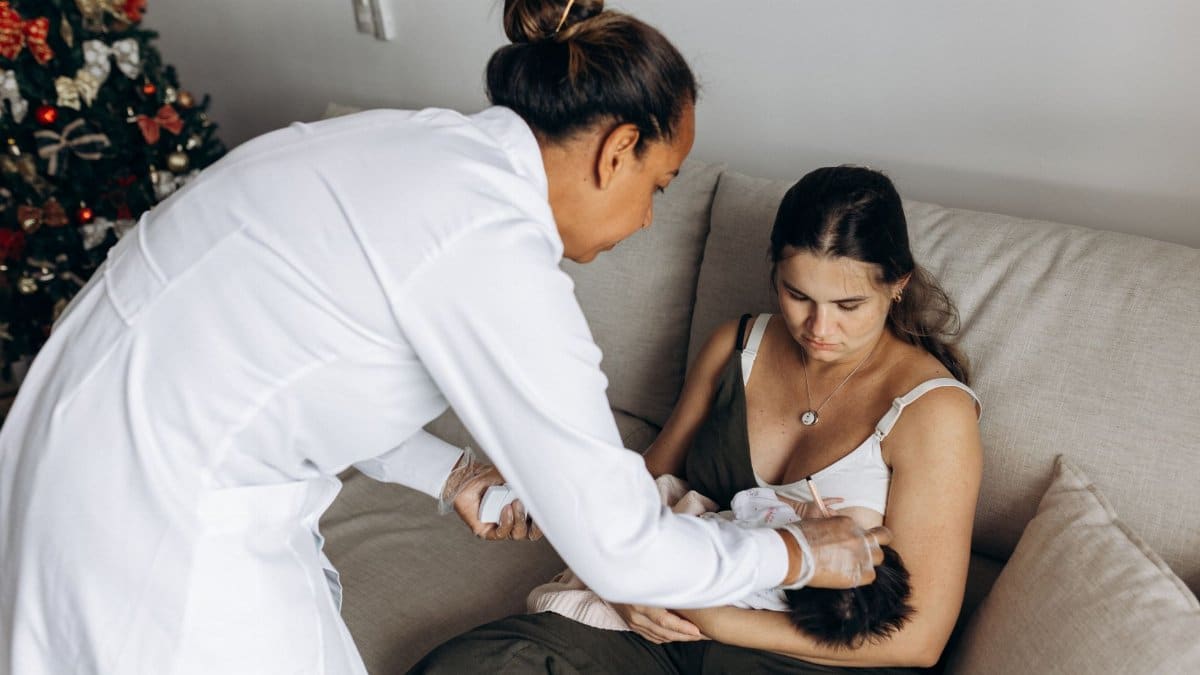
On a gray morning in a triple decker outside Worcester, a public health nurse climbed a narrow stairwell with a scale in one hand and a folder of questions in the other. The baby was nine days old. The mother had not slept more than an hour at a stretch. No one from the hospital had seen the living room, the empty fridge, or the way her hands shook when she tried to explain the feeding schedule. That private hour is the kind of care Massachusetts Governor Maura Healey wants the state to underwrite more reliably, and the phrase Healey postpartum funding has become shorthand for a modest budget ask with an outsized argument behind it.
A small line in a large budget

The proposal, as described in coverage of the administration’s health priorities, would direct about $2 million toward Welcome Family, the state’s nurse home visiting program for families in the first weeks after a birth. In a state budget measured in tens of billions, the figure can look almost symbolic. It is not symbolic to a program that has long depended on a mix of federal support, local partnerships, and the hope that a pilot will be renewed. Healey postpartum funding, in this telling, is less a grand new entitlement than a decision to stop treating the earliest days of parenthood as an afterthought that hospitals and insurers will somehow cover on their own.
Welcome Family is not a mystery to people who work in maternal health in Massachusetts. Nurses offer a visit, usually once, sometimes with follow up, to families with a newborn. They weigh the baby, talk through feeding, look for jaundice, ask about mood, and connect a household to a pediatrician, a lactation counselor, or a mental health clinician if something is off. The visit is voluntary. It is meant to reach families who might never call a hotline and who may not have a relative nearby who knows what a normal cry sounds like at 3 a.m.
What a living room reveals that a clinic does not
A postpartum checkup in an office can be thorough and still miss the point. The parent has to get there. Transportation, a job that will not grant the hour, an older child who cannot be left alone, or simple exhaustion can turn a recommended visit into a missed one. Inside an apartment, the nurse sees the crib, the bottles, the medication bottles, the partner who looks as frightened as the person who gave birth. Those details are not gossip. They are clinical information.
Public health departments have argued for years that the first month is when problems compound. A feeding difficulty becomes dehydration. A quiet sadness becomes a crisis that no one named because the only questions asked were about incision healing. Home visits do not replace obstetric care or psychiatry. They shorten the distance between a warning sign and a person trained to notice it.
The mental health gap after discharge

Massachusetts has spent considerable political energy on maternal mental health, from screening requirements to efforts to expand the behavioral health workforce. Screening on a paper form still depends on someone reading the form and having a place to send the patient. Many new parents minimize their answers. They fear being judged. They fear, wrongly in most cases but not in their imagination, that honesty could draw child welfare into the house.
A nurse who has already been invited in can ask the harder questions without the glare of a waiting room. Mood, sleep, intrusive thoughts, support at home, substances, safety: these are standard parts of a good postpartum assessment. They are also the parts most likely to be rushed when a clinic slot is fifteen minutes and the baby is crying. Advocates for Healey postpartum funding say the money is partly about time, the unglamorous resource that mental health screening actually requires.
How Welcome Family fits a longer Massachusetts tradition
The state has run home visiting in various forms for decades, often aimed at families with higher medical or social risk. Welcome Family was designed as a broader offer, closer to a universal check in the early newborn period, rather than a program reserved for households already flagged by a risk score. That design choice matters. Universal framing reduces stigma. It also costs money in a different way, because the eligible population is every birth, not a narrow subset.
Nurses in the program are typically employees of local public health agencies or partner organizations working with the Department of Public Health. They are not strangers with a clipboard and a quota. In many towns they are the same people who already know the WIC office, the early intervention referral, and which pediatric practices are taking new patients. The $2 million request would not build that network from nothing. It would help keep visits available when federal grants shift or when local budgets tighten.
What two million dollars can and cannot buy

Readers should be clear eyed about scale. Massachusetts records on the order of sixty thousand births a year, varying with the demographic tide. Two million dollars does not purchase a nurse in every kitchen for every family for a month of daily care. It can support a defined number of visits, training, outreach so that families know the offer exists, and the administrative spine that lets a referral from a birth hospital reach a local nurse before the second week slips away.
Program leaders tend to talk about coverage, not miracles. If a larger share of families receive at least one skilled visit, the state may catch more cases of postpartum depression, unsafe sleep setups, and feeding problems that lead to emergency room trips. Those are plausible benefits. They are not guaranteed by a budget line alone. Implementation, workforce, and whether hospitals actually make the referral will decide whether the appropriation is felt in real apartments or only in a line item.
The national argument this request joins

Healey postpartum funding lands in the middle of a wider American argument about what society owes people who have just had a child. Some states have extended Medicaid coverage for a full year after birth, a change Massachusetts and others pursued so that insurance does not vanish at the moment mental health needs often peak. Home visiting is a cousin of that policy, not a duplicate. Insurance pays for clinical encounters. A home visit is a public health service that may or may not be billed in the same way.
National reviews of nurse home visiting, including long running models studied by university researchers and summarized by the federal Home Visiting Evidence of Effectiveness project, have found benefits in child health and parenting support when programs are well run and sustained. The evidence is stronger for some intensive models aimed at higher risk families than for a single universal visit. Honest journalism has to say that. A brief Welcome Family visit is a different intervention from a multi year nurse partnership. It can still be worth funding if the goal is early detection and connection, not a claim that one hour rewrites a childhood.
Readers who want the federal summary can start with the Maternal, Infant, and Early Childhood Home Visiting overview published by the Health Resources and Services Administration at https://mchb.hrsa.gov/programs-impact/programs/home-visiting. State context for Welcome Family sits with the Massachusetts Department of Public Health, whose maternal and child health pages describe the offer in plain language at https://www.mass.gov/info-details/welcome-family.
Families the usual system does not see
The case for state money is sharpest for households that are easy to lose. A parent without paid leave may be back at a job before the six week visit. An immigrant family may not trust a phone call from an unknown number. A rural address may be an hour from the nearest birthing hospital, and the drive back for a weight check may be impossible without a car seat that has not arrived yet. Teen parents, parents with disabilities, and parents leaving the hospital after a stay in intensive care all face versions of the same problem: the system assumes a capacity to navigate that the first fortnight often destroys.
Language access is part of the design question, not a footnote. A visit conducted only in English is not a visit for a large share of Massachusetts births. Any serious use of Healey postpartum funding would have to include interpreters, bilingual nurses, and materials that do not read like a liability waiver. Otherwise the program will quietly serve the families who were already most likely to call a pediatrician on day three.
Workforce, not just appropriation

Money without nurses is a press release. Public health nursing has struggled with vacancies, pay that lags hospital wages, and the emotional load of walking into crises with a small kit and a protocol. If the state funds more visits, it must also fund the people who make them, including supervision and time to document what they find. Burnout in this workforce is not an abstraction. It shows up as unfilled routes and families who were promised a call that never comes.
Training matters as much as headcount. A nurse needs current guidance on safe sleep, on perinatal mood and anxiety disorders, on lactation, and on when a situation requires emergency care rather than reassurance. Those skills exist in Massachusetts. They are not evenly distributed. A funding debate that ignores training will produce uneven visits, some excellent and some little more than a weight on a scale.
Politics of a number that sounds small

In legislative season, small health items compete with education, housing, and transportation for attention. Supporters will say $2 million is cheap compared with a single prolonged neonatal hospitalization or with the social cost of untreated postpartum illness. Opponents, or simply skeptics, will ask for utilization data, for proof that visits change outcomes rather than only satisfaction, and for a plan that does not create a permanent add on without evaluation.
Those questions are fair. A responsible program publishes how many families were offered a visit, how many accepted, what problems were found, and where referrals went. Massachusetts has the data systems, in principle, to do that. Whether lawmakers require that transparency as a condition of Healey postpartum funding will say as much about the seriousness of the idea as the dollar figure itself.
What parents actually remember

Policy language flattens an experience that is physical and strange. People remember who showed up. They remember whether someone looked at the baby and then looked at them and said, in ordinary words, that what they were feeling had a name and a next step. They remember being believed about pain. A home visit cannot invent a village. It can be one competent adult who is not a relative and not a bill collector.
That is a modest moral claim, and it is the right size for this proposal. Grand promises about transforming parenthood tend to collapse when the nurse is late and the baby will not latch. The better argument is practical. Discharge from a hospital is not the end of medical responsibility. It is a handoff, and handoffs fail when no one is assigned to receive them.
Limits worth stating out loud

Home visiting is not a substitute for paid leave, for affordable housing, or for a mental health system that can see a new parent within days rather than months. It will not fix a shortage of obstetric beds in some regions or the isolation of fathers and nonbirth parents who are rarely the focus of outreach. If the visit becomes a checklist performed for compliance, families will sense it and decline the next offer.
There is also a privacy concern that deserves adult treatment. Inviting the state into a home, even through a nurse employed by a local health department, requires trust. Consent must be real. Families should know what is recorded and what would trigger a report to child protection. Blurring support and surveillance would destroy the program faster than any budget cut. The best versions of this work are explicit about that boundary.
How to judge the request when the hearing ends

A reader does not need to become a budget analyst to evaluate Healey postpartum funding. Ask whether the visits will be offered widely or only where a grant already exists. Ask whether mental health follow up is a real pathway or a brochure. Ask whether the administration will report results in public, including the families who were never reached. Ask whether $2 million is a floor that keeps a proven local practice alive or a ceiling that lets officials claim the problem has been funded.
The stairwell in Worcester is not a metaphor. It is where this policy either happens or does not. A scale, a folder, a tired parent, a nine day old infant: that is the unit of account. Massachusetts can afford to send a trained person up those stairs more often than it does now. Whether it will is a choice about what the weeks after birth are worth, measured not in slogans but in appointments kept and crises interrupted before they become emergencies.