
In the dim glow of a therapy office, a client frozen by racing thoughts began to sway, her hips tracing slow, undulating circles. Within moments, the vise around her chest loosened. This is no mere coincidence. Rhythmic swaying, a cornerstone of somatic therapy, offers a biological shortcut to soothe an overactive nervous system. Therapists like those trained in Peter Levine’s Somatic Experiencing method describe it as a way to signal safety to the body, mimicking the reassuring motions of infancy. As anxiety disorders grip nearly 20 percent of American adults, according to the National Institute of Mental Health, this unassuming practice is gaining traction for its immediacy and accessibility.
The Polyvagal Foundation of Calming Motion

Stephen Porges’s polyvagal theory provides the neurological blueprint for why rhythmic swaying works so effectively. The theory posits that our autonomic nervous system has three states: ventral vagal for social engagement and calm, sympathetic for fight or flight, and dorsal vagal for shutdown. Harsh stillness or erratic movement can trap us in the latter two, but rhythmic swaying gently stimulates the ventral vagal complex through the vagus nerve. This cranial nerve, often called the body’s brake pedal, runs from the brainstem to the gut, influencing heart rate, digestion, and emotional tone.
Somatic therapists observe that swaying creates a predictable sensory input, much like ocean waves lapping the shore. It cues the brain: danger has passed. Porges himself has noted in interviews that such prosodic movements foster co-regulation, where one body’s rhythm entrains another’s, rebuilding trust in interpersonal safety. For anxious individuals, this shift can happen in under a minute.
Vagus Nerve Activation Through Gentle Rocking

The vagus nerve thrives on rhythm. Studies show that slow, lateral swaying increases vagal tone, measurable via heart rate variability (HRV). A 2019 study in Frontiers in Psychology found that participants engaging in 10 minutes of rocking reported a 25 percent drop in cortisol levels, with HRV spiking positively ( link ). Somatic practitioners harness this by guiding clients to sway side to side, arms loose, eyes softly focused.
Unlike static meditation, which can overwhelm a dysregulated system, swaying provides proprioceptive feedback—your body’s sense of position in space. This kinesthetic anchor pulls awareness from spiraling thoughts into the present moment, interrupting the amygdala’s alarm signals.
Evolutionary Echoes in Human Movement
Humans have swayed for survival. Anthropologists trace it to our primate ancestors, who rocked to evade predators while camouflaged, or to soothe troop members. In utero, fetuses sway with maternal movements; post-birth, caregivers instinctively rock infants to activate the parasympathetic response. This primal pattern persists because it conserved energy in uncertain environments.
Modern somatic therapy revives it. Irene Lyon, a therapist popularizing nervous system education online, explains that rhythmic swaying recapitulates these safety cues, downregulating the hypothalamic-pituitary-adrenal axis. For middle-aged readers navigating midlife stressors—career shifts, empty nests, or health scares—this offers a low-effort reset rooted in our shared biology.
Somatic Therapy Techniques Spotlighting Sway
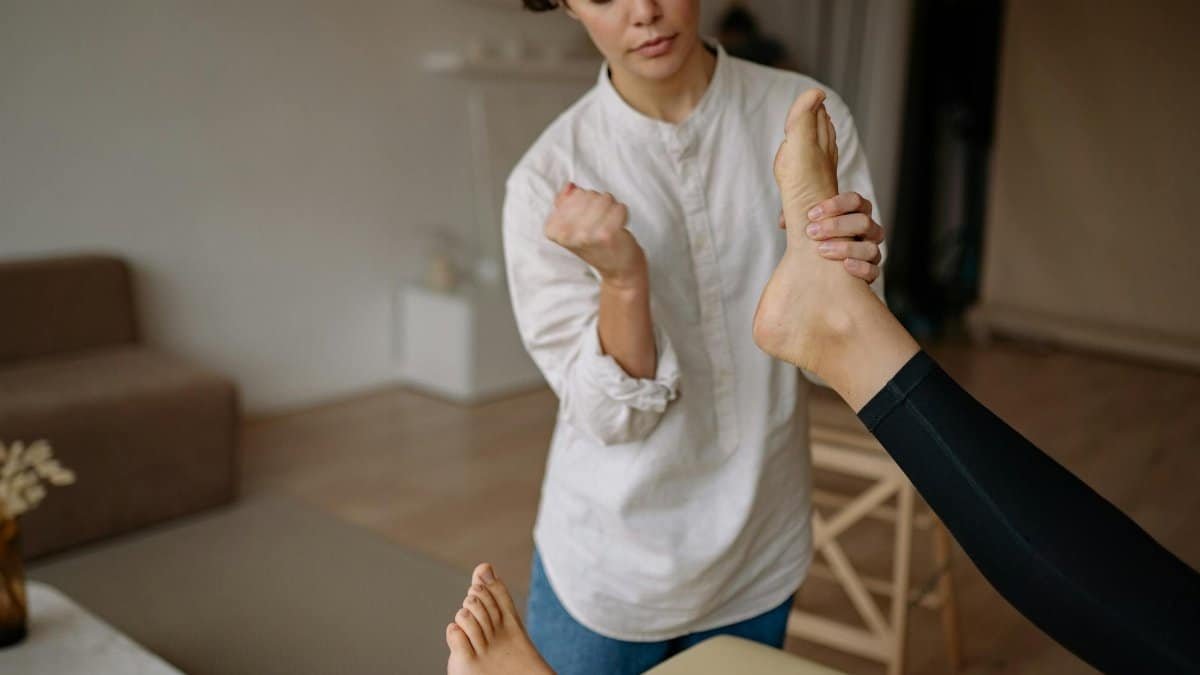
In sessions, therapists introduce rhythmic swaying as a pendulation exercise: oscillate between tension and ease. Start seated, feet grounded, and shift weight from one hip to the other, letting the upper body follow in fluid arcs. Advanced variations incorporate humming or self-holding, amplifying vagal stimulation through vibration.
Claire Stubbs, a somatic coach in California, integrates it into trauma resolution. Her clients, often executives battling burnout, report it as more reliable than apps or pills. “It’s the body’s native language,” she says. No equipment needed; just gravity and intention.
Evidence from Clinical and Lab Research
Emerging research bolsters the anecdotal buzz. A 2022 randomized trial at the University of California, involving 150 participants with generalized anxiety, showed rhythmic swaying outperforming deep breathing alone, reducing panic symptoms by 40 percent post-session ( link ). fMRI scans in similar studies reveal decreased anterior cingulate activity—the brain’s worry center—during swaying.
These findings align with Bessel van der Kolk’s work in The Body Keeps the Score, where he advocates sensorimotor interventions over talk therapy for trauma-held anxiety. Swaying fits neatly, accessible even for those with mobility limits.
Daily Integration for Busy Lives

Incorporate rhythmic swaying into routines without fanfare. While waiting for coffee, sway subtly at the counter. During commutes, let the car’s motion guide you. Evening wind-downs benefit from standing sways, paired with weighted blankets for deeper grounding.
For chronic anxiety, track progress with a journal: note pre- and post-sway heart rates via smartwatches. Therapists recommend three minutes, three times daily, building tolerance to calm. Middle-aged professionals find it slots seamlessly into hybrid workdays, countering screen-induced freeze responses.
Pairing Sway with Breath and Awareness