
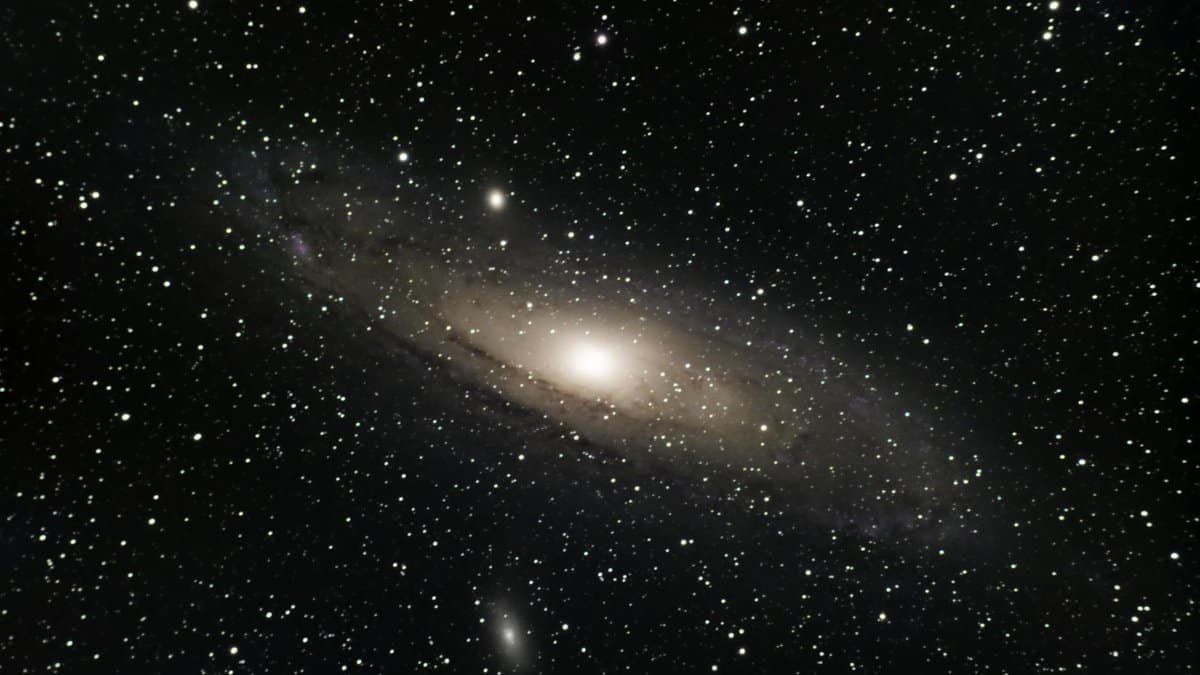
Astronomers peering through the NASA/ESA Hubble Space Telescope have unveiled one of the darkest and faintest galaxies ever detected in the nearby universe—a ghostly remnant that challenges our understanding of cosmic structures. Dubbed Candidate Dark Galaxy-2, this hubble dark galaxy emits a feeble glow equivalent to just one million suns, its visible stars so sparse they barely pierce the veil of overwhelming darkness. What makes it truly extraordinary is its apparent domination by invisible dark matter, with scant stellar light to betray its presence. As reported by the STScI News Center, this discovery highlights Hubble’s unmatched ability to capture the universe’s most elusive objects, offering a rare glimpse into the shadowy realms where dark matter reigns supreme.
Hubble’s Precision Reveals the Invisible

The Hubble Space Telescope, with its unparalleled resolution and sensitivity, has long been humanity’s best tool for spotting faint celestial phenomena. In this case, it zeroed in on Candidate Dark Galaxy-2, a hubble dark galaxy so dim that it evaded detection until now. Astronomers describe it as one of the darkest known in the nearby universe, meaning within a relatively short cosmic distance where we can study such objects in detail. The telescope’s observations cut through the cosmic noise, revealing a structure that shines with the collective output of only about one million local suns—imagine the brilliance of our sun multiplied a million times, yet still too weak to stand out against the interstellar backdrop. This faintness underscores Hubble’s role in pushing the boundaries of what we can see, turning whispers of light into scientific revelations.
Unveiling Candidate Dark Galaxy-2
Named Candidate Dark Galaxy-2, this enigmatic object earns its title through its provisional status and profound obscurity. It’s not a fully confirmed galaxy yet in the traditional sense, but its characteristics align closely with what astronomers expect from such bodies. Located in the nearby universe, it represents a snapshot of galactic evolution close to home, free from the distortions of vast distances. The hubble dark galaxy’s discovery adds to a growing catalog of low-luminosity systems, where the interplay between visible and invisible components defines their identity. Scientists emphasize its status as a candidate because further analysis is needed, but the initial data paints a picture of extreme minimalism—a celestial body holding onto existence through sheer gravitational will.
The Sheer Faintness of the Find

What sets this galaxy apart is its extraordinary dimness, making it one of the faintest known in our cosmic vicinity. Its total light output clocks in at roughly one million times that of our sun, a paltry sum when compared to even modest galaxies teeming with billions of stars. This hubble dark galaxy doesn’t blaze across the sky; it murmurs, its photons arriving in trickles after journeys through space. Astronomers note that such faintness arises from a sparse distribution of visible stars, scattered thinly across a vast expanse. It’s as if the galaxy is conserving its energy, existing on the edge of detectability. Hubble’s deep-field imaging prowess was essential here, capturing enough light over extended exposures to confirm its presence amid the void.
Dark Matter’s Dominant Hold

At the heart of Candidate Dark Galaxy-2 lies invisible dark matter, which appears to dictate the galaxy’s very form. Unlike the stars we see, dark matter doesn’t interact with light, exerting influence solely through gravity. In this hubble dark galaxy, it overwhelmingly dominates, suggesting that the visible components are mere passengers in a dark matter-driven vehicle. The structure holds together because of this unseen scaffold, binding the sparse stars in place. Astronomers infer this from the galaxy’s low surface brightness and minimal stellar content—hallmarks of dark matter halos that have only tenuously ignited star formation. This dominance echoes broader cosmic patterns, where dark matter underpins galaxy formation without fanfare.
A Sparse Smattering of Stars
Visible stars in Candidate Dark Galaxy-2 are few and far between, described by scientists as a “sparse smattering.” These luminous points provide the only tangible evidence of the galaxy’s existence, their collective glow totaling that one-million-sun output. Without Hubble’s keen eye, they might blend seamlessly into the background. This scarcity implies limited star-forming material or processes stalled long ago, leaving the galaxy in a quiescent state. The hubble dark galaxy thus serves as a fossil of early universe dynamics, where dark matter gathered first, and stars followed hesitantly. Its stellar poverty amplifies the mystery, prompting questions about how such systems persist without collapsing or igniting further.
Insights from the Nearby Universe

Focusing on the nearby universe offers astronomers a clearer view, unmarred by the light-years of redshift that plague distant observations. Candidate Dark Galaxy-2 thrives in this local context, one of the darkest and faintest exemplars we can study up close. Its properties—one million suns’ worth of light, dark matter supremacy—provide a benchmark for understanding similar faint galaxies scattered throughout our galactic neighborhood. Hubble’s data here isn’t just a snapshot; it’s a window into the universe’s underbelly, where invisible forces shape visible realities. As the STScI News Center details, such finds refine models of how galaxies form and evolve, even those on the fringes of luminosity.
Hubble’s Legacy in Dark Galaxy Hunts
The Hubble Space Telescope continues to excel at unearthing these elusive targets, building on decades of service. For the hubble dark galaxy known as Candidate Dark Galaxy-2, its instruments dissected the faint light profile, confirming the dark matter dominance and stellar sparsity. This isn’t Hubble’s first brush with dim objects; its archives brim with ultra-faint dwarfs that hint at the same dynamics. Blended seamlessly into this narrative, prior Hubble surveys of nearby clusters have revealed analogous systems where dark matter outweighs baryonic matter by wide margins, supporting the interpretation of this candidate. The telescope’s endurance ensures that discoveries like this persist, illuminating the shadows for years to come.
What This Dark Discovery Tells Us

Candidate Dark Galaxy-2 encapsulates the tension between seen and unseen in the cosmos. Its faint shine from one million suns, coupled with dark matter’s grip, illustrates a galaxy teetering on invisibility. Astronomers using Hubble have thus identified a poignant example of how the universe hides its secrets in plain sight—or rather, out of it. This hubble dark galaxy invites contemplation of the majority we can’t see: dark matter’s pervasive role, the resilience of sparse stars, and the nearby universe’s hidden diversity. While more observations loom, the initial portrait from Hubble stands as a testament to patient, precise astronomy, reminding us that darkness often holds the deepest stories.