
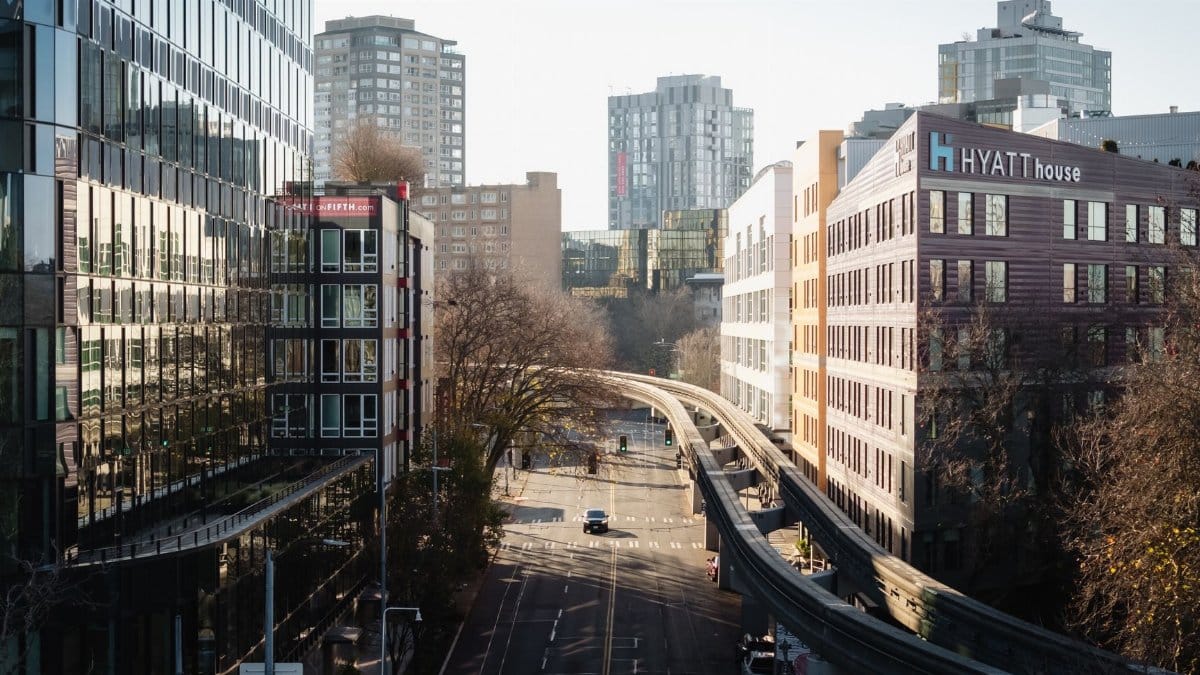
On a clear afternoon the Seattle Center monorail still looks like a souvenir that learned how to move. Two cars glide above Fifth Avenue, red and blue, carrying families, conference visitors, and people who missed a bus and decided the view was worth the ticket. For years that ticket lived under a firm ceiling. Seattle monorail fares could not rise above $4. The City Council has now lifted that ceiling to $7, with any climb spread across a decade that begins on Jan. 1, 2028. The change is not a fare hike that hits the booth tomorrow. It is permission, written into city rules, for a slow and sizable increase on one of the shortest paid rides in the region.
A ceiling, not a sudden sticker shock

The distinction matters, and it is easy to lose in a headline. Riders will not wake up next month to a $7 charge for a trip that lasts about two minutes. What changed is the legal maximum. Under the old cap, the adult fare could not pass $4. Under the new one, it may reach $7, but only through increases phased across ten years, starting at the beginning of 2028. The Seattle Times reported the council action and the timetable, which city transportation staff framed as room to keep the line solvent rather than as an overnight rewrite of the price board. Readers who treat every council vote as an immediate bill will misread this one. The vote creates a path. It does not, by itself, print a new ticket.
That path is still real money. A move from $4 to $7 is a 75 percent rise if the operator eventually uses the full allowance. For a visitor buying a single ride between downtown and Seattle Center, the difference is a few dollars. For a family making the trip both ways, or for workers who use the line as a daily link, the same math compounds. Permission to charge more is not the same as a requirement to charge more. It is also not a promise that the lower fare will hold.
What the ride actually is
The monorail is not light rail, and it is not a bus with a better view. It is a pair of trains on an elevated beam between Westlake Center and Seattle Center, a distance of less than a mile. The system opened for the Century 21 Exposition in 1962, when Seattle wanted the future to have a shape people could point at. Decades later the cars still do that job. Tourists ride it because the brochure says so. Locals ride it when the walk feels long, the weather turns, or a game, a concert, or the Climate Pledge Arena calendar dumps a crowd onto Fifth Avenue at once.
Because the line is short, the fare has always carried a hint of absurdity. People joke that they are paying for elevation, not for distance. The joke lands harder if the price approaches what a longer bus or train trip costs elsewhere in the city. It lands differently for someone who cannot comfortably walk the hill, or who is herding children and strollers between a hotel and the Needle. A two minute ride can still be the only practical link in a day that is already expensive.
Why operators ask for room to raise prices
Transit agencies rarely seek a higher cap for the pleasure of it. Labor, parts, power, insurance, and the specialized upkeep of aging trains do not freeze when a fare ordinance does. The monorail is a small system with a narrow revenue base. It does not have the sprawling tax support of a regional rail network, and it cannot spread costs across dozens of routes. When expenses rise and the ticket price is pinned, the gap has to be closed by subsidy, by deferred work, or by fewer hours and thinner service. None of those options is invisible to riders.
Supporters of a higher ceiling argue that a fare stuck at $4 slowly stops covering the ride people expect: trains that show up, stations that are staffed, and equipment that does not fail on a Saturday night. Critics answer that a tourist attraction should not be priced like a luxury shuttle, and that the public already helped build and sustain the line. Both arguments can be true in part. A cap protects riders from sudden jumps. A cap that never moves can also starve the service the cap was meant to keep affordable.
Who pays, and who can shrug

Fare policy is a sorting machine, even on a line this short. Visitors in town for a weekend often treat Seattle monorail fares as part of the vacation budget, alongside museum tickets and a sit down meal. A dollar or two either way barely registers beside a hotel bill. Residents on tight incomes do not have that cushion. Students, service workers ending a shift near the Center, and people who use the train because walking is painful notice the fare every time. A phased increase sounds gentle in a council memo. It can still become a reason to skip the ride.
The city has spent years arguing, on other modes, about whether fares should track costs or whether mobility is a public good priced below cost on purpose. The monorail sits in an awkward middle. It is transit, in the plain sense that it moves people on a fixed route. It is also a civic icon that earns money from people who came to look at it. Price it only as a souvenir and everyday riders subsidize the postcard. Price it only as a social service and tourists enjoy a bargain the operating budget may not be able to fund. The $7 ceiling does not resolve that tension. It names a number high enough that the tension will have to be managed in public, year by year.
How a ten year climb could feel
Phasing is a political technology as much as a financial one. Spreading increases from 2028 across a decade lets officials say they rejected a shock. It also means almost no current council member will own the final step, if the fare ever reaches the new top. Riders experience phasing as a series of small annoyances rather than one fight. Each step can be defended as modest. Added together, the steps are the near doubling the headline describes.
Nothing in a ceiling requires the operator to take every step. Budgets, ridership, and political heat will decide how fast the fare moves inside the new band. A strong tourist year might tempt a quicker rise. A thin year, or a backlash after the first increase, might freeze the price for a while. The honest public question is not only what the council allowed. It is who will watch the intermediate votes, contract talks, and fare tables so that slow does not become silent. A decade is long enough for attention to wander. Fare history suggests that wander is when the larger change arrives.
Downtown, the Center, and a line with one job

The monorail has a simple geography and a complicated neighborhood on each end. Downtown Seattle is still rebuilding foot traffic after the pandemic years, with office towers less full than they were and street life uneven by block and by hour. Seattle Center remains a magnet for sports, festivals, and family outings. The beam between them is a short bridge across that gap. When the line runs well, it knits two busy places without adding cars to congested streets. When it is pricey or unreliable, people walk, rideshare, or stay on one side of the trip.
City leaders often talk about a connected waterfront, a lively Center, and a downtown that feels safe and easy to enter. A higher fare will not make or break those goals by itself. It will color them. A visitor who already paid for parking, an event ticket, and dinner may still board. A resident deciding whether to meet friends at the Center on a weeknight may not. If Seattle wants the monorail to function as everyday infrastructure and not only as a sky ride for guests, Seattle monorail fares have to stay inside what repeat riders will tolerate. The new cap tests that idea more sharply than the old one did.
What the vote leaves unfinished

Lifting a cap is a narrow act. It does not set the 2028 fare. It does not publish a schedule of annual increases. It does not say whether discounts for children, seniors, or people with disabilities will widen as the base fare rises, or whether those discounts will stay fixed while the full fare climbs. Those details will determine whether the policy is a measured update or a quiet shift of cost onto the riders least able to absorb it. Until the tables are public, the $7 figure is a boundary, not a plan.
Contract structure matters too. The line is operated under agreement with the city, and fare revenue, public support, and performance expectations are tangled together. A higher maximum fare can strengthen the operator in negotiations, or it can become an excuse to trim other support. Riders rarely see that paperwork. They see whether the train is there, whether the staff are helpful, and what the machine asks them to pay. Any serious account of this decision has to follow the money past the ordinance and into those agreements. The Seattle Times account of the council move is a starting point, not the last word on how the allowance will be used.
A small system in a large argument
Nationally, transit agencies are raising fares, cutting service, or begging for more tax support as operating costs outrun ridership recovery. Seattle is living that argument on buses, streetcars, and Link light rail, often with more zeros attached. The monorail is a miniature of the same fight, which is why it is useful to watch. The stakes are easier to see when the system is one route and the proposed swing is from $4 to $7. There is less room to hide behind network maps and regional formulas.
There is also less room for romance to substitute for maintenance. Affection for the 1962 trains is genuine. It does not buy wheels, control systems, or wages. Nostalgia can even distort the debate, turning a fare question into a referendum on whether Seattle still loves its own landmarks. Love is not a budget line. If residents want the monorail to keep running as more than a photograph, someone has to pay for the hours it operates. The open argument is about the mix: riders, tourists, and the broader public.
Watching the first step in 2028

The useful date is not the day of the council vote. It is Jan. 1, 2028, when the new authority can begin to show up in an actual price. Between now and then, riders and neighborhood groups have time to ask for a published schedule, for a clear discount policy, and for a plain account of what each extra dollar is supposed to buy. Those are ordinary questions. They are also the ones most likely to be skipped if the story is filed away as a future problem.
Seattle monorail fares will remain a small line on most household budgets even at the new ceiling. That smallness is not a reason to ignore them. A city reveals its habits in minor charges as surely as in megaprojects: who is expected to absorb friction, who is granted a long ramp, and whether a beloved service is maintained as a public link or leased out as scenery. The council chose a higher ceiling and a long ramp. The next choices, about how far and how fast to climb it, will tell riders whether the monorail is still meant for them.