
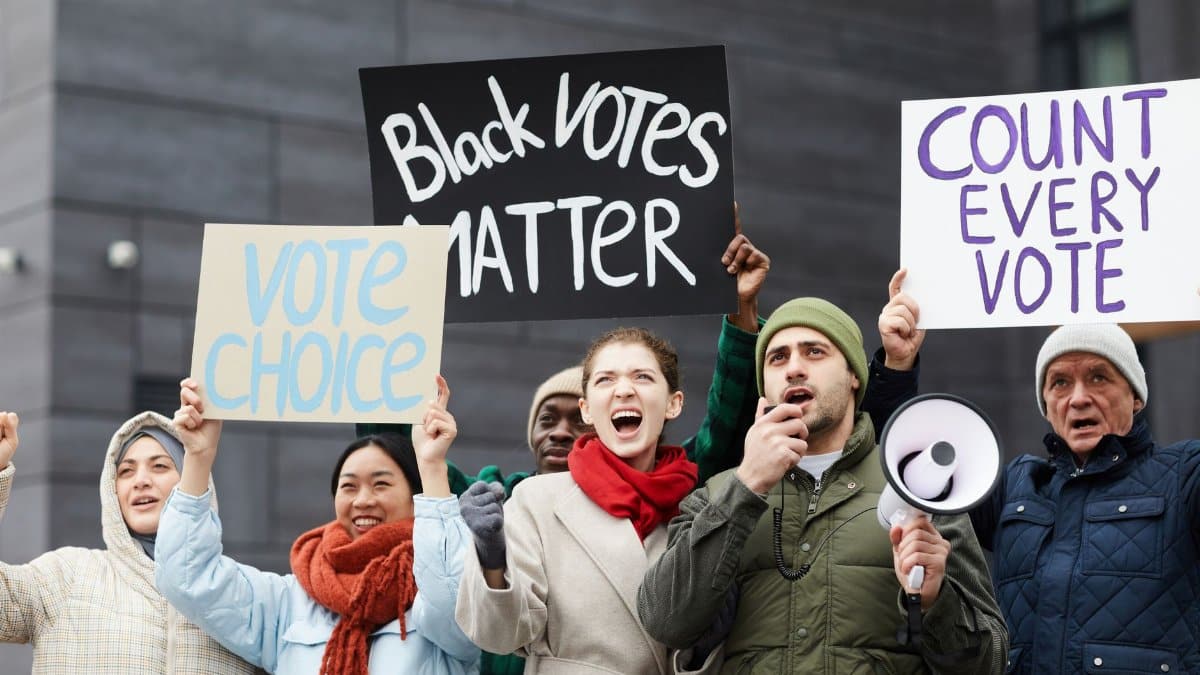
On a warm evening in Austin, the folding tables came down early. Clipboards went back into plastic bins. A few young canvassers stood on the sidewalk longer than they needed to, trading the kind of quiet that follows a threat rather than a conversation. For nearly two years that threat had a formal name in state court: the Jolt Initiative lawsuit. This month the state walked away from it.
A dismissal that closes a long public fight

Texas Attorney General Ken Paxton dismissed the case that sought to shut down Jolt Initiative, a Latino civic organization known for voter registration and youth engagement. The end did not arrive with a jury verdict or a judicial finding that the group had broken the law. It arrived because the state chose to stop pressing the claim. For the people who had lived inside the litigation, that distinction matters. A dropped case is not the same thing as an apology, and it is not the same thing as a ruling that clears every question. It is, however, the end of a demand that a court dissolve the organization.
Reporting by The Texas Tribune described the withdrawal as the close of a fight sparked by voter registration allegations that were never proved in court. Readers who want the originating account can find it in the Tribune account of the dismissal. What follows is an attempt to place that ending in a wider civic frame, without pretending the docket speaks for itself in ways it does not.
How a registration dispute became an existential case

Voter registration in Texas has long been a contested field. Rules about who may collect forms, how those forms must be handled, and what counts as improper assistance are dense enough that ordinary volunteers can feel they are walking a marked path with invisible lines. Into that landscape the state brought a lawsuit aimed not merely at a practice, but at the continued legal life of Jolt Initiative.
Dissolution is a severe remedy. It asks a court to treat an organization as something that should cease to exist, rather than as a party that might be fined, enjoined, or ordered to change a method. That severity is why the Jolt Initiative lawsuit drew attention beyond the usual circle of election lawyers. A registration dispute can be argued on the facts. A bid to erase a group asks a different question: whether the state believes the group’s purpose is so tainted that repair is not enough.
The public record, as described in news coverage of the dismissal, did not culminate in proved violations. Allegations can justify an investigation. They do not, by themselves, justify the conclusion that a community organization should be dismantled. The gap between those two ideas is where this case lived.
Who Jolt Initiative is, beyond the caption

Jolt Initiative presents itself as a Latino led effort to bring younger Texans into civic life. That work includes registration drives, education about how elections actually function, and the unglamorous labor of showing up in neighborhoods that campaigns often treat as afterthoughts. None of that work is glamorous in the way television understands politics. It is tables, phone lists, rides, and repeated explanations of deadlines.
Groups like this occupy an awkward place in American argument. Supporters see them as a correction to low turnout and thin outreach. Critics see them as partisan actors wearing the costume of civic education. Both descriptions can be partly true of the broader field, and neither description is a legal finding. What the dismissal leaves standing is the simpler fact that Jolt remains able to organize, raise money, and talk to voters without a state petition hanging over its charter.
For a middle aged reader who remembers when registration was a card at the post office and a stern clerk, the new ecosystem can look noisy. It is noisy. It is also how many eligible citizens now learn that they are eligible at all.
What the state said it was protecting

Paxton’s office has built a public identity around aggressive election enforcement. The stated concern in cases of this kind is familiar: that sloppy or unlawful registration activity could place ineligible names on the rolls, or that third party drives could pressure people who do not fully understand the forms. Those are legitimate interests for any election official. A clean roll is not a partisan slogan. It is a condition of a count that losers can accept.
The trouble begins when the interest in cleanliness is pursued through a remedy that looks like punishment for mobilization itself. If the evidence shows forged forms, fake addresses, or knowing violations, prosecutors and civil enforcers have tools that match the conduct. If the evidence is thin, anecdotal, or disputed, a demand to dissolve a Latino civic group reads less like maintenance of the rolls and more like a message about who is welcome to recruit voters.
The Jolt Initiative lawsuit sat in that uncomfortable middle for two years. The state did not, in the end, carry the claim to a judgment. That choice does not erase the original allegations from political memory. It does limit what a careful reader should treat as established fact.
What the group maintained while the case was open

Organizations under this kind of pressure tend to say two things at once. They deny the specific accusations. They also argue that the accusations are a pretext for chilling lawful speech and association. Jolt’s public posture, as covered during the litigation, followed that pattern. Leaders described their registration work as legal, necessary, and aimed at citizens who had been left out of the habit of voting.
Litigation of this length has costs that never appear in a headline. Staff time shifts from field work to affidavits. Donors ask whether a gift will be tangled in discovery. Volunteers wonder whether a Saturday at a grocery store could become an exhibit. Even a defense that ultimately succeeds can shrink the very activity the defense was meant to protect. That is one reason civil liberties lawyers treat dissolution suits as more than ordinary regulatory fights. The process itself is a form of pressure.
Why dissolution is a rare and heavy ask

American law gives states real power over nonprofits and political committees. It also treats the existence of an association as something more than a privilege the attorney general may revoke when a political season turns hot. Courts generally expect the remedy to fit the wrong. If a drive mishandles forms, the fit may be training, monitoring, or a penalty. If leaders divert funds, the fit may be restitution and removal of those leaders. Erasing the entity is closer to a last resort.
That hierarchy matters for groups that serve communities with lower historical turnout. Latino Texans are not a monolith, and no single nonprofit speaks for them. Still, when the state picks a visible Latino registration group for the heaviest available civil remedy, the signal travels farther than the caption on the complaint. Other organizations notice. So do people who were only beginning to trust that a clipboard at a festival was not a trick.
The dismissal does not rewrite that signal retroactively. It does tell those watching that the heaviest remedy will not be imposed in this instance, because the state declined to keep seeking it.
The attorney general and the season he is in

Ken Paxton is not a neutral figure in Texas politics, and it would be odd to write about this case as if he were. He has used the attorney general’s office as a platform on elections, immigration, and culture, and he has been a defendant in controversies of his own. Supporters call that record toughness. Opponents call it a pattern of using state power against constituencies that do not vote for his party.
A journalist does not need to settle that argument to describe what happened here. An elected law enforcement official filed a case seeking to dissolve a civic group, kept it alive long enough to shape two years of the group’s life, and then dismissed it without a proved violation on the public record described by the Tribune. Readers can decide whether that sequence looks like prudent recalibration or like a charge that outran the facts. What they should not do is treat dismissal as a silent conviction, or as a judicial exoneration the court never issued.
Voters who were never listed as parties

The people most affected by registration fights are often absent from the caption. They are the first time voters who need a form explained twice. They are parents who moved counties and are not sure which address controls. They are citizens who speak Spanish at home and English at work, and who want a volunteer who will not rush them. When a prominent group is hauled into a dissolution case, those people do not receive a notice. They simply find fewer tables.
That absence is easy to miss in legal coverage, which naturally follows lawyers. It is harder to miss if you have stood in a line at a community college and watched someone decide the process is not for them. Fear of doing it wrong is already a barrier. Fear that the people offering help are under investigation adds another. The end of the Jolt Initiative lawsuit removes one source of that fear. It does not remove the complexity of Texas election rules, and it does not guarantee that the next drive will be better staffed than the last.
What other civic groups are likely to hear
Nonprofit directors talk to one another. A case like this becomes a story told at conferences and on conference calls: document every form, train every volunteer, assume a hostile reading of every ambiguous rule, and keep counsel on retainer before you need counsel. Some of that discipline is healthy. Clean records protect voters as well as organizations. Some of it is a tax on participation. Money spent on defensive lawyering is money not spent on rides to the polls or on translation.
There is also a political lesson, and it cuts in more than one direction. Officials who file existential cases without the evidence to finish them spend credibility they may need when a real fraud case appears. Advocates who treat every inquiry as persecution can miss actual mistakes in their own operations. The adult version of this story asks both sides to tolerate scrutiny and to refuse spectacle. The Jolt Initiative lawsuit, as it ended, looks more like spectacle that ran out of road than like a completed accounting.
Faith, trust, and the habit of showing up

This dispute is not a sermon, but it brushes a question that religious and secular communities share. Institutions hold together when people believe the rules are meant to include them. When enforcement looks selective, trust thins. When mobilization looks careless, trust thins in the other direction. Either thinning makes the next election harder to accept.
Many Latino congregations in Texas already function as civic classrooms, whether or not they endorse candidates. They announce deadlines. They carpool. They treat voting as a duty adjacent to neighbor love. A state campaign to dissolve a secular Latino group does not police those churches, yet it lands in the same emotional neighborhood. People ask whether their ordinary helpfulness has become suspect. A dismissal can quiet that question. It cannot answer it for good.
What the public record does and does not settle

A few limits deserve plain statement. This article does not reproduce sealed filings, and it does not invent a judicial finding that neither side obtained. The central public facts are these: the state sued to dissolve Jolt Initiative over voter registration claims; those claims were not proved in a completed judgment; Paxton later dismissed the case; the group remains. Anyone who wants the newspaper account that anchors those facts should read the Tribune report linked above, including the spelling of the web address as published.
Beyond that, interpretation belongs to the reader. Some will see a prosecutor who reconsidered. Some will see a warning shot that achieved its chill and then withdrew. Some will see a reminder that Latino civic groups in Texas operate under a brighter lamp than older, quieter institutions. All three readings can draw on the same ending.
After the tables go back up

The practical sequel is ordinary, which is its own kind of news. Registration deadlines will return. Volunteers will again ask strangers for a few minutes and a signature. County offices will again sort forms that are complete, forms that are not, and forms that raise real questions. The Jolt Initiative lawsuit will sit in the background as a story people tell when they explain why they kept every copy and why they flinched when a official car slowed near a tent.
Democracy at this scale is mostly logistics. It fails in small ways long before it fails in dramatic ones: a missed deadline, a mistranslated instruction, a volunteer who guesses instead of calling the county, an official who treats a community group as an enemy rather than as a flawed partner in a public task. The dismissal removes one dramatic threat. It leaves the small ways untouched.
If there is a useful conclusion, it is modest. The state no longer asks a court to erase Jolt Initiative. The allegations that justified that ask were not established in a final ruling. Voters, donors, and rival officials should calibrate their confidence to that narrow truth. Everything else, including whether Texas can argue about registration without trying to unmake the groups that do the arguing, remains a live test of how seriously the state takes both clean rolls and equal participation.