
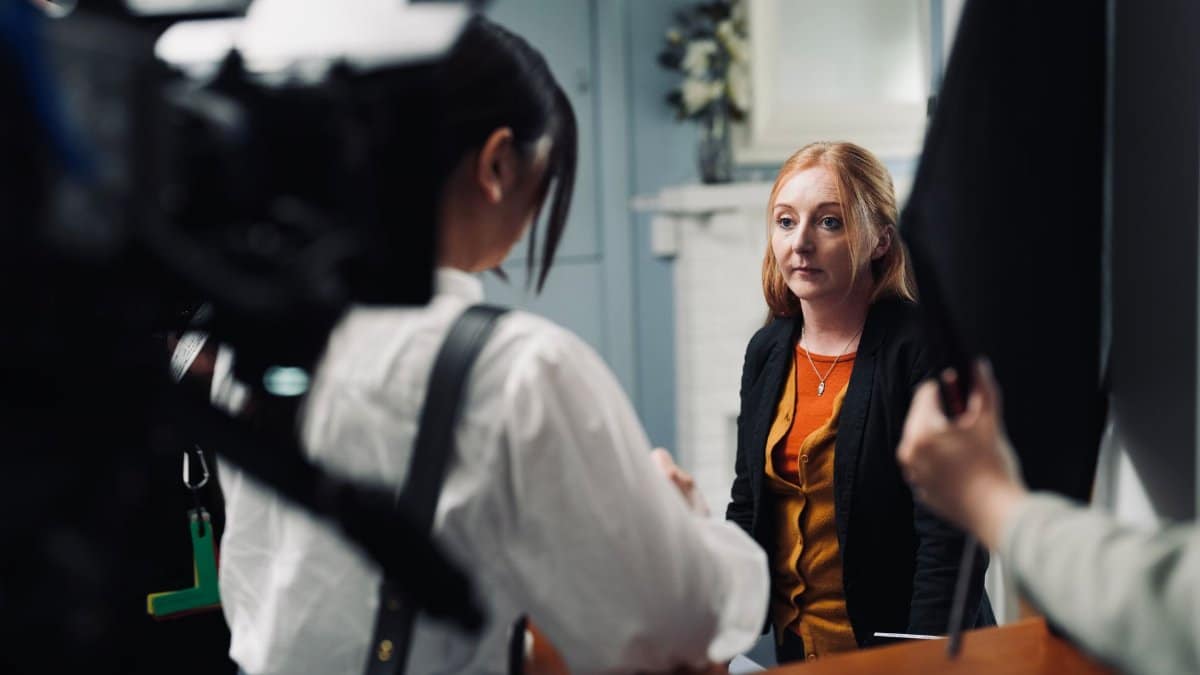
On a gray morning outside the Massachusetts State House, the person who once stayed at the edge of the room stepped toward a small cluster of cameras with a careful smile. For years she was known as a lawyer, a strategist, and the partner who kept family life out of the frame. Joanna Lydgate first lady is a title that still feels new to people who remember that earlier reserve, yet it now travels with her through school visits, civic receptions, and the long season of another statewide campaign.
The lawyer before the title

Joanna Lydgate built her reputation inside government, not beside it. She served as chief deputy to Maura Healey when Healey was attorney general, a job that rewards precision more than performance. Colleagues from that period describe a manager who read the brief, asked the hard question, and left the podium to someone else. That habit matters now. A first lady in Massachusetts holds no constitutional office and draws no salary for the role. Influence, if it exists, comes from proximity, judgment, and the willingness to be seen. Lydgate arrived at the mansion with a professional record that does not depend on her partner’s election returns. Voters who bother to look can find a career in public law rather than a blank biography filled in by staff.
Democracy work that outlasted one administration

After leaving the attorney general’s office, Lydgate helped found States United Democracy Center, a nonpartisan group focused on protecting election administration and the rule of law. The work put her in rooms with secretaries of state, local clerks, and lawyers who spend their days on certification rules rather than slogans. It also gave her a public footprint that predates the governorship. When critics ask what she brings to the first lady role, that record is the honest answer. She has spent years arguing that democratic institutions are maintained by ordinary officials doing unglamorous jobs. That argument does not vanish because she now attends a State House reception. It does, however, sit awkwardly next to a campaign that wants warmth more than white papers.
Last time she stayed in the background

During Healey’s first race for governor, Lydgate was present and largely unseen. She appeared at a few events, declined most interviews, and let the candidate carry the narrative. Campaign aides treated that choice as a gift. A partner who does not generate side stories frees the candidate to talk about housing, transit, and the cost of living. It also left a vacuum. Voters knew Healey as attorney general and as a former basketball player. They knew far less about the person who would share the governor’s residence. The current campaign has not erased that privacy. It has narrowed it. Schedules now include joint appearances that would have been optional four years ago, and photographers no longer treat her as a figure to crop from the frame.
What the office actually asks

Massachusetts does not hand its first lady a portfolio. There is no statute that assigns her schools, veterans, or the arts. Previous partners of governors have chosen literacy, health, or military families, and some have chosen almost nothing at all. The role is a custom, not a contract. That flexibility is both a privilege and a trap. Without a defined job, every appearance can be read as politics, and every absence can be read as indifference. Lydgate has leaned toward service that looks like her old work: conversations with people who run elections, visits that highlight public servants, and a reluctance to turn personal life into programming. Advisers around the governor say the goal is presence without performance. Whether voters accept that distinction is an open question.
Privacy as a family decision

The couple has long treated home as a boundary. They do not narrate daily routines, and they have resisted the modern expectation that a political household must offer constant access. In a media culture that rewards disclosure, that stance can look old fashioned. It can also look like respect. Children, relatives, and friends did not run for office. A partner who agrees to some public duties has not agreed to surrender every private hour. People close to the residence describe a deliberate filter. Official events are on the calendar. Casual speculation is not. The filter is imperfect. Once a person stands on a stage, strangers will invent the rest of the story. Choosing not to feed that invention is still a choice, and it has costs in a race where familiarity is a form of currency.
Joanna Lydgate first lady and the problem of symbolism
Joanna Lydgate first lady carries a symbolic weight that no briefing book can manage. Healey is the state’s first woman elected governor and its first openly gay governor. Her partner’s visibility is therefore never only personal. For some voters it is ordinary, a fact of modern public life. For others it remains a marker, welcome or not, of how far the office has moved. Lydgate cannot control that reading. She can only decide whether to hide from it. Stepping forward does not mean she has agreed to become a symbol on demand. It means she has accepted that absence would be read as a symbol too. The grown up response, visible in her limited but real schedule, is to show up without pretending the attention is neutral.
A spotlight that grew without a script

There was no inauguration day memo that transformed a private partner into a public figure. The change accumulated. A hospital visit here, a commencement there, a photograph that traveled farther than anyone in the room expected. Staff learned to build time into events for the questions that follow her rather than the governor. Reporters who once had no reason to call began asking for comment on issues adjacent to her old legal work. She has answered some of those calls and ignored others. The pattern suggests a person negotiating a role in real time, not executing a brand plan. That negotiation is visible to anyone who compares the last campaign with this one. Then she was a name in a profile. Now she is a face on the trail.
How a partner is read by voters
Voters rarely cast a ballot for a spouse or partner, yet they notice. A hostile appearance can damage a candidate. A warm one can humanize a figure who otherwise speaks in policy. The risk for Lydgate is mismatch. She is not a natural cheerleader, and campaigns sometimes want exactly that. If she speaks as a lawyer about institutions, some listeners will hear distance. If she speaks only in personal terms, others will say she has abandoned the expertise that made her credible. The narrow path is to be specific and brief. Talk about clerks who protect ballots. Talk about teachers and nurses she meets on official visits. Decline the invitation to psychoanalyze the governor. That path will not satisfy every interviewer. It may satisfy voters who distrust performance.
The line between advocacy and the administration
Her democracy work creates a particular tension. A governor’s partner who cares about election integrity will be asked, fairly, whether she is lobbying the administration she lives beside. The clean answer is structural. She does not hold a state job. She does not sign regulations. Advice offered at a kitchen table is not the same as a directive from the corner office. Still, appearances matter. If she uses official travel to advance an outside organization’s agenda, the distinction collapses. The safer public posture is testimony by example: show up for poll workers, praise local officials, and leave bill language to the people who were elected to write it. Nothing in her visible schedule suggests she has forgotten that line. Nothing guarantees that critics will honor it.
Service without a pulpit

The quieter part of this story is not doctrinal. Lydgate has not presented herself as a religious figure, and it would be false to invent a spiritual platform she has not claimed. What she has claimed, through years of legal work and a cautious public schedule, is a belief that institutions deserve care. That belief has a moral shape even when it is expressed in statutes and training sessions. Middle aged readers who sit on school boards, church committees, or town finance panels will recognize the temperament. It is the temperament of people who stay for the unglamorous vote, who read the minutes, who think duty is less interesting than it is necessary. A first lady with that temperament will never dominate a rally. She may still set a tone.
The campaign’s use of a careful presence

Campaigns are not seminars. They need images. Healey’s team has begun to use joint appearances in ways the first race largely avoided. The calculation is straightforward. A governor seeking another term must remind voters that she is a person with a home, not only a record of signed bills. Lydgate’s presence does that work without requiring her to deliver a policy speech. The danger is overuse. A partner who appears at every stop stops being a person and becomes a prop. The schedule so far suggests restraint. She is more visible than before and less visible than a full surrogate. That middle ground is politically smart and personally sustainable. It also leaves room for the candidate to own the argument.
What colleagues notice that cameras miss

People who worked with Lydgate before the governorship talk less about charisma than about preparation. She arrives having read the material. She asks who is affected if a rule changes. She does not fill silence with anecdote. Those traits are easy to undervalue in a political culture that prizes clips. They are also the traits that make a limited public role credible. When she speaks for a few minutes at a civic event, the words tend to be concrete. When she does not speak, the silence does not read as emptiness to anyone who has watched her work. Journalism often flattens that distinction. A profile can correct it without turning into a tribute. Competence is not warmth, and warmth is not the only civic virtue.
The residence and the boundary around it

The governor’s residence is both a house and a symbol. Tours, holiday events, and official dinners turn private rooms into public stages for a few hours at a time. Hosting is part of the job the state informally assigns, and Lydgate has taken on pieces of that hosting. Guests describe evenings that are correct rather than theatrical. There is food, there is a short welcome, there is an end time. Nobody mistakes the house for a campaign headquarters, and nobody should. The boundary protects staff as much as family. Employees who keep the building running are not characters in a serial. Treating them that way would be a failure of manners dressed up as transparency. A first lady who understands hospitality also understands when the doors close.
Criticism and the fair share of it

Not every objection is prejudice, and not every defense is principle. Some voters simply do not want partners of officials in the news. Some want more access than any family should give. Some disagree with Lydgate’s views on election administration and will say so. That disagreement is legitimate politics. What is not legitimate is the demand that she either disappear or perform a personality she does not have. Public life includes scrutiny of conflicts, schedules, and the use of state resources. It does not include a right to her private conversations. A serious press corps can investigate the first category and leave the second alone. Readers can tell the difference. So can she.
Joanna Lydgate first lady after the votes are counted

Whatever the election decides, the title will not be the whole of her life. Joanna Lydgate first lady is a phase tied to another person’s term of office. The law practice, the democracy work, and the private commitments began earlier and can continue later. That fact should comfort anyone who worries that political spouses vanish into the role. It should also temper the spotlight. A person who knows the role is temporary is less likely to inflate it. She is more likely to spend the borrowed authority on concrete courtesies: a visit that helps a local official feel seen, a refusal that keeps a child out of a headline, a sentence that reminds an audience how ballots are actually counted.
A growing spotlight with the edges still hers

The last campaign kept her behind the scenes. This one has asked for more, and she has given more, on terms that still look like her own. Joanna Lydgate first lady does not need to become a second candidate to matter. She needs to be accurate about what she is doing and plain about what she will not do. Massachusetts has room for that kind of public partner. The spotlight will keep growing as long as Healey remains the state’s most watched official. The useful question is not whether Lydgate enjoys it. The useful question is whether she uses the attention to point back at the unglamorous work of self government, and then goes home when the event is over.