
The chairs were set in straight rows, the lights lowered just enough that faces remained readable, and the conversation at the door stayed quieter than a crowd of that size usually allows. About 400 people had come to a Houston hall for a Houston Oct 7 remembrance on the third anniversary of the Hamas attacks of October 7, 2023. They were not there to settle an argument. They were there to sit with a date that has reordered Jewish life in this city, to hear names, and to watch a film about hostages whose absence still organizes kitchens, group chats, and Friday night tables from Meyerland to the northern suburbs.
A gathering built for attention, not applause
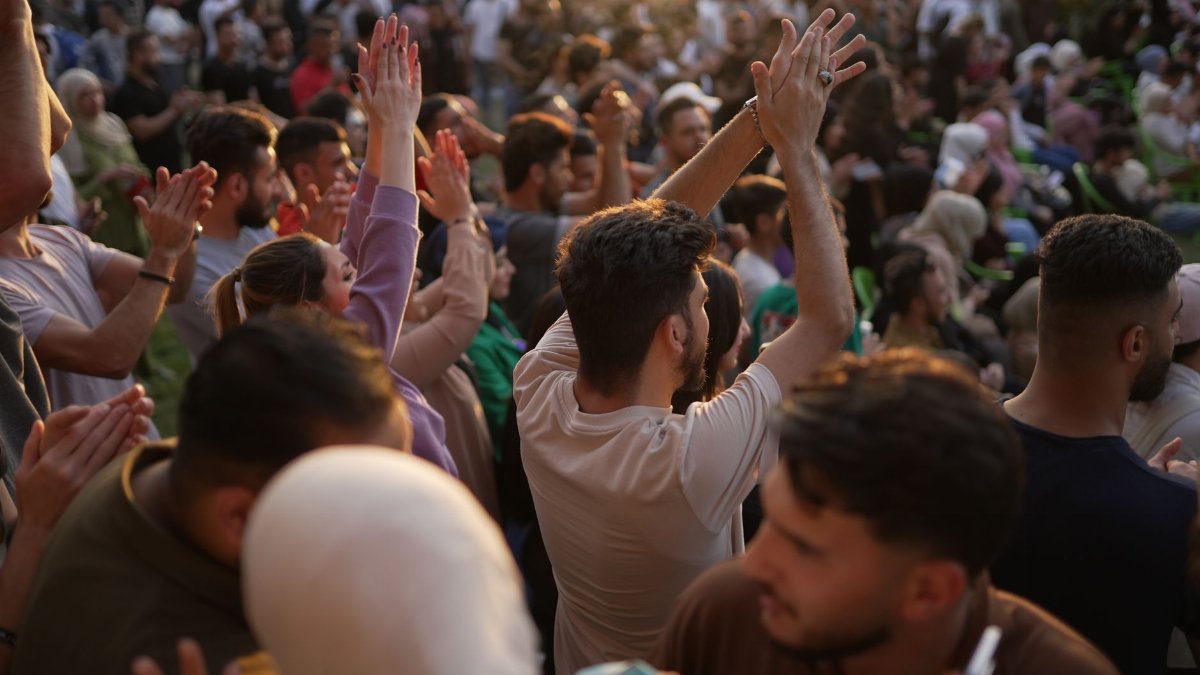
People arrived in work clothes and in clothes saved for synagogue. Some carried programs. Others carried nothing and looked slightly lost until a friend found them. The scale mattered. Four hundred is large enough to feel like a community and small enough that a cough travels. Organizers had chosen a form closer to a memorial service than a demonstration. There were prayers, brief remarks, and long stretches in which the only task was to listen. In a city that stages enormous festivals and enormous storms, this was a deliberately modest public act. Modesty did not make it slight. It made the evening harder to leave halfway through.
Houston Jewish institutions have spent three years learning how to hold this date without turning it into a slogan. The room reflected that learning. Speakers did not race. The audience did not treat silence as a gap to be filled. When people stood, they stood because a name or a prayer asked them to, not because a cue light told them the moment was supposed to look moving from the back row.
Why a film carried part of the evening

The center of the program was a film about hostages, screened for people who already knew the outline and still needed the particular. News has a way of sanding faces down to categories: captive, released, still missing, killed. A film reverses that sanding. It restores a kitchen, a joke, a parent on a phone, the ordinary life that violence interrupted. For a Houston Oct 7 remembrance, the choice of cinema over another round of speeches was a kind of pastoral decision. Grief that has lasted three years does not always want to be explained. Sometimes it wants to be shown a person again.
Watching together changes the footage. Alone, a viewer can pause, look away, or let the story dissolve into the next item on a phone. In a hall, the credits arrive for everyone at once. Neighbors see who wiped a face and who sat very still. That shared exposure is part of what communal memory is. It is not only the content of the film. It is the fact that no one had to carry the images home as a private download.
The date that rearranged the year

October 7 is no longer a date Houston Jews encounter only in headlines. It sits on congregational calendars beside the High Holy Days and beside older commemorations that once seemed to hold the century’s darkest lessons by themselves. Rabbis and educators have had to decide what children are ready to hear, which songs belong in a school assembly, and how long a name should be read before the room can no longer bear the list. None of those decisions is permanent. Each anniversary revises them.
The attacks killed about 1,200 people in Israel and took hundreds hostage, according to widely reported tallies that communities here have repeated until the numbers feel both unbearable and insufficient. Numbers do not parent a child. They do, however, explain why a Tuesday in Houston can feel like a holy day that no ancient calendar predicted. People who were not in synagogue every week have found themselves unable to skip this one evening. Attendance is its own theology. It says the dead and the captive are not someone else’s file.
Hostages as a fact of daily life
Hostage advocacy did not end when cameras moved on. In Houston living rooms, families still track who has come home, who has been confirmed dead, and who remains unaccounted for in a fog of official statements and rumor. The film did not invent that vigil. It gave it a public hour. People who have worn yellow ribbons, or who have stopped wearing them because the ribbon began to feel like a costume rather than a plea, sat in the same rows. Disagreement about tactics did not cancel the simpler fact that human beings were taken and that some have not returned.
That fact has a spiritual weight that political language often flattens. A hostage is not a symbol first. A hostage is a person whose morning was stolen and whose family has been living inside an unfinished sentence. The remembrance treated that sentence as something a city congregation could hold for an evening, even if it could not finish it.
How congregations prepared the room
Preparation for a night like this is mostly invisible. Someone prints programs. Someone decides whether the film needs a warning. Someone stands at a table with water because people cry and then feel foolish about crying and then cry anyway. Security, sadly ordinary at Jewish institutions in recent years, is arranged without being allowed to become the story. Volunteers learn which door stays open and which face at the entrance is a member who simply arrived early and needs a task.
These logistics are a form of care. A Houston Oct 7 remembrance succeeds or fails on whether a grieving person can find a seat, hear the sound, and leave without being recruited into someone else’s performance of outrage. The third anniversary has an advantage the first did not. Organizers have practice. Practice is not the same as ease. It is the knowledge that shock is no longer the only available emotion, and that endurance requires a schedule, a microphone that works, and a person willing to say when the program should end.
Young people who inherited a headline

Teenagers in the room were in middle school or just beyond it when the attacks occurred. For them the date is not a rupture in adult memory. It is part of the climate in which they learned what it means to be Jewish in public. Some have been mocked online. Some have argued with friends. Some have become more observant, and some have grown wary of institutions that seemed, in their view, too slow or too loud. A memorial that only addresses parents will miss the people who will carry the date longest.
The film helps across that gap because it does not require a sermon to land. A young viewer can recognize a hostage who was, not long ago, a student, a dancer, a sibling with a ridiculous nickname. Recognition is not the same as political agreement. It is the beginning of moral attention. Houston religious schools and youth groups have been trying to protect that attention from both denial and despair. The evening was one more attempt.
Neighbors who came without a shared liturgy
Not everyone in the chairs was Jewish. Christian clergy, civic acquaintances, and friends who had been invited by members sat with the slight stiffness of guests who want to do right and are unsure when to stand. Their presence mattered in a city where Jewish life is visible and still a minority. Remembrance can become a closed circuit, comforting and airless. It can also become a public claim: this grief is real, and you are welcome to witness it without being asked to impersonate it.
Witness is a modest verb and a serious one. It does not require guests to master Hebrew or to pretend the wider war has a simple moral caption. It requires them to stay through the uncomfortable minutes. Several did. In a Houston Oct 7 remembrance, that staying is a civic courtesy with religious consequences. It tells the mourners they are not narrating into an empty city.
Mourning beside an unfinished war
No honest account of this anniversary can pretend the attacks sit in a sealed past. The war that followed has killed many thousands of Palestinians, displaced families across Gaza, and divided Americans who share grocery stores and group texts. Houston is not immune to that division. People in the hall have argued, sometimes bitterly, about ceasefires, campus protests, and the obligations of criticism. Some stayed home from communal events because they could not bear the politics they expected to hear. Others came precisely because they feared politics would erase the dead of October 7.
The evening did not resolve those fractures. A film and a set of prayers are not a peace plan. What they can do is refuse the erasure that happens when every fact is immediately converted into ammunition. The attacks were a massacre. Hostages are not a rhetorical device. Palestinian civilian death is not a footnote to be skipped by people who claim to care about human life. Holding more than one of those sentences at once is difficult. Difficulty is not a reason to collapse them into a single approved mood.
Memory after the first shock has passed

Third anniversaries are treacherous. The first is raw. The second still feels like proof that the community did not scatter. By the third, the culture has other obsessions, and even loyal mourners feel the pull of ordinary fatigue. Fatigue is not betrayal. It is human. The risk is that fatigue gets mistaken for completion. Nothing about the hostage families, or about the people killed at a music festival, on kibbutzim, and in towns along the Gaza border, is complete because Houston has held three Octobers.
Communities that know this from older catastrophes have language for the long middle. Yizkor, the memorial prayer, exists because love outlasts news cycles. The Houston gathering borrowed that instinct even when the program was contemporary. It assumed that repetition is not redundancy. Saying the date again is how a minority keeps a wound from being redescribed by people who were never asked to tend it.
What the city is being asked to remember

Houston is a practical town. It measures events by turnout, traffic, and whether the institution will still be there next year. By those measures the night was a success: a full room, a film that held, a community that can still convene. The deeper request is less practical. It asks neighbors to remember that Jewish safety and Jewish grief are local subjects, not imported dramas. Synagogues in this city lock doors that once stood open. Parents calculate which public symbols are worth the risk. Those calculations began before 2023 and sharpened after it.
A Houston Oct 7 remembrance does not undo that climate. It states, in public, why the climate feels different. People were murdered for being Jews, or for being Israelis within reach of people who intended slaughter. Houstonians who love this city’s mix of languages and congregations have a stake in refusing the idea that such slaughter can be filed under distant politics and forgotten by Thursday.
The parking lot after the credits
When the lights came up, the room did what rooms do. People hugged longer than usual. Someone looked for a jacket. A teenager asked a parent whether they could leave. The film had ended, which is a mercy films have and history often does not. Outside, the Houston night was warm and ordinary. Cars waited. The date would still be on the calendar in the morning.
That ordinariness is the strange gift of a local memorial. It does not transport anyone to the sites of the attacks. It returns them to a city where they pay taxes, coach games, and argue about schools. The remembrance asks them to carry October 7 into that city without turning every errand into a eulogy. About 400 people practiced the carry for a few hours. They will have to practice it again, in smaller rooms, until the absent are no longer absent or until the living admit that some sentences stay unfinished and still must be said aloud.